Though it’s easy to reiterate the memetic adage that there are no games on the PlayStation 5; when I was roped into actually buying the console (mainly to play Final Fantasy XIV at an acceptable framerate), I was immediately impressed by Housemarque’s odd, high-budget, roguelike Returnal. It wasn’t any one aspect I came away loving either, but the synthesis of all its combined ideas and presentation.
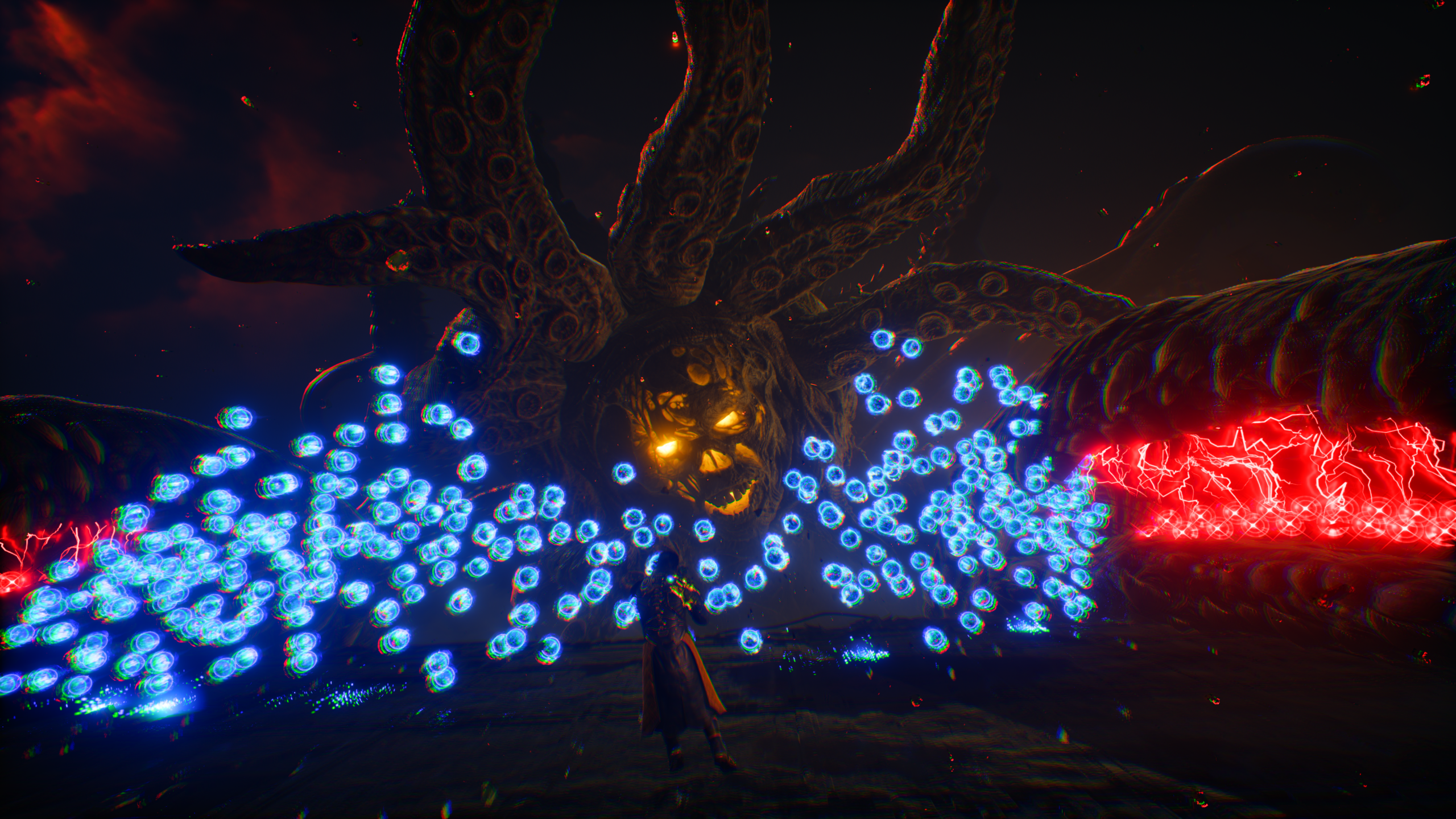
In a sea of games showcasing technological advancement through facial pores and scope creep, this was a surrealist Shoot ‘em Up where you watch all your millions of projectiles bounce around and collide with complex enemies in high-definition space. It was incredibly impressive to see, and had me cheering at what people so often call “next-gen” tech for one of the first few times in my life.
It’s not the hardest game, nor is it the most interestingly unique mechanical sandbox ever created. At the same time, however, I was consistently drawn in by the mystique the game gradually unwound without ever fully answering. Returnal isn’t a game you solve; it’s an experience you meditate on and engage with as you explore its hostile, impossible alien architecture.
All this prologue is to say that when Saros was unveiled last year, and seemed to be a more mechanically nuanced successor to Returnal, I was incredibly excited! Returnal with parrying, shields, and The King in Yellow? Hell yeah sister, pass me some of that! Expanding upon the established baseline with more dynamic environments and a more considered meta progression seemed like one of the most straightforward slam dunks in gaming.
Unfortunately, even though it succeeds at so many of its goals, Saros disappoints specifically because of how safe it feels, a concept completely antithetical to the uniqueness of its predecessor.
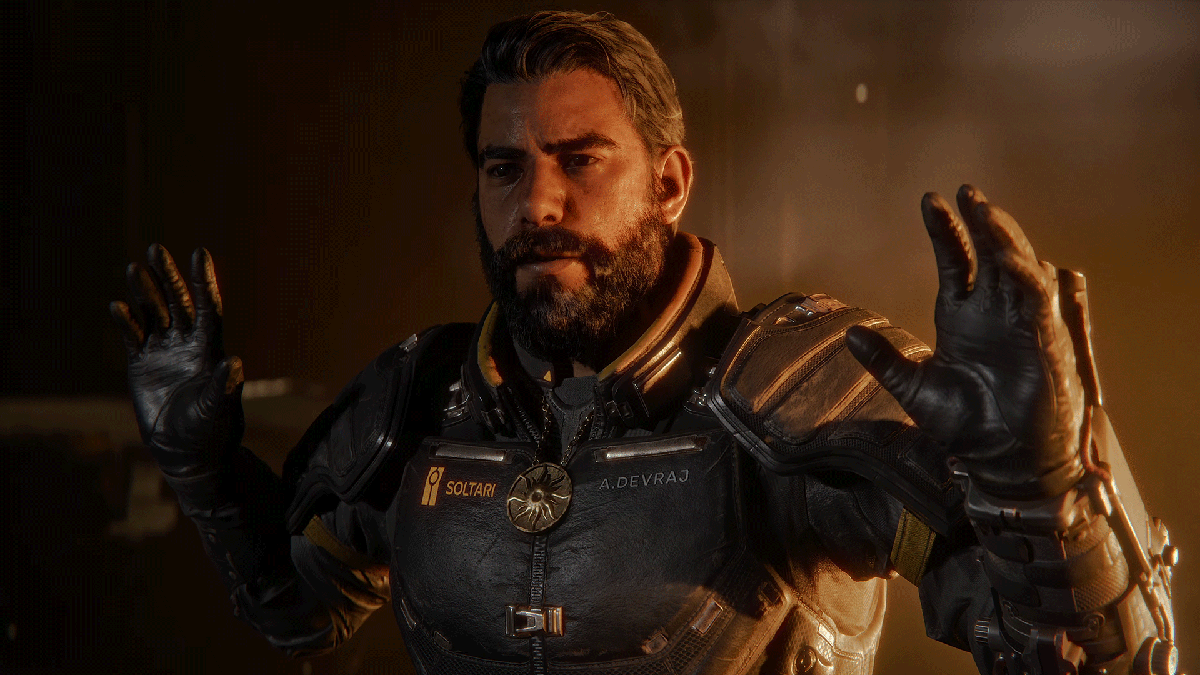
Saros takes place in a future where a hyper capitalist Earth ruled by Mega Corporations has ventured out to colonize and pillage the rest of the known universe. You play as Arjun Devraj, an enforcer for the Soltari Corporation who’s been sent out to investigate three waves of colonists and research teams that have gone missing on a mysterious planet named Carcosa (one has to assume that The King in Yellow doesn’t exist in this world, or else the old adage about the Torment Nexus has held true). Upon arriving, Arjun and his team quickly realize that the situation is far more dire than they could have imagined, as they face down an ever-changing landscape, horrifying bio-mechanical creatures, and eldritch forces corrupting their bodies and minds.
If you’ve never read The King in Yellow (which you really should), Saros will probably come across as an incredibly original game, much in the way Returnal’s fooling around with cosmic horror felt fresh and bold. If you have read it, or anything directly inspired by it, you can kind of guess the broad strokes of where Saros’ story will go. There’s corruption, confusion, gestures towards romance and time foolery, so on and so forth.
As one intimately familiar with surrealist horror, The King in Yellow has always stood out to me as a particularly influential work. Yes, of course, the concepts of corruption and paranoia, alongside pivots towards breezier themes, can be found in countless works throughout history. Its specific portrayal of an almost “frame narrative” conceit with its titular play feels so astounding for its time, and has clearly influenced nearly everything like it that’s come after. Think of every creepypasta about a cursed movie, something like The Ring, cursed object narratives; they all take concepts and executions directly from the 1895 collection. It was an incredible breakout hit, and at the time there just wasn’t much like The King in Yellow.
However, it is no longer 1895, and we have access to pretty much every successor you could dream of in the far flung future of 2026, which hurts Saros in ways Returnal never quite had to deal with.
Returnal is ultimately a story about trauma and loss, and it tells this story not through traditional cutscenes, but with first-person exploration sequences through mundane locations that instantly feel out of place in its setting of an overgrown alien world. Finding a contemporary and perfectly intact house in the middle of the wilderness, going in to slowly explore and experience things in a different perspective…it hits all of my strikezones as someone who pops off at all those times NieR suddenly becomes an isometric Zelda game. The spaceman is fantastic as well, a featureless observer stalking you through the world, adding mystique and ever more questions; effective for a game with exactly one character.
Saros delivers its take on the Returnal narrative quirks via gradually unlocked sequences where you slowly walk through surrealist contemporary environments with light visual storytelling (things like magazines with keywords, or clubs named “The Yellow Club”). The perspective doesn’t shift from the standard third-person method of play, instead slowing you to a crawl as you make your way through alleyways, hotel rooms, and apartments. It all comes across as incredibly banal; something you could find in literally any other big budget game.
Coupled with this, Arjun is not alone on his foray into Carcosa, and works alongside several Soltari employees who he has the option to talk to in between the exploratory runs into the mechanical wastes. These conversations are delivered in the classic style of stilted one-off conversations where rhetoric and quotations are spouted off, and the only back and forth dialogue is half-hearted “stay safe out there”s. Though I appreciate a different direction from the isolation of Returnal, where main character Selene only has herself to talk to (both literally and figuratively), Arjun’s aping of the static NPC interactions from the Horizons and Ghost of Tsushimas of the world doesn’t quite fit for a work so ostensibly absurdist.
But the story is such a minor part of both Returnal and Saros that it feels secondary to the real meat of the experience: its run-based roguelike center. If you played Returnal, you know exactly how Saros is structured. You enter a biome, explore along a Metroid Prime-esque map with side rooms and optional challenges that serve to bolster you with artifacts that can modify your play style, randomized variants of a few different guns, and, if you’re lucky, base stat upgrades that make you stronger as you go on.
To repeat myself: if you’ve played Returnal, you know exactly how Saros is structured. This isn’t just a hit on the same old rocky space Giger-inspired world, but that so many of the game’s procedurally generated rooms are almost 1:1 copies of several found in Returnal. There were countless times where I would walk into a ramped room and immediately flash back to fighting my way through as Selene, letting me predict what enemies will spawn and where with ease. On the surface, this feeds into some ludonarrative resonance with the mystique of just how many times Arjun has been experiencing his cycle of death and rebirth and how much his body remembers versus his mind. But, from a tangible gameplay perspective, it makes me realize just how little Saros has meaningfully evolved from its predecessor.
Which isn’t helped by an inherited problem also suffered in Returnal; rocky ruined terrain is great for making a wide open space a video game takes place in, but it’s not exactly super compelling to look at. The unique biomes in Returnal were a desert, a mechanical forest, and an underwater grotto; the pivot from grey to red to blue worked reasonably well for keeping things fresh. Saros, unfortunately, is less inventive with its biomes, and thwarts its own attempts at colorization.
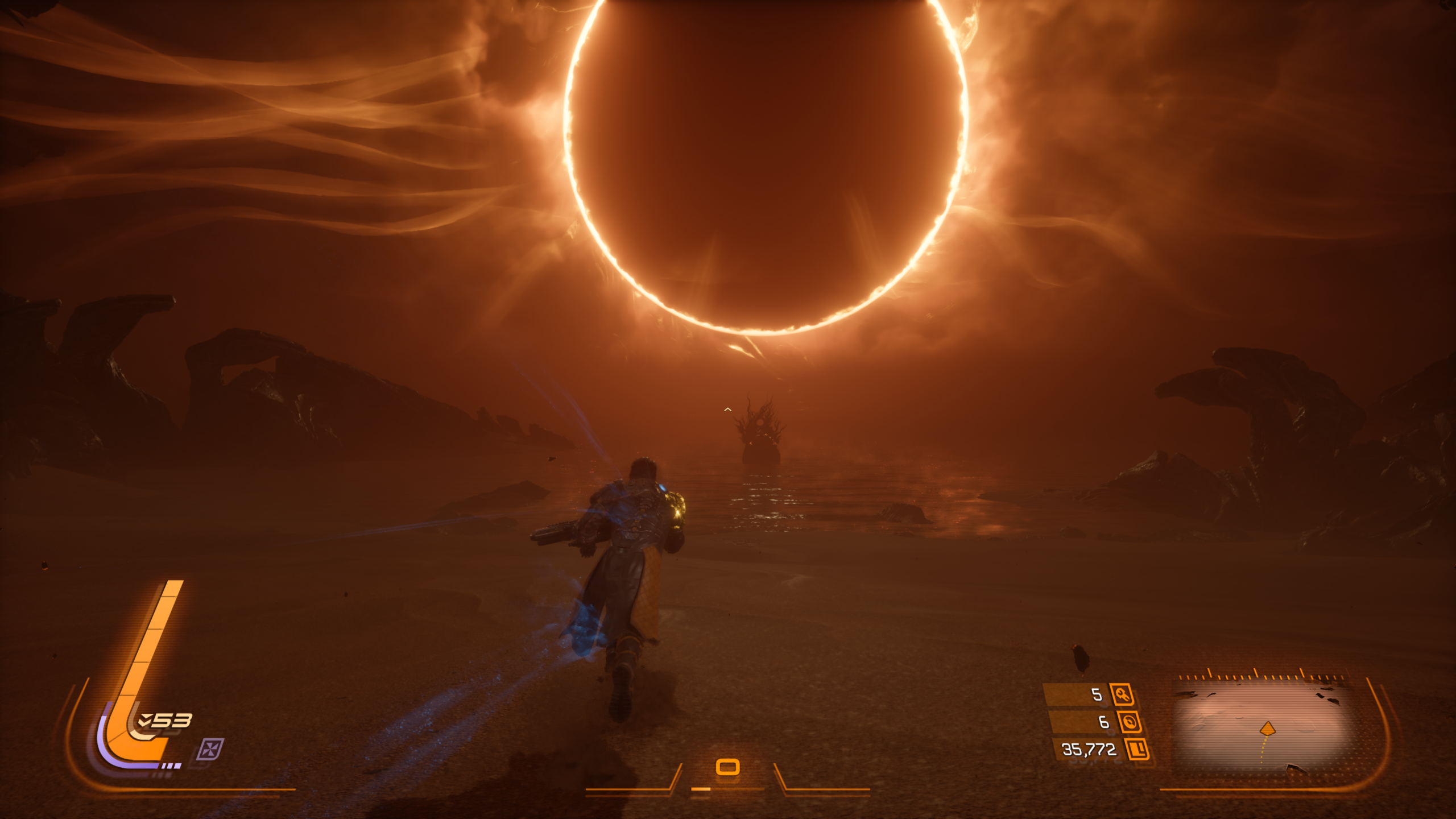
The first area of the game is a ruined marble palace on cliffs with lots of red flora peppered around. When you initiate one of the game’s core mechanics (“the eclipse”) to progress further into the level, everything is immediately subdued into a brownish-yellow sludge that removes all pastoral vibrancy. This goes for the areas with more muted colors as well: a mechanical mine glows more sinisterly yellow, a swamp becomes even more brown and yucky, the sea becomes orange and…you get the picture.
Once again, in terms of thematic resonance this is a great mechanical execution—we see Arjun accept power that dulls the world around him as a means of fitting the role he must—but as players we also unfortunately live in a world of brown and gray sludge games literally everywhere since the advent of 3D titles. Coupled with the level design familiarity for players of Returnal, Saros falls into one of the worst pitfalls of modern big-budget gaming: an experience that quickly becomes samey and uninteresting.
Which is a shame, because a lot has been tangibly improved from Returnal. You no longer rely entirely on the modern action classic of dodging for survival, since Arjun has a shield that allows him to absorb most projectiles (while charging his weapons), and a parry that can be used to negate several attacks. This allows the gameplay to feel more interesting than Returnal in terms of how you engage with each encounter, without sacrificing the speed and impact of what you can do. There’s an illusion in games that shields go hand in hand with a slower and more methodical method of play, but realistically, shields should allow a player to execute on ideas with a speed otherwise not afforded. The best offense is a good defense, as they say.
I also appreciated the guns a lot more than Returnal’s arsenal, though much of it feels comparatively streamlined. You still have your shotguns, pistols, and assault rifles, but the new chakrams and crossbows feel really good to fool around with. Instead of a set of 8 or so traits on a weapon, Saros opts to create 3 core variants of each weapon, with two different sets of passives slotted on top. My favorite of these traits auto-fired my bullets directly at any enemy nearby, letting me focus on dodging and parrying over actually aiming. The way Saros is about quicker levels you deliberately choose to go to rather than the “One Big Run” format of Returnal means that having a greater variety of guns that may prove potentially useful compared to a deluge of Rotgland Lobbers with useless defensive modifiers is incredibly welcome. There are definitely still bad guns, but the ratio of good to bad, and how fast you’ll get them, changes the game substantially.
Now, more divisively, I have to get into my Rosarie Rant that may or may not alienate you, the reader.
To me, Returnal was an absurdly easy game. I defeated almost every boss on my first attempt, and much of my time spent in the game was on the more repeatable post-launch DLC tower and co-op with friends. That first foray of exploration was intriguing and intoxicating, but it was also over in about 8 hours (with 6 extra for trophy cleanup). There wasn’t much meta-progression, and a lack of modular difficulty options meant I was left pining for the scary Shmup experience that could have been.
Saros is just as easy, if not even easier than Returnal, and the two features I was pining for have done little to mitigate this.
The improved meta-progression allows you to become significantly stronger as you continue to play the game, meaning that players who are struggling with specific breakpoints can almost “grind” their ways out of frustration, but very little has a meaningful engagement with how you play the game beyond this. When I think of a game like Hades—one that inspires you to progress through interacting with different weapons, different passives, and building up your home base—I can see how people dump hour after hour into such an experience, because things feel increasingly different over time. Saros doesn’t create a meaningfully different experience with its progression, it just makes an easier one.
On the flip side (or perhaps, alongside), the modular difficulty options and sliders we’ve come to see in games like The Last of Us Part II or Doom: The Dark Ages are here in the form of Carcosan modifiers. These modifiers let you make your experience even easier, or more difficult. For the most part, there’s no deep or tangible reward to this, unlike something like the Tales of series’ encouragement to crank up the difficulty while grinding for better drops. There’s a balancing act of sorts where you aren’t allowed to launch into a run if you’ve made the game too easy, but you aren’t really getting anything out of making the game harder other than personal satisfaction.
This would be fine if the imposed challenges were actually interesting, but in practice they’re just making Arjun more fragile, or your enemies beefier. There are a couple more interesting limiters like losing weapons and passives over the course of your run, but those only went so far. I’m glad they tried more with Saros, but it really feels like their focus wasn’t on making unique experiences for players interested in an easier or harder time, but rather catering specifically to a mass production ideal of players. On the surface, modular features for difficulty seem like a no brainer, but in practice, you lose out on the curation of level design and tuning that’s had people trying to 1cc their favorite shmups for decades.
Another problem I have with Saros is, dear God I’m going to say it:
I don’t care about angry men.
I’ve been beating the drum of how dull and insipid the worst parts of Sony’s catalogue have been for the last decade or so, and it just seems to get worse every year. God of War does a “character redemption” by turning Kratos from a parodical avatar of rage into the realistic avatar of rage; your dad. The Last of Us Part II couldn’t stop its cast of mostly female characters from fixating on the past and present futures created by angry men. Ghost of Tsushima is almost entirely about angry men getting mad at you, and Ghost of Yotei threw in your brother just in case you thought you were finally free. Indeed, it’s almost harder to name a Sony game that doesn’t have the stereotypical rage of a masculine force as a major theme, and Saros is no exception.
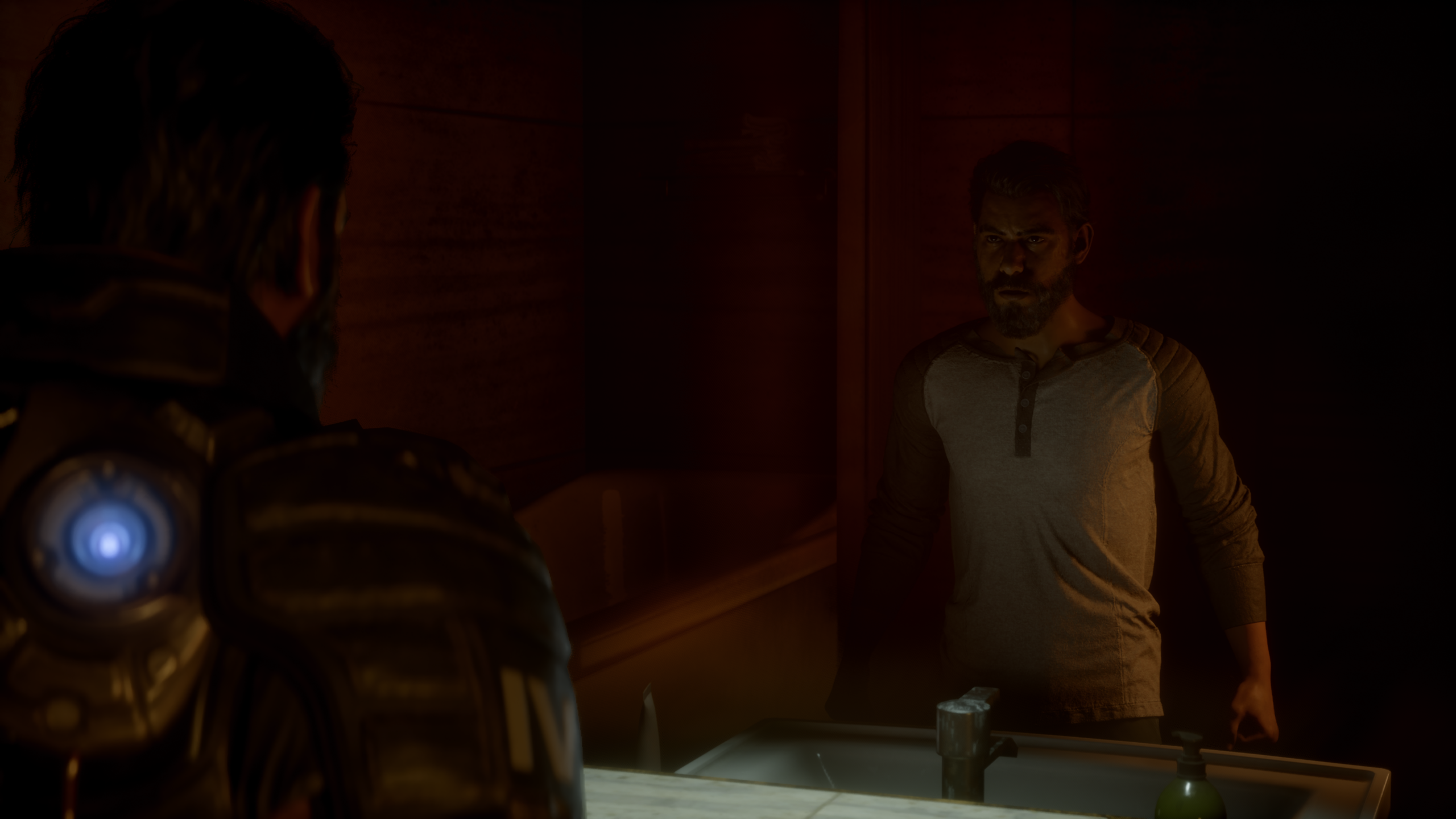
Arjun is an interesting character for sure, and gradually eking out this backstory, and the absurd directions things take on the larger scale, has a degree of intrigue to it. Compared to Returnal though? A story about cycles of maternal abuse and self-reflection? Hearing about a guy who’s upset he fumbled his ex-wife is not exactly the most compelling narrative experience for me, especially when it’s wrapped up in the absurdity of a Lovecraftian draping. I get it, a lot of the creatives behind this game are men, and the same goes for much of the medium of game design, as the machinations of Patriarchy and its intersections with Capital collide to consistently exile women from most things. That said, however, was there really nothing more interesting you could have Rahul Kohli do than yell about how he needs to find his ex-wife? Like, that’s the depth of the emotional nuance we get out of him for 95% of the game?
At the end of the day, the most damning thing I can say about Saros is that you could find its experience almost anywhere. Its blend of high budget and roguelike is still unique, and if you didn’t pick up Returnal, it’s probably still a very distinct experience in a lot of ways compared to the slurry of genericism you’ll find elsewhere in the AAA gaming space. I expected more though, and I will continue to expect more. Housemarque has consistently shown with games like Resogun and Super Stardust that they have the shmup chops and technical know-how to make something really interesting. Seeing something truly compelling like Returnal become just like everything else in its sequel is an unfortunate disappointment.
One Small Step Back
"Alright"
Saros is a blast to play, but its swerve towards a more traditional narrative and presentation mar its path towards being a worthy successor to Returnal.
