Dark Souls: Mother of Mourning is a 4-issue comic series written by George Mann, illustrated by Maan House, colored by Steve Canon, lettered by Andworld Design’s Jame, edited by Ibraheem Kazi, designed by Oz Browne, and published by Titan Comics from December 2025 to May 2026. A volume collecting all 4 issues was released September 29, 2026, and Titan Comics provided a digital review copy to Gamesline.
The prologue of Dark Souls concludes with an enormous crow appearing out of nowhere to carry you in its feet to the land of the ancient lords: Lordran. Who is this crow? Why does it carry people from the Undead Asylum to Lordran, and back again? No item description in the game will resolve this mystery for you, nor does any character audibly wonder about it. For the rest of the game, the crow roosts atop a nearby ruin in the hub area, giving the player a chance to consider the crow’s mystery every time they return.
Near the end of the first issue of Dark Souls: Mother of Mourning, a crow who has been following our heroic knights speaks in human language, projected directly into their minds. This is a shocking event that requires several panels of dialogue to accept. “What sorcery is this?” “Kill it now, it is demon-spawn.” “This strange speech is a clever trick.”
How does the crow speak? A blessed trick of the titular Mother. How does the crow know the location of the Mother’s soul, the great treasure which our knights seek? The Mother knew it in life, for it was her herald. “This is unnatural.” “No, it is blessed!” In two pages an arcane mystery has been introduced, debated, explained, and debated again, with little space given to ponder this strange event for myself.
Mother of Mourning has no obligation to mimic From Software’s obtuse approach to storytelling, which honestly started to wear on me by the time I saw the same old tricks yet again in Bloodborne. I welcome a fresh method that is unlike anything Hidetaka Miyazaki would produce; yet in practice, the exposition-heavy style that bookends Mother of Mourning is too conclusive for my liking. By the final issue, truths are unambiguously revealed, lines of good and evil are cleanly drawn, and the narrator even tells us the moral of the story.
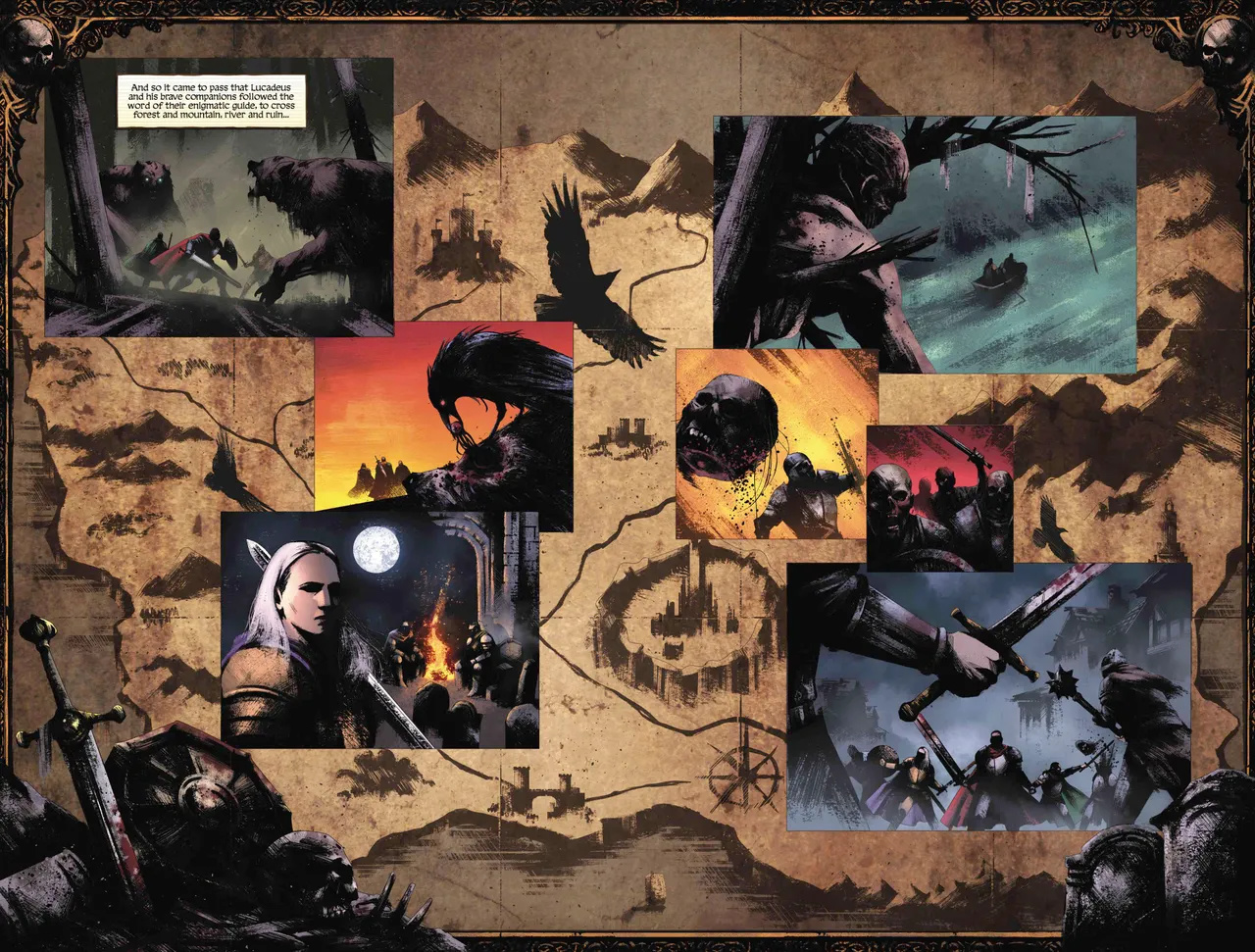
Mother of Mourning promises a truly original Dark Souls tale, free from the gravity of that game trilogy’s characters and events, connected to the series only by shared thematic concerns: the magic of souls warmed by a world-sustaining flame, the crumbling kingdoms and accursed undead produced by the flame’s fading, and the powerful adventurers who seek to reignite the flame before the dark takes over. Then, there’s the most important shared theme of all: warriors seeking comfort in the embrace of a beautiful woman.
In this new take on Dark Souls, the Knights of Mourning quest for the lost soul of the Mother of Lilies. The Mother was a hero of a past age, but is now a holy relic-corpse guarded by the Knights. By returning her soul to her mortal remains, the Knights hope that the restored Mother can rekindle the fading flame and return their forsaken land to its past glory. Our protagonist is Lucadeus, a straight-as-an-arrow stoic knight who leads two companions on this quest that so many other knights have failed.
Tonally, Mother of Mourning distinguishes itself by emphasizing the horror and gore of Dark Souls, at the cost of de-emphasizing its quiet tragedy. This is most apparent in the treatment of the undead: rather than pitiable subjects doomed to slowly lose their sense of self, they are uniformly portrayed as hostile monsters to be righteously dispatched with bloody violence by non-undead knights. Although the story does eventually become critical of the Knights of Mourning’s reliance on heroic violence, the fundamentally monstrous nature of the undead, their eagerness to gruesomely attack any non-undead they meet, is never challenged. That concept shouldn’t work for me, but it does, thanks to Mother of Mourning’s greatest strength: the striking gothic horror artwork.
Maan House is primarily a horror illustrator, and he brings an unsettling terror to the monsters beyond what is ever present in the games, whose art direction is guided by Miyazaki’s concern for dignity and beauty. House’s monsters play on the primal visual fears of a predator’s gaze and a mouth that’s showing too many teeth, especially when attached to something that’s shaped like a human. That sounds simple, but it’s executed well enough to make me seriously consider the limitations of Miyazaki’s direction.
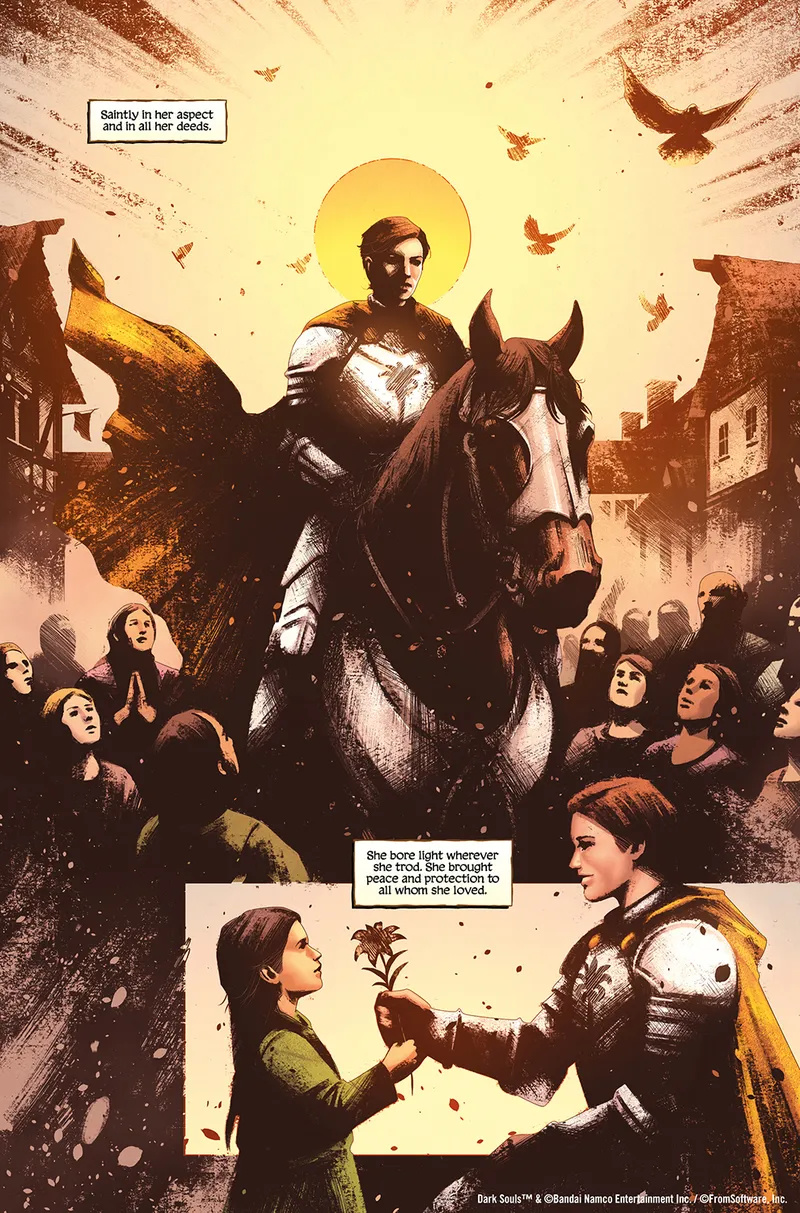
In general, Mother of Mourning is at its strongest when it allows the illustration, the color, and the panel design to communicate meaning without being crowded by text. The action is sometimes a little overindulgent in hyperviolence, but it flows propulsively from panel to panel, creating dramatic moments of tension and release beyond what the Dark Souls staple of “two hits and a dodge roll” can achieve. There’s strong contrast between dark stippled shadows and bold splashes of color: the green and purple of the ruined present, the red and orange of action scenes, and the yellow of the legendary past. Even in that golden age, the shadows always loom, threatening to swallow the light that the Mother of Lilies fought so hard to preserve.
The third issue is my favorite for how effectively its coloring and panel design contrasts the ruined present with the legendary past. Mother of Mourning emphasizes that history repeats itself, but also gets worse and worse each time. The current-day Knights of Mourning fight the same great monster that the Mother of Lilies did, and they are driven to precisely mirror the stories they so revere, but in a more dilapidated and darkly-lit monster’s lair. Even the monster’s coloring suggests that she has lost vitality over time. The Knights might be able to defeat this villain, but in the long arc of history, the darkness is winning.
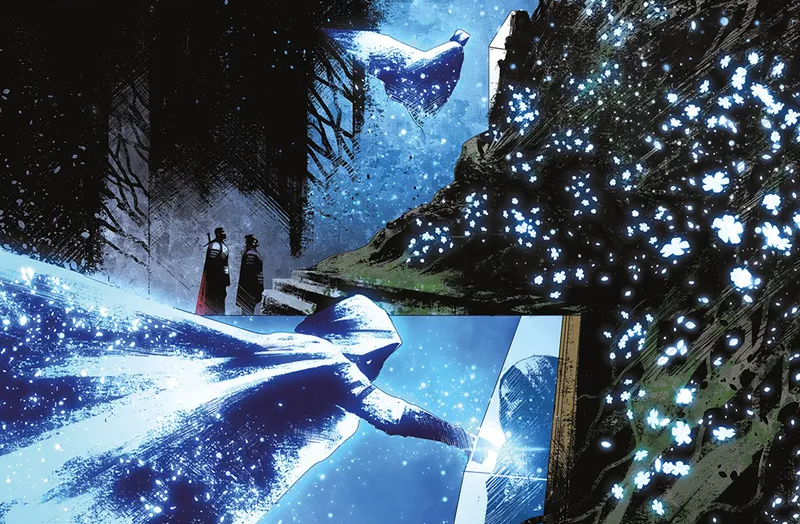
The third issue also introduces the disarmingly bright blue of the Mother’s soul, reminiscent of the sorceries in Demon’s Souls. Through color alone, the comic communicates the overwhelming power of the Mother’s light, the only thing capable of lightening the shadows that otherwise dominate each page. Immediately, all the sacrifices of the Knights are justified. The Mother is different from everything else in the world, and maybe she really can save it.
We don’t review comics very often here at Gamesline, so let me close with a prescription for how to read comics. It’s really easy to glide quickly from panel to panel, reading the text boxes and skimming the images. But it takes an enormous amount of labor to make a single page of a comic, and it’s always worth your time to slow down and really digest what’s happening in each panel. Mother of Mourning is not very impressive as a read-the-text story, but as a series of sequential horror illustrations it’s a rewarding experience.
Good
"Holding Out for a Hero"
Dark Souls: Mother of Mourning is a little heavy on exposition and violence, but its fantastic horror artwork is worth basking in.