
Have you ever played Killer is Dead? Oneechan-bara? Senran Kagura? MegaTagmension Blanc + Neptune VS Zombies?
None of these games are what I would call traditionally “good”, and yet I found myself playing several hours of each, and spending the years afterwards thinking back fondly on the tiny little things they did to diversify themselves within the 3D Action space; or the ways in which they failed to cohere into a unified and effective vision.
It’s easy to dismiss a game as not worth your time. Hell, it’s even easier to let marketing and sociology train your brain into only accepting the potential of a work if it meets certain metrics. Prestige, notoriety, budget, or a place within the current zeitgeist can all determine how something is perceived, and quickly place it within the confines of binary “good” and “bad”.
This isn’t an advocacy for playing exclusively bad games to learn empathy or free your mind per se—I’m sure we’ve all seen enough memetic mutterings on the minutiae of mid— but it’s something I’ve felt strongly about over the years as social media has continued to become ever more dominant in the conversations around media engagement. It’s incredibly rare to find honest discussion about anything outside the mainstream that’s not the subject of a viral video essay, or something that plays well to a viral screenshot (e.g. the thousands of Koudelka screenshots reposted by people who would never dare touch it).
As someone with a lifelong interest in critique, it has been my aspiration to always try things, especially if they fall within the boundaries of “things I should like”. Not out of some obligation to the artform, or to show off my hipster cred because I’m the most special girl who has the 0.2% rarity Monopoly Madness platinum trophy: but because it feels good to connect and understand what exactly it is that makes me love the works I adore, and in some cases what things get in the way of that love’s consummation.
I don’t love Killer is Dead because of its bizarrely discordant narrative, or its weirdly stiff combat, but I did love the moments you get a sick execution and blood flies everywhere Revengeance style. Oneechan-bara is trashy and only just above the depth of a musou, but it resonates with me because it was a game that taught me how heavy and deliberate every move feels, and why stuff like Dynasty Warriors has consistently fallen outside my purview. Senran Kagura and the incredibly mediocre Neptunia game I mainly mentioned so you could momentarily question if their existence taught me how character dynamics and weird one off bits are something that can elevate something that would otherwise be largely blasé or if I’m just messing with you.
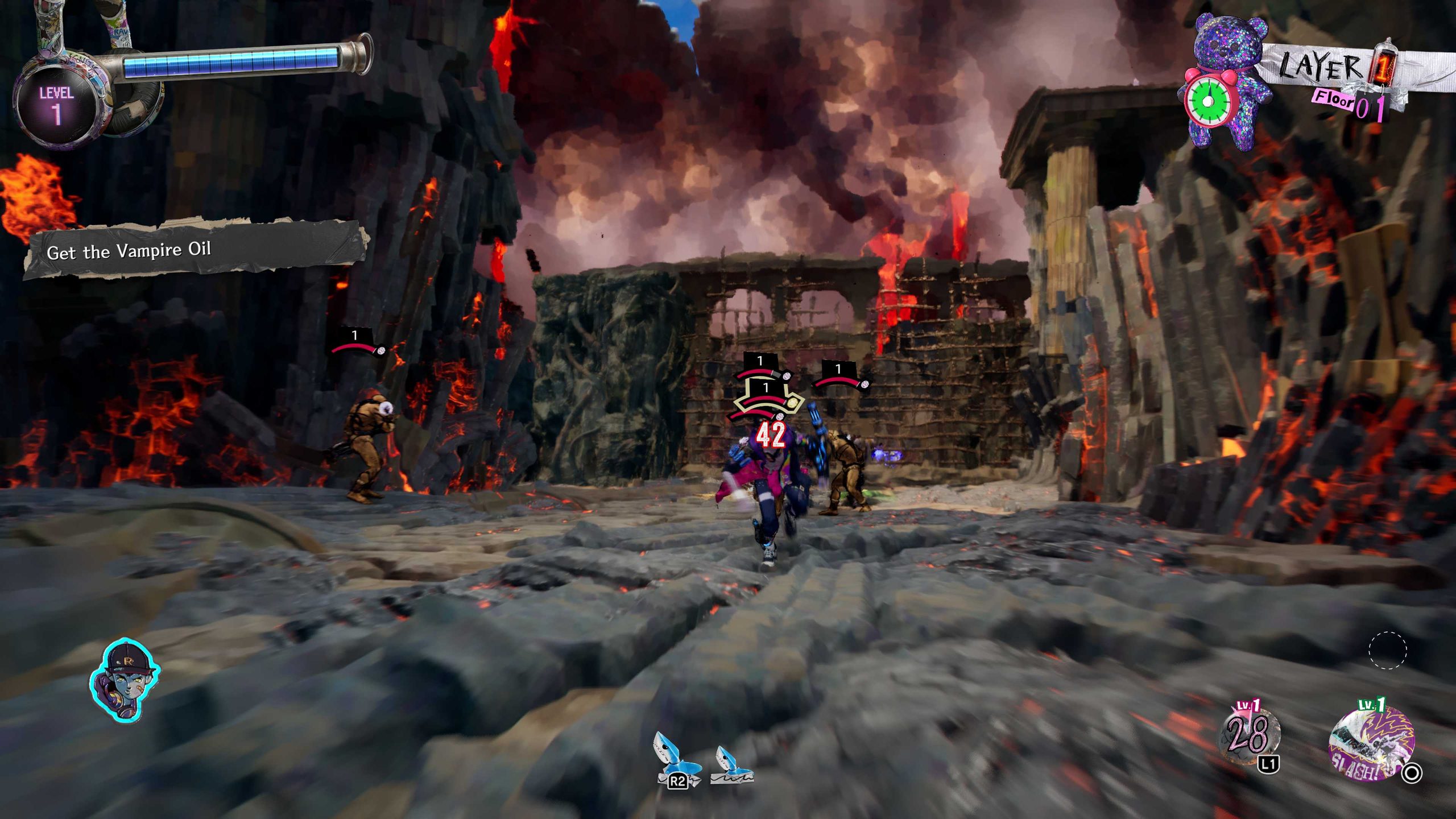
This is a lot of preamble to say that Stupid Never Dies is not a very good game, but it is a game that I’m going to think fondly back on over the years as I subject myself to whatever new soulslike or “parry slop” contemporary comes my way.
Stupid Never Dies is the debut game from GPTRACK50, a development studio established in 2022 under the leadership of former Capcom producer Hiroyuki Kobayashi. Kobayashi worked on all sorts of games during his 20+ year tenure at Capcom, but the ones mentioned the most during the marketing cycle for Stupid were, understandably, the Devil May Cry series.
I say understandably, because Stupid Never Dies is a 3D real time combat game that could theoretically be placed within the bounds of the conceptual genre of Character Action; an ever contentious genre with a definition that changes depending on how annoying the person talking about it can be. I’ve been a fan of character action games my entire life, with titles such as Devil May Cry, Ninja Gaiden and hell, I’ll bravely yell out Kingdom Hearts, all serving to amp up the beating passion in my tiny little heart.
It’s an underexplored genre, and the reason it’s always been somewhat of a hotbed for discourse and aggressive ontologies is because a lot of games tend to market themselves off comparison points to the scant games that have been pre-agreed upon to wear the label, while failing to grasp even their most basic principles. How many Final Fantasy XVI’s or Stellar Blade’s must we push ourselves through before we stop believing?
Stupid Never Dies takes place in a world where movie monsters showed up on Earth suddenly one day, and quickly became oppressed (yep, fantasy racism again) by humans after a series of scattershot wars. However, humanity quickly got their comeuppance when an all powerful being known as KOM (King of Monsters) united the disparate monsters under one banner and nearly wiped out all humans on earth, before mysteriously retreating to the lower levels of the planet’s crust.
You play as a zombie draft dodger (a fantastic concept) named Davey, who hid himself away in an abandoned mall to avoid taking part in the conflict that ultimately destroyed the world. One day, he accidentally eats the egg of a Phoenix, and gains the ability to “Style Eat” other monsters to temporarily attain their powers. This odd ability lets him enter the lower levels of the Earth’s crust, each based on the various environments inherent to the myriad of movie monsters that inhabit them, and bring the fight to KOM so he can eat them and potentially gain the power to restore the human race.
Of course, Davey is an incredibly stupid zombie, so the only way he can be convinced to go on this grand journey is to fulfill his own greatest wish; the resurrection of a girl he found frozen in the back of an ice cream shop whom he instantly fell in love with.
I don’t think the core narrative of Stupid Never Dies is very good. It meanders around refusing to go in any meaningfully interesting directions; and at times veers into incredibly questionable territory with the relationship between Davey and his frozen dream girl. Much of the backstory of KOM is entirely backloaded, and a lot of the game is weirdly juvenile jokes that wouldn’t feel out of place in one of Suda 51’s games, albeit with less obscure references and dick jokes. By the time I hit the credits on Stupid Never Dies I was kind of blown away by just how little actually happens in it, and how you can barely perceive a meaningful change within any of the odd cast of characters when you enter its half-hearted post-game story.
Ultimately though, this wasn’t something that really mattered to me, because Stupid Never Dies was astoundingly easy to play, and I consistently found myself going back to its not-quite-deep yet not-so-basic combat.
Stupid Never Dies is a roguelike in the milieu of the modern Hades-inspired mold. You go through various randomized floor layouts, gain different powers (yeah you pick one of three), and accomplish various goals alongside a robust suite of meta-progression upgrades which make you stronger and stronger as the game goes on.
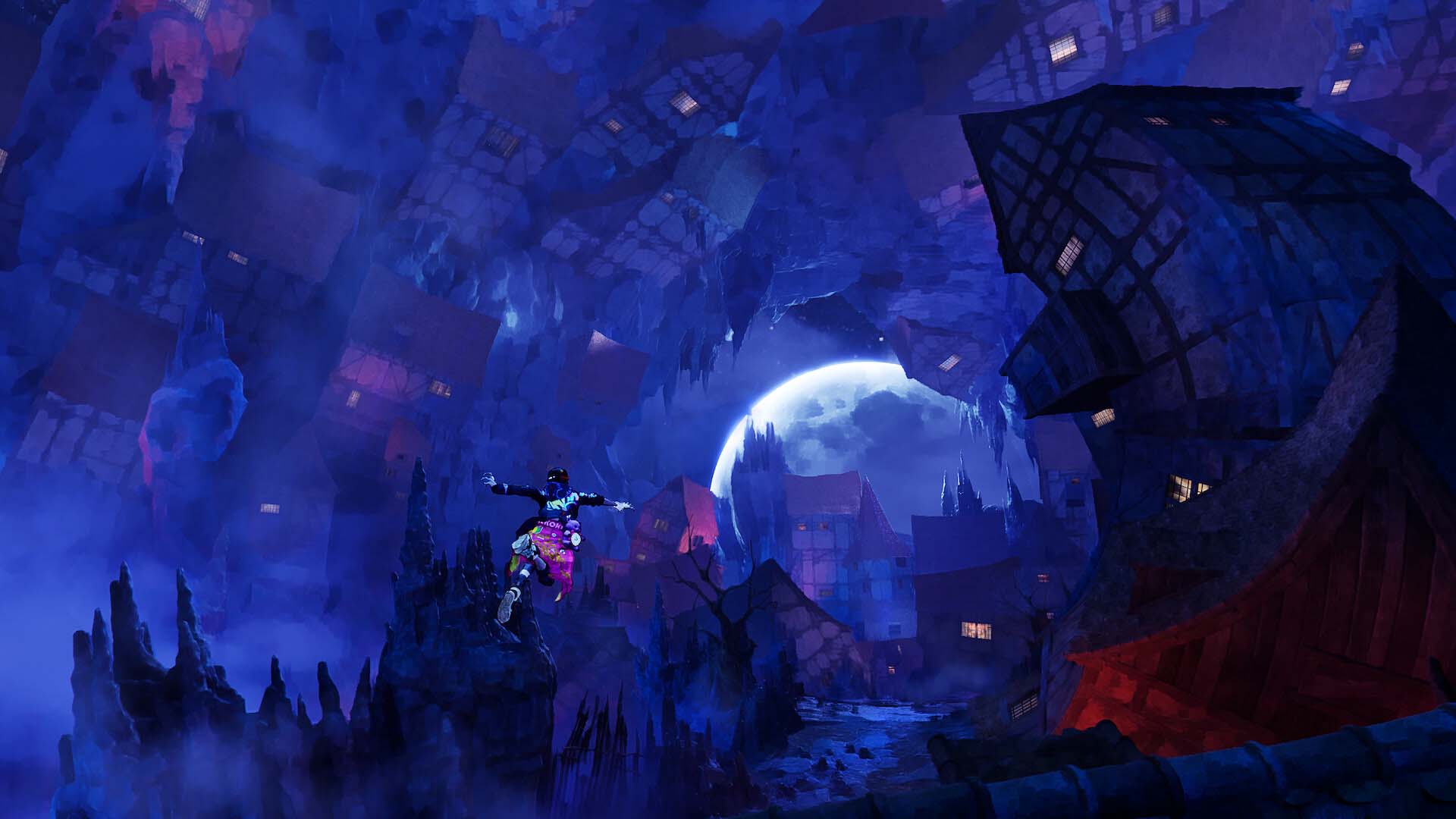
You begin each run as the default zombified Davey, but over the course of the run you’ll gain temporary alternate forms that change your base moveset of punches and kicks into all sorts of monstrous nonsense. You can turn into an intangible will-o-wisp, a skeleton-raising lich, a flying harpy…the list goes on. Each form expires after three floors of exploration, so you’re consistently incentivized to try and learn everything, though you’ll inevitably pick and lean towards favorites (the ice fairy transformation was something I frequently looked for).
You gain these forms by pressing the right trigger to perform a healing bite into the elite monsters you defeat, though you can also bite their rank and file friends to borrow single-use moves as well. The biting system of Stupid is actually really interesting to me, because it adds a layer of defense mitigation that a lot of these games feel too scared to approach. We live in an era where the best approach in the vast majority of games is to utilize dodge rolls or parries to neutralize damage entirely, so seeing a mechanic based on the idea that you Will Be Taking Damage means that you have to more meaningfully plan the trajectory and timing of your attacks. Almost dying on a particularly tough encounter, only to chomp my way back to full health was incredibly satisfying, as was choosing to not regain health by instead biting an enemy for their skill, prioritizing damage if I knew I was close to victory.
So yeah, biting is on the right trigger, the left trigger is for a Stupid Parry (yeah it’s really called that), the left bumper is for your instant skills, and the right bumper allows you to use one of 5 cooldown-based abilities that each monster form is randomly assigned on pickup. There’s a single button for combos, unlike a Devil May Cry, though you can perform something similar to a heavy attack that’s unique to each monster to mix things up. The only truly modular skill you have complete control over is your Overtech skill, which comes from permanent equipment that you’ll gain over the course of your runs that can be adjusted before a run or between floors of the dungeon.
This is all pretty basic stuff, barely indistinguishable from something like a Final Fantasy XVI which I would so easily deride, yet for some reason it awoke some sort of primal peace within me. I attribute much of this to the game’s fixation on animation priority and aerial juggling, something that most hack n’ slash games tend to avoid out of potential balance concerns and physics-based difficulties. It’s incredibly satisfying to imagine a combo where you alternate between flying swoops and more deliberate intensive attacks, and the enforced randomness of the skillsets you have access to at any given time means the types of combos you’re capable of are constantly changing.
The meta-progression additions don’t really get in the way of how good those moves feel either; they just add things like debuff efficacy, how frequent you have access to certain moves, as well as the amount of damage dealt. An interesting aspect to the format of the roguelike mode is that each consecutive run increases an ever growing XP modifier, meaning that you’ll level up faster and faster as you play more of the game, giving you access to those augments earlier in a run once you’ve gotten a better handle on them. By the time I got to the end of my time with the game, I was leveling up 10+ times after my first enemy kill, which was very funny, but also let me accelerate my way through to the more elaborate and harder fights further in.
The only problem with the extraneous nature of the meta-progression system is that you don’t end up feeling like you’re making a lot of meaningful progress or change as you go through the game. Sure, you can get different variants of your equipment with various passives and a handful of differing active abilities, but outside of that things are kept largely numbers-based instead of mechanically changing how you engage with the game. In something like Hades, you unlock new weapons at a consistent rate and even gain alternate movesets for said weapons, with incentives to switch up what you’re fooling around with so that runs can feel meaningfully distinct. In Stupid Never Dies, I appreciate that the core game flow doesn’t change (I’ve always hated when games do something like increase the window for performing a parry or add i-frames onto a dodge, and so on), but it means that when you hit hour 20 of the experience, it starts to feel overwhelmingly stale.
The only thing that continues to feel fresh is easily the game’s strongest suit: visual presentation. I’ve bemoaned the blandness that widespread Unreal Engine 5 usage has inflicted upon the medium of games, and if anything, Stupid Never Dies has oddly emboldened my stance by completely circumventing the dull grays and browns of your Expedition 33’s and First Berserker Khazan’s entirely, creating a vibrant and colorful world to jump around in. Even when you’re in what would ostensibly be a drab cave in any other game, the floor feels almost bioluminescent in how the color pops everywhere you look. I consistently found myself waiting to end up in some dreary brown post-apocalyptic sludge dimension, but it never came. Boss fights in particular felt incredibly readable and easy to intuit without an over-reliance on particle effect visual cues (outside of the incredibly obvious Stupid Parry-based moves).
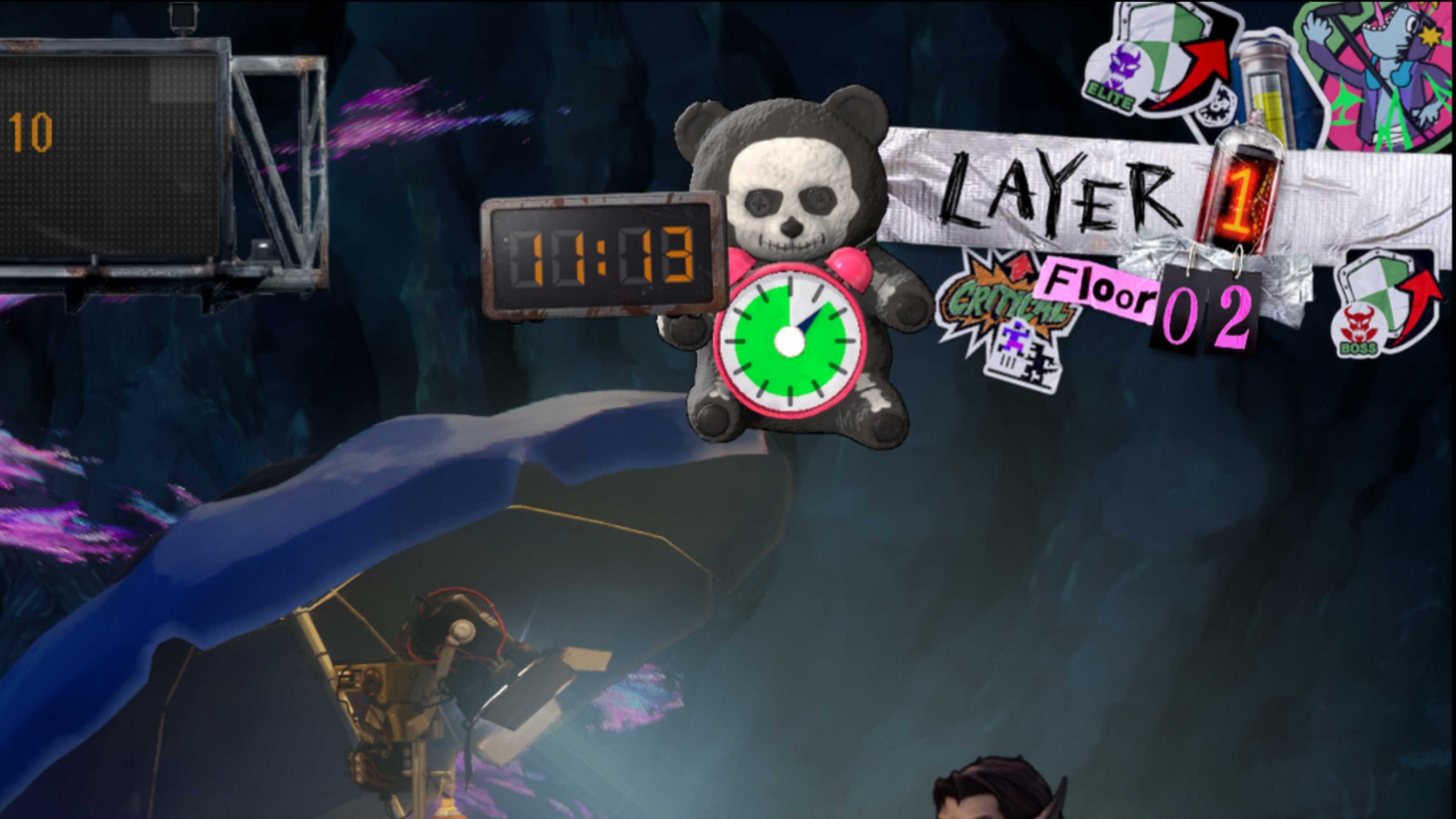
Cutscenes are consistently impressive, utilizing a patchwork collage format that instantly stands out. There will be cut-ins of all sorts of random knick-knacks and skater-style stickers, as well as 1940’s iterations of the various monster clans you run into. Sometimes, the game shifts entirely into traditionally animated cutscenes with an intensity and vibrancy I’ve only seen during the more surrealist and intense parts of an anime (you know like when FLCL suddenly shifts to incredibly detailed linework). My personal favorite superfluous visual doo-dad was the everpresent teddy timer in the top right of your screen. That weird little thing dances like a damn cocomelon tiktok and I felt my brain getting the same chemicals some of us get when we see a gif we need to watch over and over again. Entrancing thing.
Though I was thoroughly ready to be done with Stupid Never Dies by its end, I still surprisingly enjoyed most of my time with it. It’s the type of game that goes down incredibly easy, even if it’s not necessarily blowing your mind or moving your soul. When people make their little quips about how they want more 7/10 video games, that’s pretty much exactly how I feel about Stupid Never Dies. It’s not great, it’s not even amazing, but much like the way I think about Killer is Dead’s incredibly awkward flirting minigame, I know I’ll be drawing from the well of Stupid Never Dies in the future as I consider what can, or shouldn’t be.
Okay
"Totally Fine Dude"
Stupid Never Dies won’t set your world on fire, and it has a pretty lame-ass story, but if you like games like Devil May Cry and just want to mess around for a bit, you could do a whole lot worse.
