Since the advent of gaming as a hobby, there has been a latent hunger for more; a transcendence of the limits of the medium. I would not hesitate to say that on some level, across all mediums of art, this has eventually been the case. Why settle for a song when you can have a video with it? Why settle for a story when you can have an epic? Why settle for a single sense when you can have them all? Why settle for this world when you can have another?
Over the past few generations of video gaming, I have noticed a trend, a fascination which started as a conscious or unconscious desire for more. Games grow bigger, wider, deeper, and yet satiation never seems to come. People dream of infinity; a world that is worlds.
This desire, which I have seen in myself, in others, and in the profit-minded industry, leads to a hunt, a chase for a fleeting, impossible creature. Artists and audience, industry and media, all seem to be hunting for one thing: the Omnigame—a game which encompasses everything.
Lying, in Hope a Truth Falls Out
To better articulate a term I just pulled, in its entirety, from my ass, let me articulate a phenomenon I’ve noticed. Let’s talk about the fantasy of VR.
As Virtual Worlds came to embed themselves in our lives—and in some cases even before—humanity has imagined the departure of the mind to places elsewhere. Immersive VR—Virtual Reality which fully tricks the mind into believing it exists elsewhere, often called full-dive VR—has been an ambition among nerds for a long while now. When VR headsets first hit consumer markets, nerds worldwide rejoiced.
“Finally, an escape from this intractable shithole,” they cheered.
“You can even be a catgirl with RGB light-up ears,” said another demographic.
“I’m going to make a virtual Kmart,” said a third.
Yet, the ambition, the promises of these headsets, didn’t match up with what was experienced—which in most cases was a lot of forehead sweat and motion sickness. But this never stopped anyone from dreaming.
Human beings are creatures of stories, I’ve found. The realms of fiction can be utilized to explore trauma, fears, hopes, and dreams. Speculative fiction can be a way of expressing anxiety about how the world could be. Post-apocalyptic fiction and cyberpunk are all expressions of fear, but they are just as often conduits for hope. Lots of people simmer with excitement and fear both for the promise of something like full-dive VR and the inherent transhumanism lying beyond. In some cases, the initial fear or anxiety expressed in those original stories is expunged all together.
For example, The Matrix, in its original iterations, expressed a terrifying world; a world where you could be completely unaware of the powers that be and their ability to fully control everything. Jacks installed into the body with cables stabbing into the brainstem, sending dreaming humanity to a world which usurps reality. It imagines a setting where one can generate infinite creations, indistinguishable from the real thing. Across several decades, we have seen many dozens of parodies to a point where it has entered a sort of cultural undercurrent of memetics. The Matrix has become bullet-time, black trench coats with designer sunglasses, and the bridge between real and virtual worlds.
The anime .hack//sign similarly features a story where a person is immersed in fantasy, trapped in a virtual world and divested of identity. It is less intrusive, only requiring a headset, but the result is similarly difficult. The main character is reduced to an avatar, forgetting themselves completely. In all their fear and isolation, they are both literally and metaphorically lost in the dissociation of an MMO.
It is far more common in the modern day to see permutations of the .hack formula. There are dozens of manga and anime which borrow a central conceit of being trapped in an MMO while removing the teeth of the premise for the purposes of comedy, farce, or simple wish fulfillment. Even where there aren’t direct analogues, there are many cases where pieces of media directly borrow the concepts of an MMO or single-player RPG while ascribing it as another world altogether–the Isekai. The video gamey nature is now, at heart, a baked-in part of the fantasy.
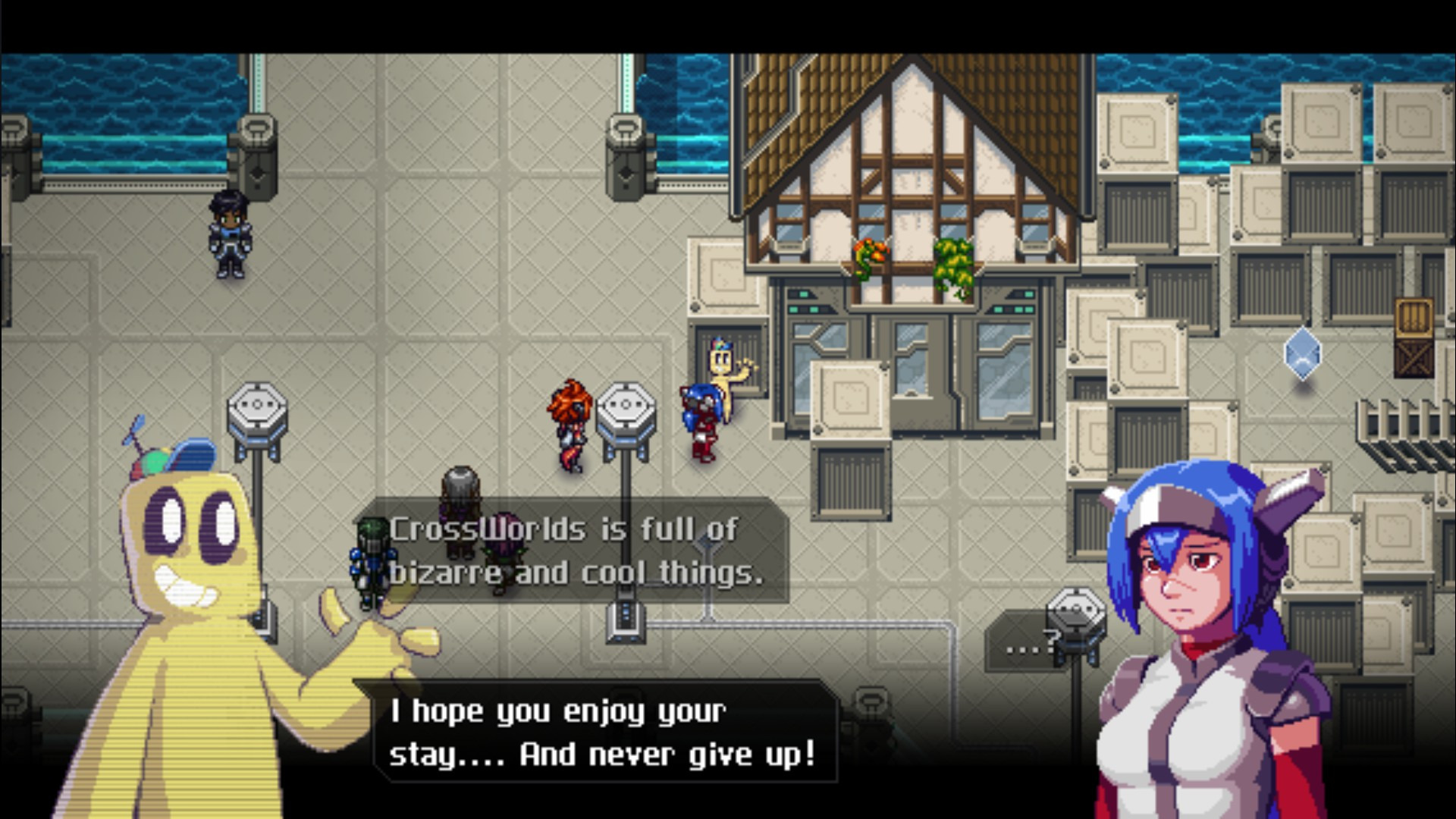
Now, many years later, games like Crosscode emerge. Your protagonist, Lea, is trapped in a virtual world, but one decidedly much friendlier than either The Matrix or .hack//sign. It offers a vision of a world where something like a completely immersive MMO can exist and be as banal as a smartphone today. An entire planet is treated as a theme park in the setting, and people log into it through remote-controlled bodies just as easily as World of Warcraft or Final Fantasy XIV. Though Lea’s life is complicated by her imprisonment in this technology, it still presents this world in a way which comes across as desirable. If your name is not Lea, within the world of Crosscode, you get to live an impossibly lush fantasy life on an alien planet cultivated to construct your wishes.
Over the years, many such stories have come to exist. Stories about games, and frequently games about games. Games have become commonplace enough that we can write fantasies about what indulgences they may be in the future, surpassing the scope of what would be possible in our version of reality. We imagine a world like The Matrix but with all the worst parts removed; we imagine a world like .hack//sign but without interpersonal politics and identity loss. The gamer takeaway, despite everything negative in the original stories, is ultimately how cool it would be to be part of something quite so large, so immersive, containing so much, or at least in potential. In a sense, such stories are told in an attempt to one day inspire the creation of their subject.
We have lived through a time where the ambition of capital has attempted to generate such dreams. The embarrassing stumbling steps of something like the Metaverse—a name even evoking its origin point in cyberpunk fiction—were handwaved with promises of what it would eventually become. That is, provided everyone forgets that the origin of cyberpunk is terror at the control of oligarchic corporations.
The dream of the virtual world is, as I described at the onset, the dream of an omnigame. An usurpation of reality, traded for something more favourable. A video game where you can do everything you can imagine and where the limits are basically nonexistent. Genre becomes a thing of the past because the game is a world in of itself; a monolithic effort which, within itself, contains multitudes.
Yet, virtual reality is not the only thing affected by this fantasy. Yes, nerds will continue to dream about the promise of immersive technologies, but I think I’m also fascinated with the underlying thoughts which cause such obsessions. It isn’t truly enough for VR to be immersive or for worlds to be as lush as the real thing. I think, digging deeper, people are obsessed with dreams of “more.” This, I will admit, is an obsession I have also seen within myself.
Ultraviolet Recursive
Once more I must talk about myself, because despite wide sweeping statements about “people” in the abstract, I cannot truly know their hearts. I am not a sociologist; all my notations are anecdotal. Just the same, I can’t help but be fascinated with the trends I see, which at heart are born from obsessions similar to my own. I know this because the fact such media exists to flatter such fancies shows that other people carry the same affliction.
The affliction in this case is an obsession with expansiveness and depth. As a person with many difficulties, it’s very easy for me to shrug at the material realities of the world around me and slumber in another one for a while. My love for Final Fantasy XIV has been mentioned before but, in so doing, I buffed out the worst of the rough edges. Let me express some of those uncomfortable serrations now.
As I’ve mentioned before, my first experiences playing XIV were coupled with immediate distaste. My disdain here was particularly performative because it was so tightly associated with Final Fantasy, a franchise which has won countless hours of my life. When I finally began to appreciate Final Fantasy XIV, it was because of the unfortunate shape my life had contorted into. Life was awful and I wanted something with uncountable hours of capital C Content to steal my time away.
When it started hitting, it hit hard. I played through every expansion, and every bit of side material I could get my hands on. Final Fantasy XIV came to be the medium through which I experienced life itself. I grinded out relics; I conquered raids; I made zero friends at all. Just the same, I was utterly captivated by the yawning abyss of the world in front of me. One land gave way to the next; one story read after another. Moving from biome to biome, I felt like I had traveled vast stretches of time and space, without physically moving at all. The scope of the project in front of me made it all the more immersive and, without a life of my own, it superseded reality. Yet, as I approached what I knew to be the finite end, I grew frightened. The appropriately named Endwalker was the open palm demanding my attention. The true bounds of the game, and its world, would not allow me to proceed.
“Stop,” it said. “You have reached the limits of creation.”
It was a command I did not have the ability to deny. So, I stopped. This realization, that the world I imagined as infinite was all too finite, was painful in a way I don’t know how to articulate. Drinking from an unending cup only to one day find it empty, makes your throat burn all the drier.
With eyes still bloodshot and an appetite unsatiated, I turned my eyes to greener pastures.
That’s when Elden Ring came out.
Elden Ring is, at this point, a famously capacious game. The first time I was teleported far from where I expected to be by one of the game’s many traps, it was too late. Elden Ring fully had its hooks in me. The map zoomed further and further out, revealing a world so much larger than I could have anticipated. Many others have experienced the same. That moment will be in my memory forever. Provided I don’t have yet another memory-effacing incident.
Nearing the end of my binge of Final Fantasy XIV, I somehow also made time for a full-time Elden Ring addiction. I played Elden Ring for so long many of my friends began to speculate if my sudden positive mood boost was not, in fact, a bout of mania. Without sleeping, I played Elden Ring for thirty-two uninterrupted hours, stopped only by my eyes’ refusal to focus or unfocus.
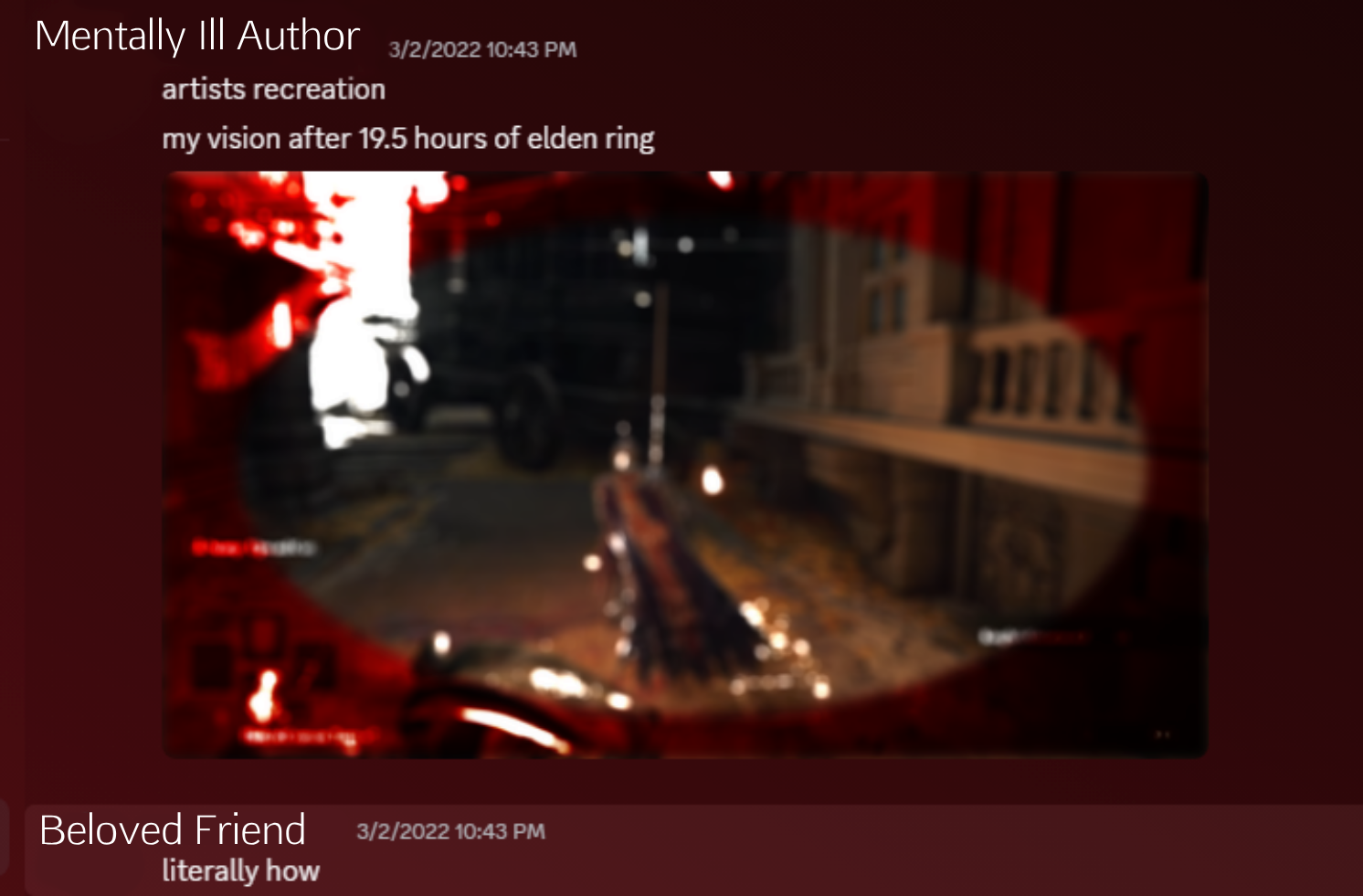
Even after thirty-two hours of consecutive gameplay, I still held onto the experience which had begun in XIV. A world big enough to feel like something real, something I could not hold in my head all at once. I would exit the game world, and people online would speak on the things they had seen and the detail of the world, and I would yet still be shocked they were seeing things I had not yet.
However, at the same time, I was disgusted with this game I desperately wanted to insert myself into. The world seemed to push me into a set of “video gamey” behaviors. What was supposed to be an open world turned into a series of velocities to the same copy-pasted cave to get an item for a build I didn’t give a shit about. The enjoyment has trickled out even further over time. What felt like an impossibly detailed world turned into an arena for violence and backtracking. I saw the borders of a virtual world and recoiled in terror. There was detail, but the depth I was looking for was not there. I dug, even when the realization was too harsh to deny.
I don’t like this game very much. It’s fine if you do, but after 200 hours this shit kinda ass.
There is a lot to be said about my behavior here. While this is obviously a hyperbolic example born out of abysmal mental health, I still have never forgotten the feeling this period of my life left me with. When I was at my worst, spinning out and unable to control myself, the taste of artificiality lingered on my lips, and I was disgusted. I stood at the borders of two worlds and felt myself wanting for more. Even after everything I have just said, I do not believe this was simply the product of a diseased, consumerist mindset. I think the reason I grind my teeth against the imposed limitations of virtual worlds is because in many ways it reminds me of my own limitations in the real one. There are many limits—either by my own body, society, or elsewhere—imposed upon me. Contrary to observations made of me, I cannot do a full 720 front flip while wielding an ultra greatsword (I’d probably go for a more lithe and elegant weapon, like a scythe or some kind of claw thing.)
TTRPGs called to me for a similar reason. I wanted a world powered by the limitless fields of imagination, a world which imposed no boundaries. If I could imagine it, I could make new worlds, new peoples, new ideas. A play session could go as far away as the ends of the universe, or as close as the nearby room; the depths of either would be whatever I cared to describe. Speaking even more candidly, it was the reason I got into writing fiction in the first place: I just wanted to make something, a story beautiful to someone like me. Everything I wanted, and nothing I didn’t.
When we were younger, based on the memories I can piece together, we were fully smitten by the allure of a multi-disk epic. It wasn’t exactly the length or the sophistication of the mechanics which captured my heart. It was a world with more than I had the avarice to ask for. A place where I could unfocus my eyes a bit and be there. The people contained within the story were those you could walk alongside for many hours, and as they lived beside me, they would begin to become real. The craving I felt—and sometimes still feel now—is the same hunger people have for this “omnigame,” a game which denies them nothing.
I know how compelling this was, even as an illusion; how bad it was for me to indulge in excess. One should not run through their life utterly addicted to a desire for more. Pleasure is fine, but it should not infringe on your ability to feel future pleasure later; my way of acting was an utter abandonment of the future to glut on the now.
A Limitless Astroturf Lawn
It’s not just by our own wishes that we think about bigger and better games. It’s the part of the essay where we talk once more about the undue influences of corporations and marketing on preferences.
As people come to desire more from games, having higher demands of their substance, corporations come with promises of impossible things. It was at this point a readily quoted joke, memetic from the moment of its conception, was spoken:
“If you can see that mountain, you can most certainly climb it.”
While those things have certainly become truer with the advancement of technology, it does not change the fact that corporations benefit from telling lies about the nature of the worlds they produce to better make a sale. Further, they benefit from the inclusion of greater amounts of material in their product. A game packed with hours of content keeps a consumer captivated and justifies the labor that went into making it—especially when such time can provoke post-purchase sales.
In a world where games are expected to make an exponential amount more money than the price of making them, it is—to the financially invested—ideal to have a product which can keep as many eyes captive for as long as possible. Thus, we see a development cycle where expansions to the base material is an expectation. I’ve shit talked Destiny 2 in the past, and this is the reason why; a game which is, on paper, a wonderfully fun time, became a content mill which kicked you off the ride if you ceased to purchase and guzzle down Content. Season passes, character DLC, expansion packs, features added as quality of life or just fan expectation. Yes! You CAN pet the dog; $90 please. The disinterested gacha woman pet raising game can now also be an extraction shooter, tower defense, rhythm game, in-depth mahjong sim roguelike VN.
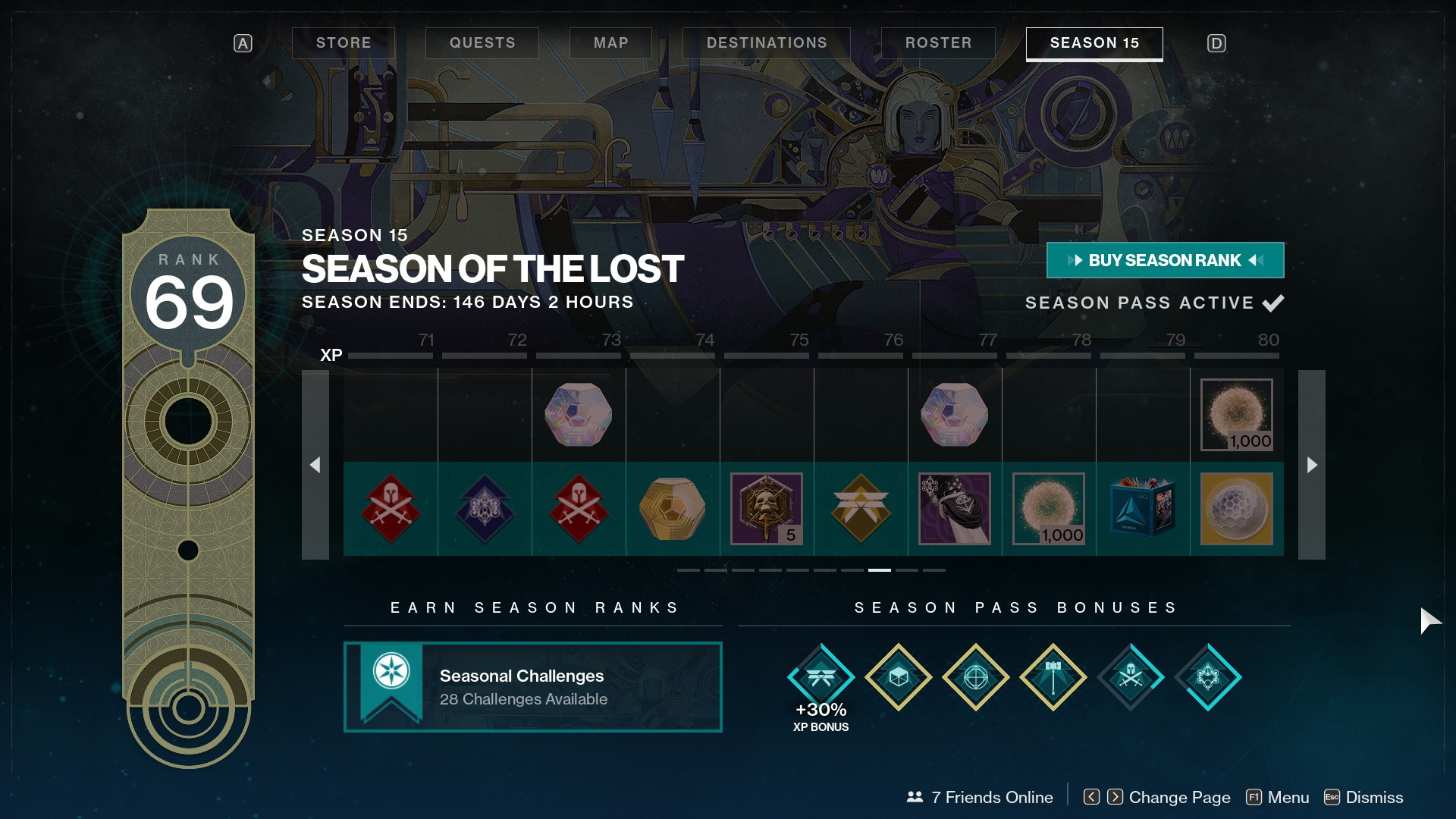
These additions, while being good for the lifeblood of the game on paper, shape fan expectation. A game must generate a certain amount of Content over time to coerce continuous play from your community, or the game, by the most vocal parts of the fandom, is considered “dead.” It is never that the game simply had a set and met expectation of scope; the game must “live” to placate a fanbase perpetually starved for new content and who stand desperately at the boundaries of the world wanting to push them ever outward. Eventually, with mandatory growth, this creates a game which must be everything to everyone. Keeping players in a world is obviously beneficial to the company who owns the devs who make the game, and on and on the content-production cycle goes, until the game stops making money or the people who own the studio realize they can save 100 percent of their money by just firing everyone.
Even though it is a cynical sentiment, I think it bears articulation because, ultimately, a problem needs to be made visible for a person to see it as a problem. The corporate influence of what a “gamer” desires, ends up influencing and impacting what culture demands. Obviously, there still remains a subset of tightly designed, specific games, but often in the most traditionally marketed and visible works, we see a push for homogenization and broadness. As a game’s scope widens to let everything in, they become infinite in the most capitalistically craven way. A digital Golden Corral—everything for everyone.
As expectations grow, certain demographics get frustrated when a game has a narrowed, intentional focus. They cry out when they feel their needs aren’t being met, fair or not. Such demand most negatively impacts the developers who can least afford to balloon their game’s scope, which says nothing of artists who have something specific and precise they wish to articulate. You can look in the discussion section of just about any indie game–bad idea, never do this–and see people begging for things completely out of scope with what the game even promises. Or complaining about “woke,” either or. Even if I have expressed distaste for something like The Witcher 3 or Elden Ring, neither of those games would benefit from arbitrarily including a farming minigame, gacha system, or seasonal engagement trap.
Of course, this isn’t a new phenomenon; people have asked for things they shouldn’t have for as long as speech has existed. The newer change is the massive amount of interconnection between audience and art. An artist can make something they believe in with all their heart, and instantly get feedback, alongside numerous points of comparison of other artists and pieces of art. It is possible to talk about a game entirely in passing, untagged, and somehow the creators will still have it foisted upon them. The industry, as it is, is better equipped than ever to impose a sort of self-regulating state of permanent expectation and discontentment. You can be compared to peers, and people you have literally never met, before your project even so much as has a name.
I don’t want to believe that people are so easily seduced by the machinations of industry, but just the same, I see a rising lack of engagement with art itself, replaced with a cicada-like urge to stripmine a game for content. As long as satiation is prioritized over satisfaction, we will see a trend of expansion without end continuing to proliferate. The content consumption mindset is here, and we’ve all seen the way it insidiously snakes around even our language, until all things are rendered into generic infinite grist.
And the Snake Swallows the Snake
People will always wish for more. Despite everything I’ve just said, I don’t think that’s a bad thing. Wishing for something more than is possible, or wishing for something to be easier, or for something never done before, is how we push the limits of what we think is possible.
As we wish for more, it’s only natural that games become larger to encompass the size of the dreams people have. The resultant obsession with the capaciousness of games is an expected byproduct. Just the same, I think the size of a game, in the sense of the things it contains, is on some level an expression of love. Having something be more is justification for the time you spend in something destined to be fleeting and ephemeral. The whim to remove your memory of something, to experience it again, to once more become an audience fascinated and unbothered by the prescribed limits of a game world, is commonplace. I can’t judge them for this, even if it sometimes results in negative outcomes.
It is bad actors who exploit this wanting in us, and resultantly cause people to spend exorbitant amounts of money for a dream. These dreams have monetary and labor ramifications which impact the entire industry, and only play further into the hands of a capitalistic system wanting to turn an art medium into a grocery store decision. From a commercialistic perspective, a family-sized package is the expectation—it costs the most. It’s something to be mindful of.
This is the contradiction born of extremes. At heart, wishing for something bigger, deeper, more expansive, more expressive, more immersive, is how we got to a point where we could start making the technologies we see today. Just the same, it is capitalizing on that desire which creates an industry that cares about content over people. It is capitalism’s greatest strength: to steal people’s desires and sell them back for profit.
Despite the dangers of exploitation, I think people should dream for more. It is where inspiration is born. You see something, something big and beautiful, and even when it satisfies your desires, it sticks with you; it lingers and against even your own interest, you hunger for more. Though you can choose to simply reindulge with diminishing returns, or turn to the AI slop engine which gives you a version of Skyrim that infinitely generates quests for you, I think the dream of more can also be something which inspires new creatives, new creations. The cycle of inspiration and creation is as an ouroboros, continuing so long as people have a desire to make art about the things they care about, and the capacity to be dissatisfied by what has already come.
You can’t truly make a game containing everything without immense cost or compromise. That’s the beauty of creation: you can’t have the whole world, so you must pick and choose what you want as your craving hands leave behind something else, falling from your grasp like grains of sand.
I don’t think we can truly ever capture infinity. But, there’s still nothing wrong with trying.
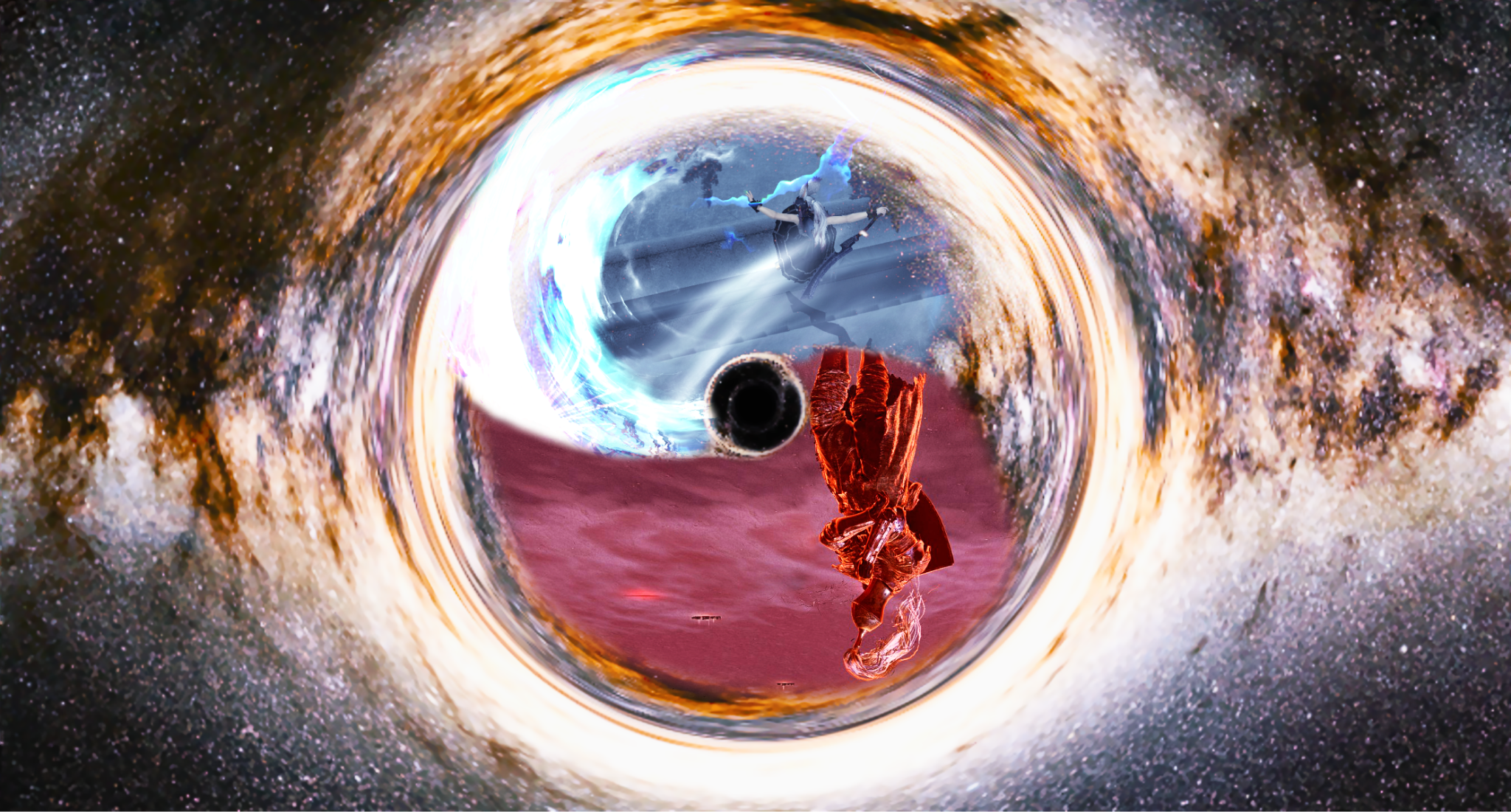
The header image was acquired from Wikimedia Commons, and remixed under the Creative Commons Attribution-Share Alike 4.0 International license. Author: Yukterez (Simon Tyran, Vienna). Source material for the Milky way background (also available on Commons): ESO/S.Brunier. Code for the relativistic raytracer and other angles: Yukterez.net/
The video was originally sourced, unedited, from https://www.youtube.com/watch?v=yyNQGOo0hsc