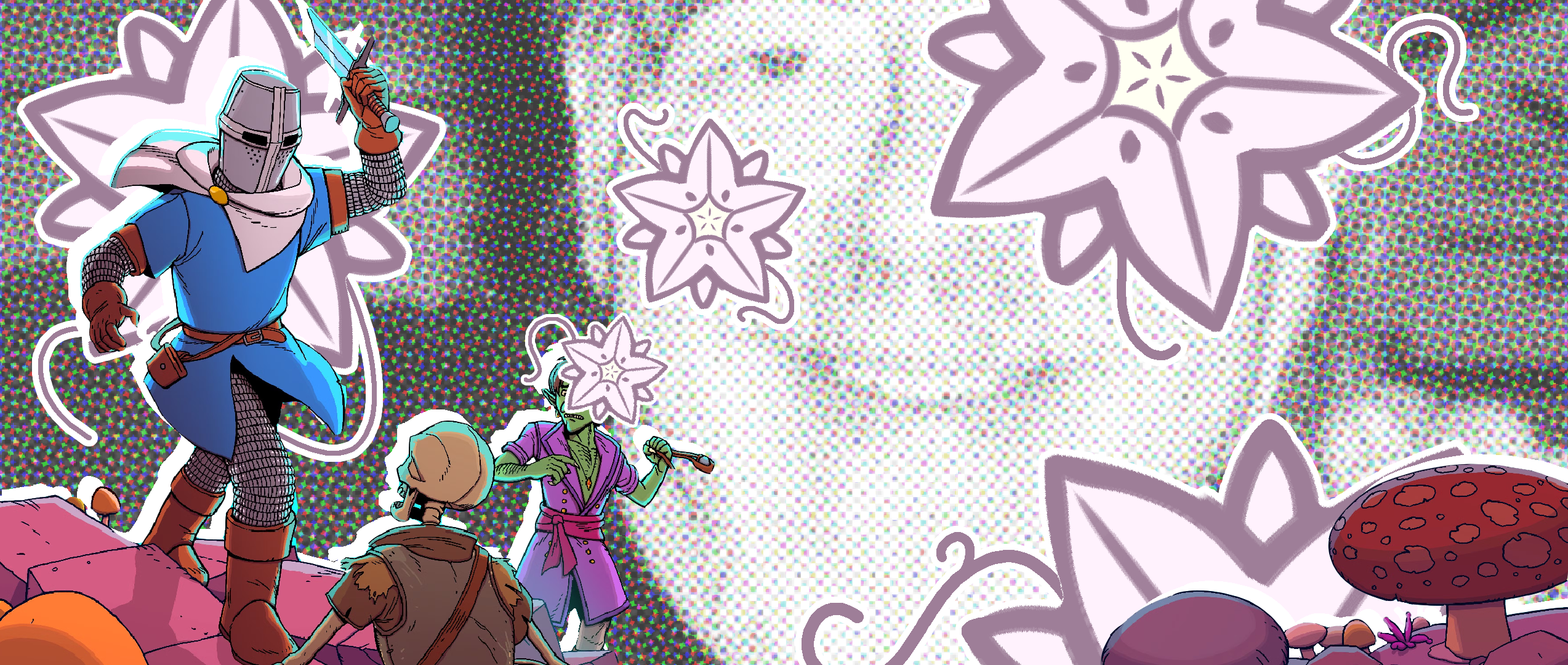
Esoteric Ebb (2026) by Christoffer Bodegård follows the formula of modern fantasy world building. It’s a world of scrappy upstart goblins, liberalism versus tyranny, and the comedy of contemporary topics paired with zany magic.
There’s also something buried underneath it all.
Esoteric Ebb presents an agreeable and progressive view of the world: Feminism is good! Genocide is bad! But for all its words, it has no bite.
One of the thematic banners Esoteric Ebb flies most proudly is gender. The main character must come to grips with what it means to be a man in a man’s world. After an early game dispute between some nationalist young men and the youth of the game’s socialist party (the “Azgalists”) you have a chance to mull over feminism versus ethnocentric men’s rights activism. Mechanically this comes down to choosing between Strength (your toughness and masculinity skill) and Wisdom (your smart and kind skill that’s also feminist), a dichotomy that immediately put a sour taste in my mouth.
I went with my Wisdom stat, which allowed me a diceroll to figure out gender. As your Wisdom stat explains to you why feminism is good, the voice in your mind tells you women and men are the same… except they aren’t.
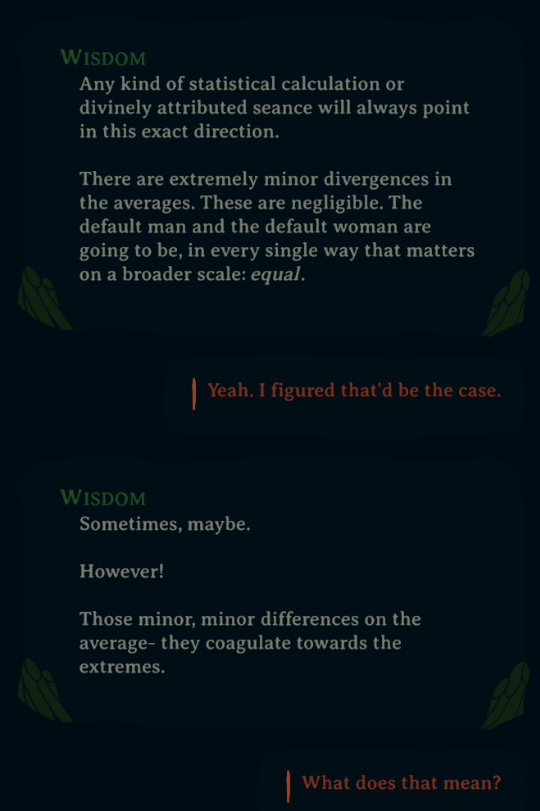
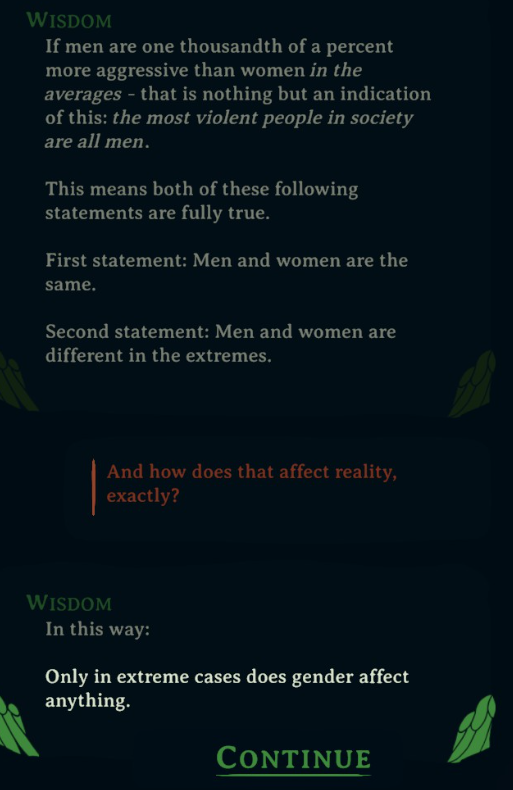
The thesis of this feminist pondering is that statistics will reinforce what a cruel, patriarchal society already thinks. For my character, this was the climax of feminism. Nothing ever challenged this conclusion he came to, not even the dialogue written specifically for hitting on every woman you see.
It’s no surprise why nothing changes: this thesis stinks. It admires women but doesn’t take them seriously. It comes to the brink of basic feminist thinking then falls back on just enough bioessentialism to keep things safe and comfortable. It has nothing challenging to say, and frankly, if the dumbass main character doesn’t really have anything to say I think that is fine, however the game around him feels thoroughly in this camp.
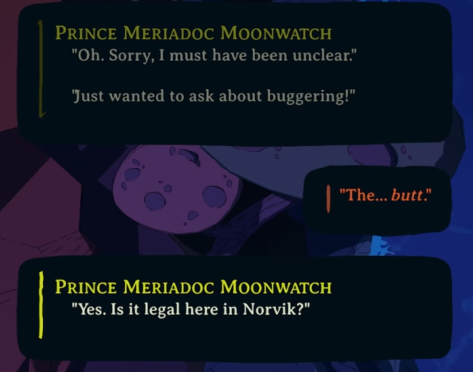
It leads multiple conversations involving women into awkward innuendo for cheap laughs, focuses heavily on keeping white men important and logical, and even makes a pretty homophobic joke about sodomy at one point.
This is a recurring theme: Esoteric Ebb goes to great lengths to make the status quo seem like a heartwarming triumph. In the game’s final hour, its ability to take the world at face value and repackage it is equally impressive and horrific.
In Esoteric Ebb you’re in pursuit of a murderer who is planning to kill twenty-seven innocent civilians to resurrect his god who pursued human superiority through mass genocide. When you, a human cleric, meet said genocidal god, he’s quite nice and level-headed.
He feels so bad about creating a system that encourages bigotry and violence. He is the face of warmth, the god of your character’s religion. And honestly? Despite the tonal-dissonance, this material is interesting. This is a great launch point for conflict and intense emotion. It’s overly charitable to fascism, but it could go somewhere.
Unfortunately where it goes is the credits.
It made sense for Urth, the human god, to show up as part of the pretty big infodump at the end of the game. I thought it was strange though, how polite it all was. But it makes perfect sense when you realize all he represents: another guy that killed a lot of goblins.
He gets to be reasonable because fantasy dictates there are dark races that must be slain, and that’s something our fantasy-loving culture views as problematic… but reasonable.
“I told myself every Goblin on those red hills needed to die for the safety of man… that without clearing these lands entirely of these hostile natives, there would be nothing but… perpetual war.” (He eventually changes his mind after making a goblin friend.)
That’s it. Wrap it up and put a bow on it.
It was only once I sat there, bow-wrapped story in hand, that I started to really ask questions, hoping maybe I could find a deeper meaning.
It drove me mad.
When I speak to the genocidal god of fascism in the final confrontation of this game, I’m seeing a man who represents tangible crime and injustice done in the real world. But who is really standing here? Is he Adolf Hitler? A literal embodiment of the genocide textually done by his character, eroded into the visage of a kind old man by time and the endurance of white hegemony? Or is he Gary Gygax? An avatar for D&D itself, reputation laundered through comfort and placidity?
Why is he standing here, polite and fatherly at the end, ready to relieve us of our inner discomfort towards the gross, white fascism of fantasy? And why the hell is everyone so damn polite?
The first ever election is happening in the city of Norvik. Nationalists, liberals, and proletariat are butting heads. With everything at risk, you’d expect mass civil unrest, volatile smear campaigns, or even violent clashes out in the open. But outside of the culprit’s awry machinations, the biggest open conflict is teenagers stealing leftist newspapers.
Your party member for the vast majority of the game is Snell, and he’s a goblin. He’s also a well written character in a game where most characters are two halves of a bad character. He gets pretty quickly fed up with your character, but he’s not emotionally shut off the whole game. When it’s time for him to confront the god that slaughtered his people, he has a few choice words. He shouts, he swears… and that’s about it.
For most of the conversation he’s just sort of waiting for his chance to speak, and when he’s done raising his voice he fits back nicely into decorum, even entertaining Urth’s offer to answer his questions. Snell is quickly disarmed by this old man, and despite his outburst, the conversation is civil. Urth gets the last word on this one.
The god Urth, who in death has had lots of time to reflect, gets to talk a bit about Nationalism and Fascism.
“One is a fairly new idea of a united nation-state, whether by culture or folktype or anything else. …Fascism is…It does feel rather abstract doesn’t it? …I never particularly identified with it. They seemed to hate liberal ideas, while I was always quite fond of egalitarian pursuits.”
This sounds like it’s leading into an exploration of the relationship between liberal nationalism and fascism, but there’s no follow-up argument. We just get to see how recent political developments are affecting him. Your inner monologue at times points out the hypocrisy, but the lens of sympathy is rather thoroughly on Urth. This is a game where foreigners and women are wrung out for jokes at every turn, but the god of your hegemony has the final say, even when you know better.
There is some wisdom in Esoteric Ebb, but the game is so focused on finding the logic of cruelty, the lessons received by white guilt, that it fails everywhere else, all in service of feeling less guilty in the end. Urth’s genocide was incomplete because he in his greatness simply chose not to finish it, which is pretty insulting to the reality of genocide. In real life, genocide fails to reach totality for reasons aside from the generosity of the perpetrator. But the reality of this need not be confronted when we’re talking about goblins and orcs.
Esoteric Ebb’s greatest shortcoming is that it presents a lot of very flammable topics and chances for riveting introspection, but ends up pushing you to feel nothing. It’s not a source of introspection. Despite all the time it spends in your character’s head, it seems overly willing to take the conclusion out of your hands. The stats aren’t just informants of your character, they are a Greek choir. They say things like “woah, cool!”, “that’s not nice!”, and “gender is hard!” as if they are here to make sure I don’t come away with a complex opinion.
What is the purpose of a fantasy game where you meet the kindly face of genocide? Is this supposed to absolve my character of guilt for being a human male? Am I supposed to feel good about having a cordial conversation and then voting about it? Is it a big payoff when the genocidal god sides with whatever party I already plan to vote for, going so far as to encourage me to fix nationalism from within? Am I supposed to feel bad? Am I supposed to feel anything?
Or could it be that this is just another fantasy game with a modern sense of humor wrapped up by a feel good message? Where the only brown people are bugbears and orcs. Where I can go to imagine how much good is done by loving Dungeons & Dragons (but not those bad parts). A fantasy story where genre convention can be wiped clean without being challenged. Where evil is always tucked away out of sight, slowly looking older and kinder.
Ava is a writer and illustrator that draws colorful robots and writes gross, visceral literature.

Imitating disco elysium’s format is a good idea but a game better have some amazing writing and a much sharper message than this to reach the high bar it set. This is actually making me look back and more deeply appreciate how singularly good the writing in DE was.