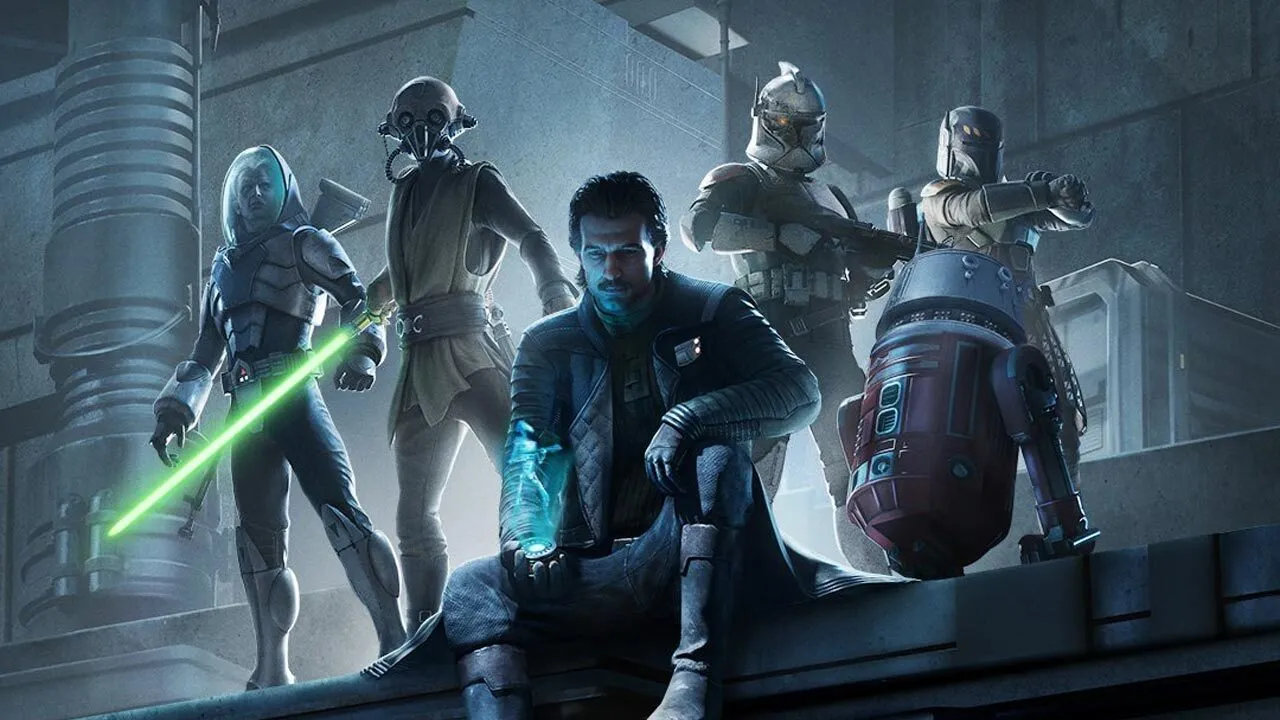
For as long as I have been playing Star Wars games, I have wanted the same impossible thing everyone else wants: the game where you can do all of it. Fly the ship. Land the ship. Walk into the cantina. Take a bounty. Join a squad. Buy a terrible jacket. Get into a speeder. Become a Jedi if things have gone particularly wrong. Somewhere in the back of the brain sits a tiny executive producer asking why this one game cannot simply contain the entire galaxy.
It is an appealing dream. It is also, increasingly, one I distrust.
Lilith’s recent Gamesline feature Ouroboros: The Game and Everything, Forever gives this hunger a wonderfully dangerous name: the “Omnigame”, the fantasy of a game capacious enough to become everything. Star Wars is almost uniquely vulnerable to that fantasy because the setting already looks like it contains every game genre at once. Dogfights, sword fights, westerns, espionage, political drama, racing, tactics, horror, smuggling, archaeology, gambling, droid repair, questionable food. The galaxy is a design document written by someone who refused to delete any ideas.
But when I look back at the Star Wars games I remember most clearly, the pattern is almost the reverse. They are rarely memorable because they let me do everything. They are memorable because they knew what I was doing there. Scope and ambition are not the same thing. Sometimes the most ambitious choice a Star Wars game can make is deciding what it will not let you be.
A cockpit can be a whole galaxy
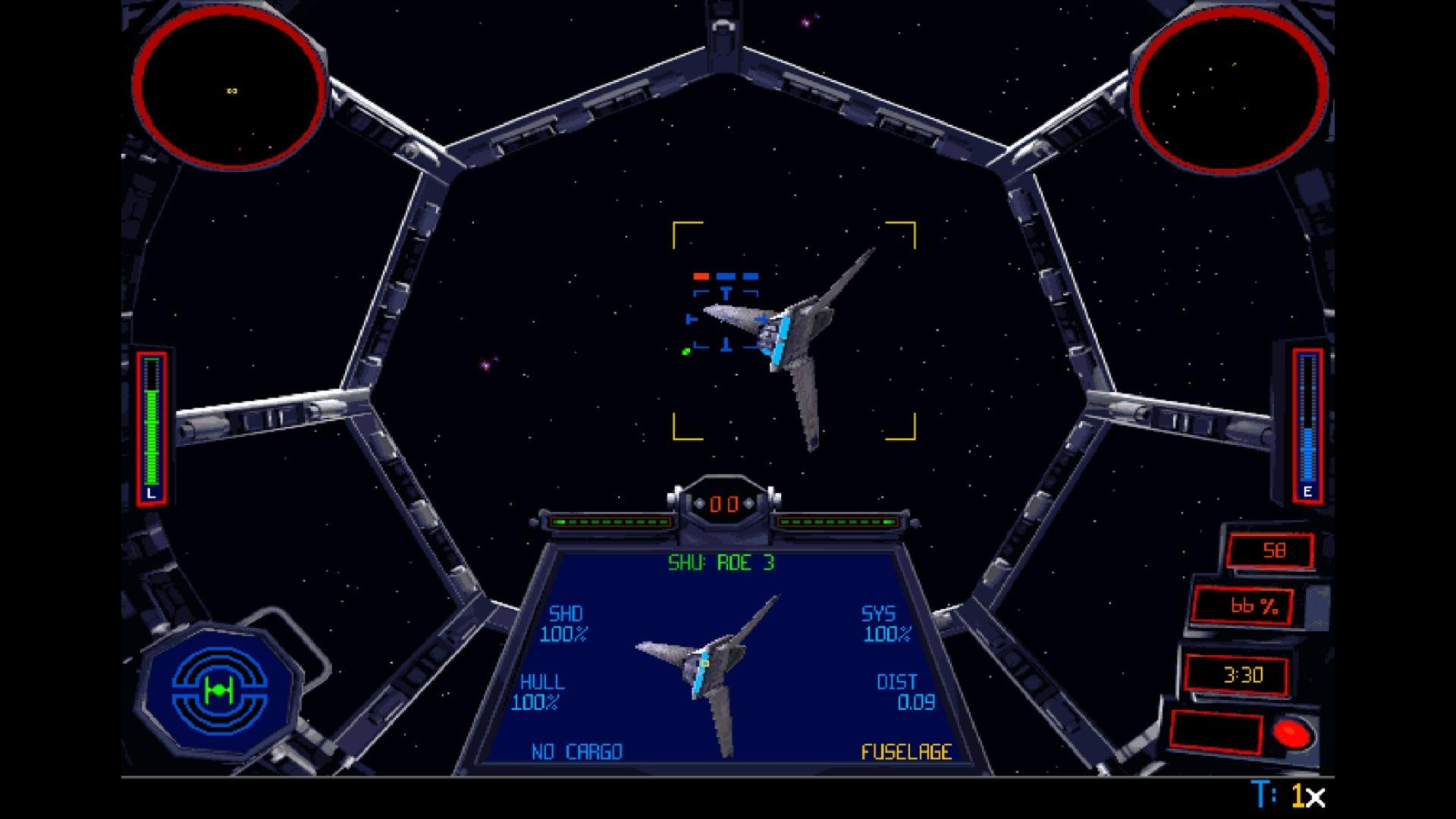
Star Wars: X-Wing did not need to let you stroll around a Rebel base, flirt with a smuggler, customize an apartment or abandon the war to become the Outer Rim’s least qualified moisture farmer. It put you in a cockpit and took that cockpit seriously. The briefings mattered. Shield and laser energy mattered. Mission objectives mattered. Being a Rebel pilot was not a costume you wore between more important activities; it was the game.
That specificity made the universe around the cockpit feel larger, not smaller. You knew there were commanders, technicians, transports, convoys and battles continuing beyond your view because your job depended on them. The game did not have to model the entire Alliance to make you feel employed by it. There is a peculiar magic in being given a task and realizing that the galaxy will continue whether you become a hero or accidentally fly into something expensive.
Dark Forces found a similar strength from the opposite direction. Kyle Katarn begins as a mercenary doing intelligence work for the Rebellion, before later games pull him deeper into Jedi mythology. In the first game, Star Wars is Imperial facilities, stolen plans, weapons research, elevators, locked doors and corridors that occasionally seem to have been designed by an architect who hated navigation. That is enough. It is a very specific slice of the setting, and because LucasArts commits to it, the Empire starts to feel like an institution rather than a collection of movie props.
Michael’s old Gamesline piece on four favorite Star Wars games gets at something important when it remembers Dark Forces as a game about feeling weaker on the battlefield, armed with ordinary weapons rather than destiny. His Battlefront section makes the same point even more directly: sometimes the interesting perspective is the grunt. You do not need to be the most important person in Star Wars to feel like you belong there.
The galaxy feels bigger when you have a job
Star Wars: Republic Commando understood this almost aggressively well. It did not ask whether the player might also want a lightsaber skill tree, a swoop-racing league and a property portfolio on Naboo. You were Boss. You had Delta Squad. Doors needed breaching. Positions needed covering. Sev was probably saying something that would concern Human Resources if the Republic had remembered to invent it.
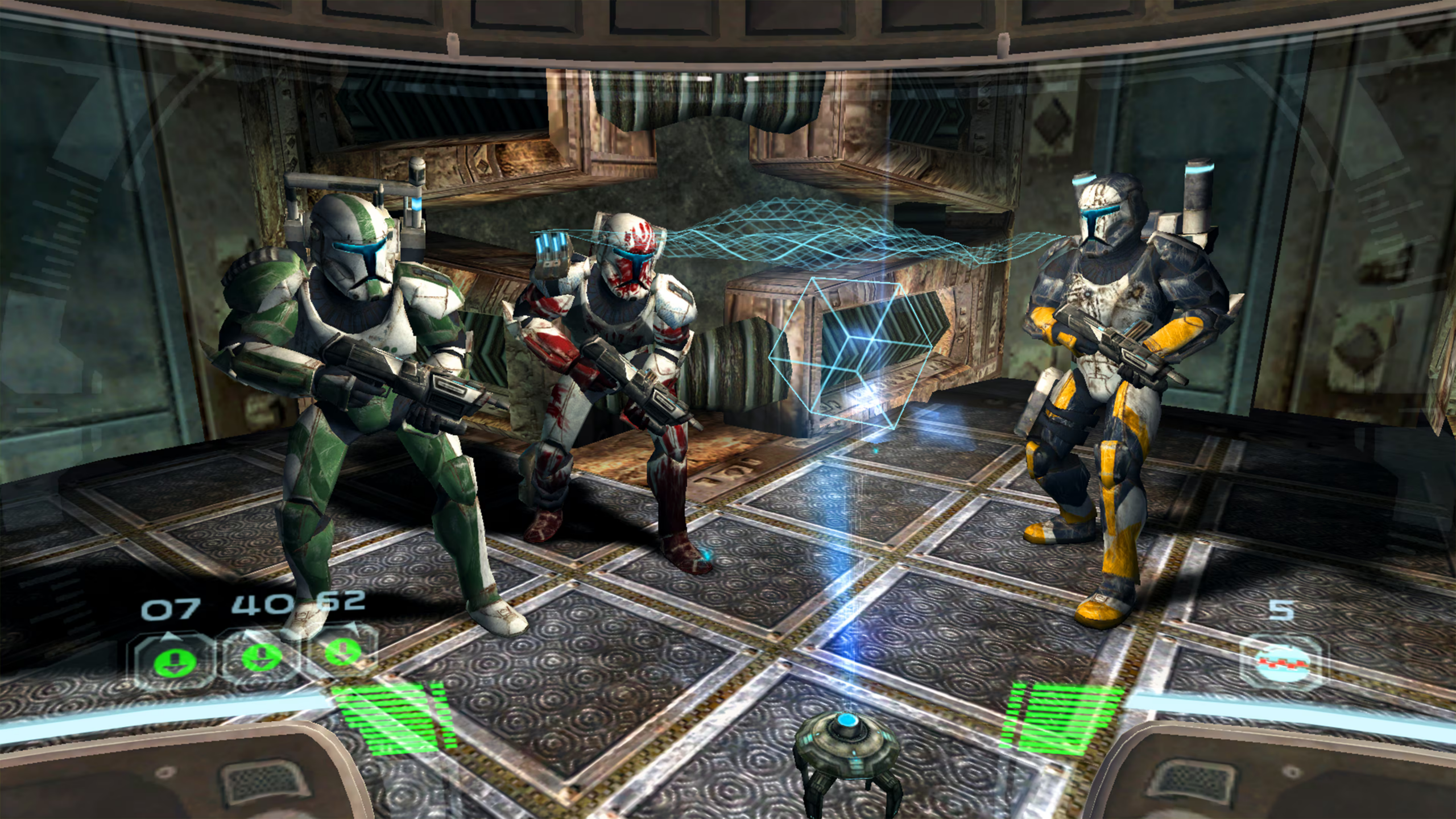
The squad commands are not a side system. They are the fantasy. Ordering Fixer onto a console, Scorch onto explosives or a commando into a sniper position turns the Clone Wars into procedure. The war becomes more believable precisely because the game reduces it to rooms, objectives and four soldiers who depend on one another. The galaxy outside those rooms feels enormous because the player is not allowed to own it.
Bounty Hunter is rougher, and I am not going to perform the retro-review trick where age magically transforms awkward controls into secret genius. But it understands its job description. Jango Fett has contracts, weapons, a jetpack and a professional relationship with danger that borders on administrative. The pleasure comes from inhabiting a particular kind of Star Wars life. You are not auditioning to become the franchise. You are a bounty hunter. The title was not being coy.
This is why “small” is the wrong word for these games. Their maps may be smaller. Their verbs may be fewer. Their promises are narrower. But the world around the player can feel much larger because it is allowed to remain outside the frame. A good job implies an economy, an institution and other people doing other jobs. A game that lets you do absolutely everything sometimes implies the opposite: that the galaxy has been waiting patiently for you to arrive and operate all of its machinery personally.
Outlaws is huge, but it still knows who you are
Star Wars Outlaws looks like the obvious counterargument. It is an open-world Star Wars game. It has multiple planets, vehicles, faction relationships, stealth, shooting, exploration, upgrades and enough icons to make a map designer wake up sweating. If my argument were simply “small map good, big map bad,” Outlaws would be standing outside with a blaster and a very reasonable grievance.
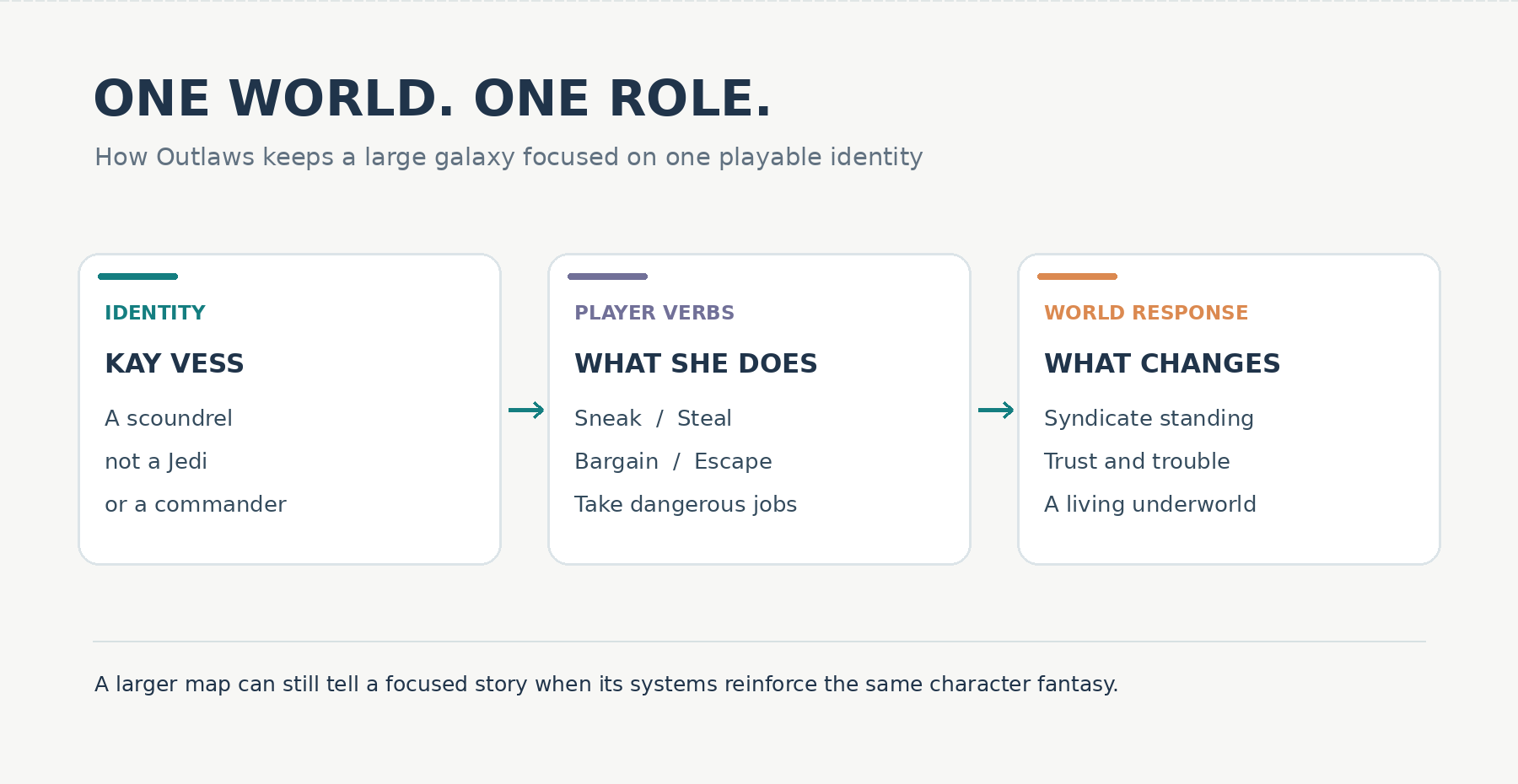
What saves it from becoming a Star Wars sampler platter is Kay Vess. The world may be broad, but the fantasy stays narrow. Kay is a scoundrel. She sneaks, steals, hustles, bargains, takes jobs, worries about syndicates and escapes problems on a speeder. Even activities that could feel disconnected usually orbit that identity. The game is not asking what every Star Wars fan has ever wanted to do. It is asking what Kay would plausibly do next, which is usually something illegal followed by something urgent.
Iris put this better than any feature checklist could in her 2025 favorites when she wrote about simply enjoying the feeling of existing in Star Wars. Her memory of wandering Akiva in the rain is not really about content volume. It is about inhabiting a place long enough for it to stop behaving like a theme-park attraction and start feeling like somewhere a person might live.
That distinction matters. A large game can be focused. A small game can be unfocused. Scope is not a measurement in square kilometers; it is a question of how many different fantasies the design asks the player to believe at once.
When “broader” sounded like the future
Gamesline has an unusually neat fossil of the opposite philosophy in its archive. In 2017, when EA closed Visceral Games, Michael covered the announcement and the fate of Amy Hennig’s still-unreleased Star Wars project. EA described the project as a story-based linear adventure, then said it wanted to pivot toward a broader experience with more variety, agency, depth and breadth.
I do not think one corporate statement from 2017 proves that linear games are morally pure and open worlds are secretly organized crime. Development is messier than that, and we still do not know every problem that existed inside Visceral’s project. But the wording captures an idea that became extremely powerful across big-budget game development: broader sounded like progress. More systems, more choice, more hours, more reasons to return. Width itself became a feature.
The strange thing is that Star Wars had already spent decades demonstrating the opposite lesson. X-Wing became special by locking the player in a cockpit. Republic Commando became special by caring about four clones. Dark Forces became special by turning Imperial infrastructure into an FPS playground. None of these games suffered because they failed to also contain a farming sim.
A game can absolutely be broad when breadth is the point. Knights of the Old Republic needs planets, companions and choices because role-playing is about building an identity across them. Battlefront needs battlefields and armies because scale is the fantasy. But “more” only helps when it sharpens the promise. Otherwise the galaxy becomes a buffet, and Star Wars has enough strange cantina food without turning game design into one.
2026 is rediscovering the trick
This is why the two Star Wars games that interest me most in 2026 are almost comically different from one another.
Star Wars Zero Company, released in August, is a single-player turn-based tactics game set late in the Clone Wars. It gives you Tesh Keff Hawks and a company of odd professionals to learn the language of war through tactics game mechanics like positioning, team composition, and mission prep. There are Jedi in this universe, obviously. Star Wars keeps those around the way an office keeps a printer: everyone assumes one will appear eventually. But the tactical fantasy does not depend on becoming one. It depends on deciding who moves, who covers, who risks the shot and who you cannot afford to lose.
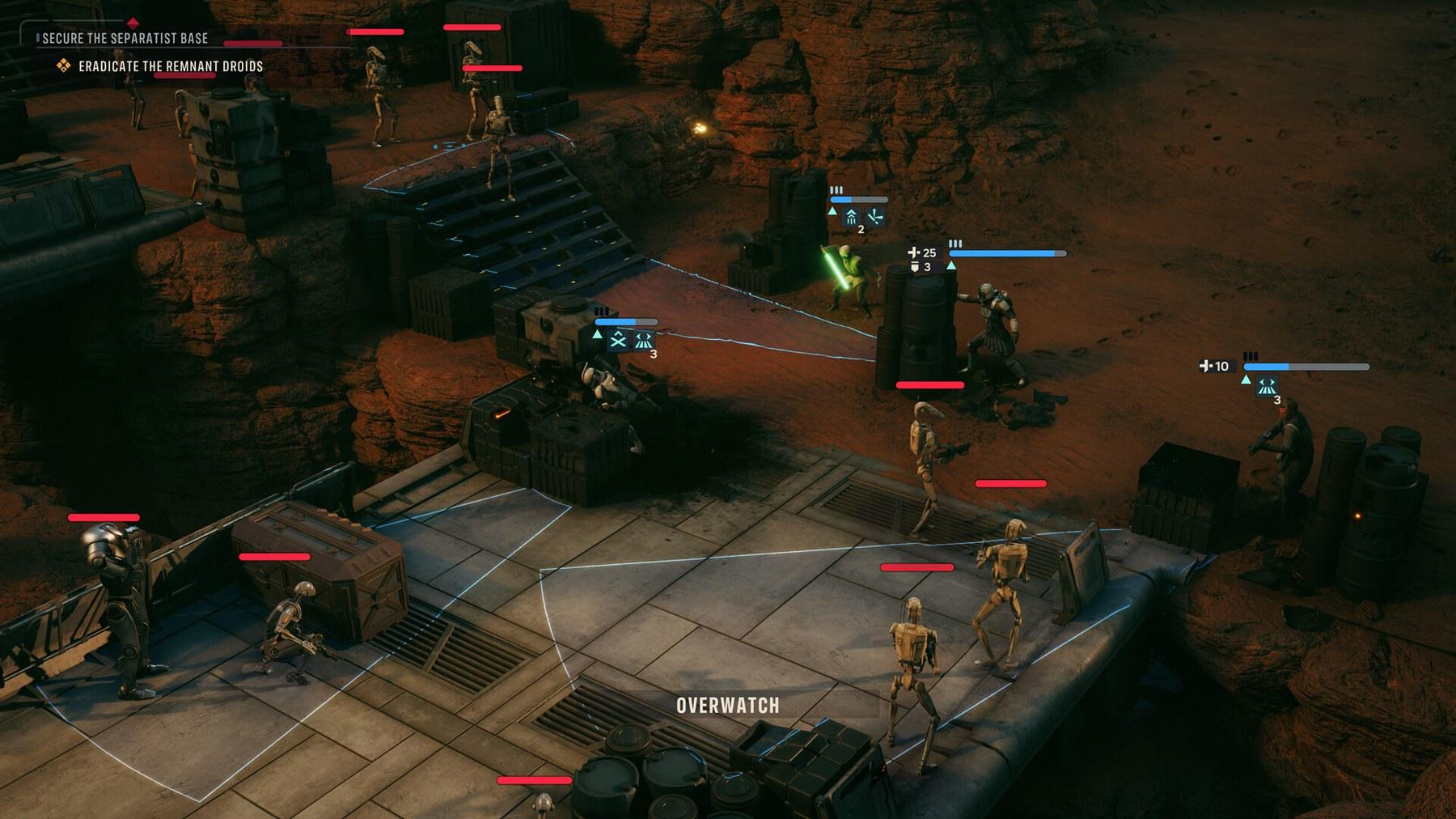
That focus is what makes its wider campaign systems work. Character relationships in the form of Bonds matter because they change how people fight together. Injuries matter because they change who you are willing to send. The base matters because it prepares the next operation. If you want to see just how many different roles Star Wars games have tried over the years, the complete Star Wars games archive is a useful reminder that the license has rarely needed one definitive form. It has needed lots of specific ones.
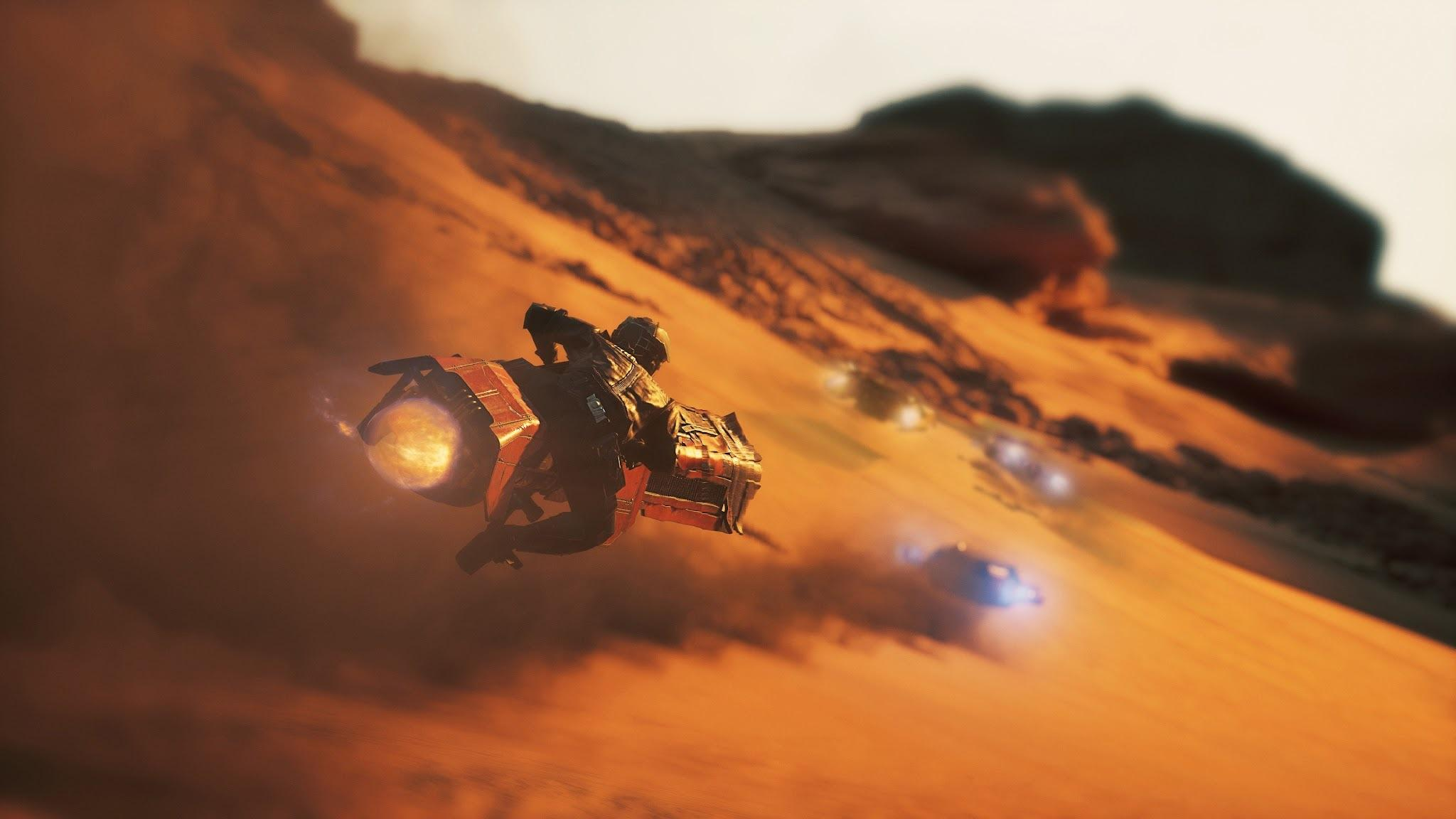
Then there is Galactic Racer, released on October 6, which throws the tactical grid in the nearest bin and asks what Star Wars looks like when racing is not a diversion between story missions but the entire point. Fuse Games has built a competitive, runs-based repulsorcraft league around vehicle handling, rivalries, upgrades and decisions made between events. Its wonderfully direct promise — “No Force. No prophecy. Just skill, strategy, and the will to rise” — is not a rejection of Star Wars. It is a bet that one particular corner of the galaxy can support an entire game. Even the paddock and the mechanic Hibi reinforce the idea that racing is a profession, not a minigame the Jedi stumble into between adventures.
With the game now released, that argument is no longer simply about what Fuse Games hopes to achieve. Galactic Racer commits to a distinct racing culture, with different vehicle types, workshops and a campaign built around competing, rebuilding and trying again. That does not mean every design decision must be perfect for the larger point to hold. The game does not need to squeeze in a lightsaber sequence because someone in a meeting worries that players might forget which universe they are in. Give the racing enough character, friction and consequence, and the galaxy beyond the track begins to feel larger than any checklist of franchise features could make it.
We do not need The Star Wars Game
I understand the fantasy of the definitive Star Wars game. I still want it sometimes. Give me the ship, the blaster, the cantina, the apartment, the racing league, the tactical squad, the smuggling route and a completely unnecessary fishing minigame on Mon Cala. Let me live there forever. Then let me complain that the fishing economy is unbalanced.
But I no longer think that game would automatically be the best use of Star Wars. The galaxy has lasted this long because it suggests more lives than any one story can contain. Games are uniquely good at taking one of those lives and making us perform it. Pilot. Commando. Mercenary. Bounty hunter. Scoundrel. Tactical commander. Racer.
The strongest Star Wars games do not need to prove the galaxy is large by giving us all of it. They prove it by giving us a corner with enough rules, texture and consequence that we can imagine everything continuing beyond the edge of the map.
Maybe that is the real lesson buried in all those decades of licensed games: Star Wars gets bigger when the game stops trying to contain it.
Søren Kamper is the editor of Star Wars: Gaming, an independent publication covering the history, design and development of Star Wars video games.