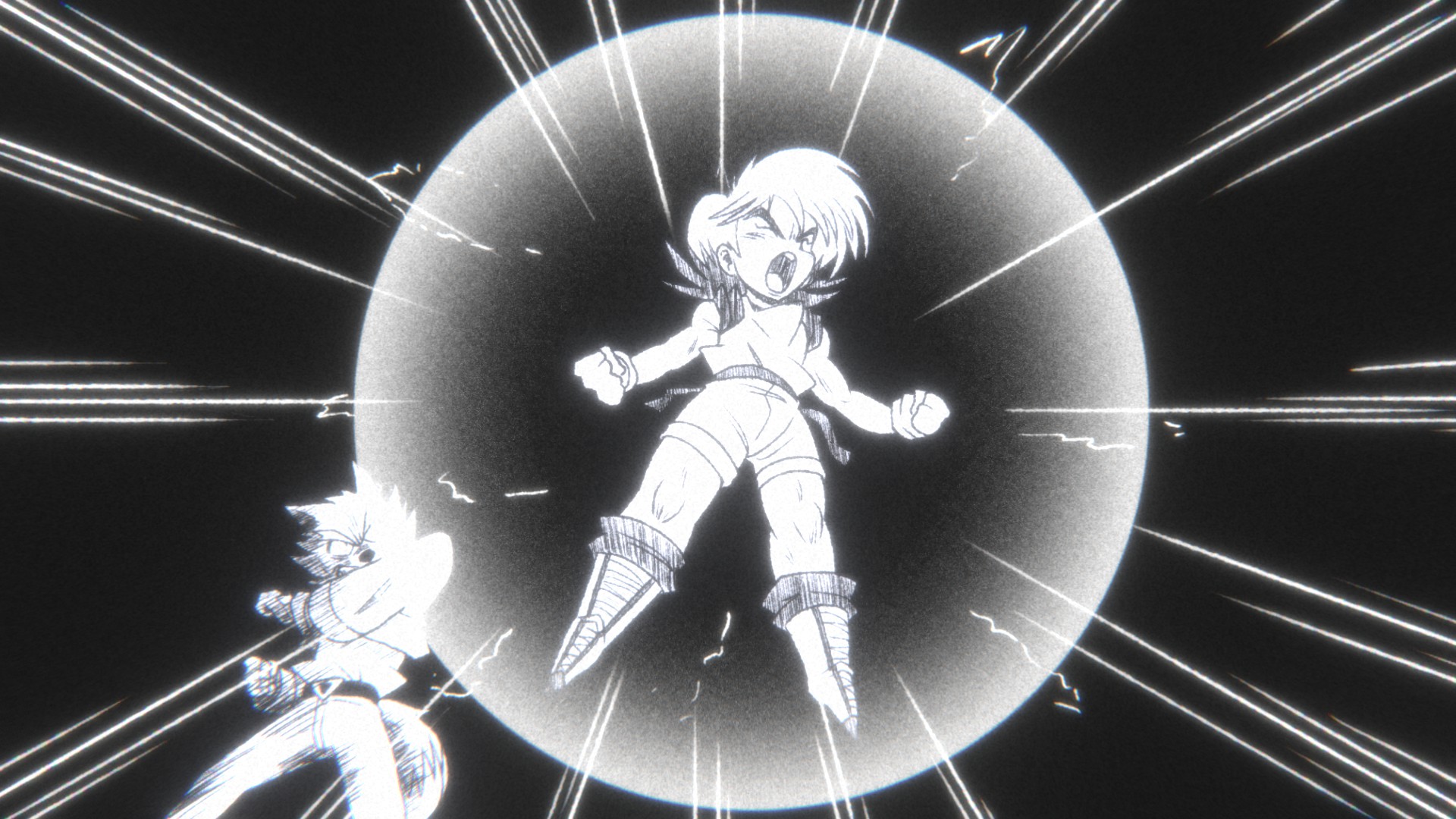
By the time you get to the final boss of Wander Stars, the Power of Friendship has grown from a narrative theme and a deckbuilding tool to the ultimate killing blow against an absentee father, standing in a field of red spider lilies with a long-lost brother hovering above him crucified in starlight, after making a wish on torn pieces of a map that bound everyone there together over time and space. This promptly follows a mech battle, a heart-to-heart between estranged siblings, and a brief amnesiac high school pocket dimension adventure molded by the big bad to sidetrack our heroes from their mission of confronting him, obviously.
You play as Ringo, a plucky young fighter on the hunt for her brother with the (begrudging) help of Wolfe, a beastman with a couple secrets of his own. Along the way you team up with other characters including a determined little witch named Canela and a moody gluten-intolerant space pirate named Ax, who happens to have history with Wolfe. There’s a map of particular legend, that even when torn apart each piece will point to another in proximity, but its ultimate purpose is a mystery.

Wander Stars is the second game to come out of Paper Castle Games, and it’s easy to see that this was a passion project. Visually, it’s eye-catching, perhaps influenced by artists like Rumiko Takahashi (of Ranma ½) and the big, explosive aura of Dragon Ball. The post-combat stat screen UI and graphics are very Persona with both a dynamic visual design of big blocky elements and jazzy music, especially when contrasted with the more traditional shonen anime style of the rest of the soundtrack. Everything has that CRT fuzz. Scenes go from vivid and polished to sketchy black-and-white for moments of intensity and drama, effectively so. I really try not to compare proper nouns to other proper nouns, but when the whole thing is sincerely and aggressively anime-inspired (and marketed as such), I’ll give myself a little break. None of this is a weakness, it’s actually what I like most about Wander Stars. Though this laser-focused aesthetic doesn’t carry the whole game into excellence, it’s clearly a love letter to art of an earlier time.

Wander Stars is a few things in modest doses: deckbuilding, roguelite, dungeon crawler. Ringo is a student of kiai, the martial art of focusing energy and releasing it with an explosive shout, used here quite literally. The combat is turn-based and attacks are composed of words made up of actions (kick, punch, etc.) and modifiers that can increase damage, quicken cooldowns, apply elemental bonuses, widen the area of effect, and compound into some ambitious combos, like Fast Special Wide Poison Strong Punch or Cool Dragon Sharp Super Claw. Each word has a cooldown, whether it’s only one turn or eight, so there is some timing and resource management to consider. Over time your inventory of words grows with both experience and teaming up with characters across the story, and every episode opens by choosing which words you want to proceed with. Though there’s over 200 words to collect and use, on a balanced difficulty you can easily get away with a dedicated set of favorites, with a few specific exceptions where your progress might be impeded only a little bit by choosing nonoptimal words.
Each turn lasts as long as you’ve got available slots, which allows some breathing room for using items, restoring cooldowns, and putting your guard up. Some battles are especially quick work because of this. There were definitely a couple of bosses where I got into a flow state of attacking with modifiers that reduce cooldowns and return health upon striking a weakness, and enough slots to hit a weakness every time, so every move was a crit and gave me a few bonus slots, which I then used to guard, and those reduced cooldowns meant I could do that successively, ending fights quickly with full health and no sweat.

Every non-boss fight ends in either a Peace Out or a KO. Both are acceptable, but each enemy has a breaking point at which they will give up, usually a window of 3-5 health points, and you can accept their surrender or knock them out. It’s usually more to your advantage to allow them the graceful loss, but it can also be challenging to gauge how hard to hit to get to that sweet spot. Showing mercy and peacing out will earn you the respect of your opponent, and they’ll offer you a Pep-Up, which is just another modifier for things inside and outside of combat, like restoring health through traveling on the map, exposing enemy weaknesses at the start of a battle, temporarily increasing the amount of words you can carry through an episode, things like that.
As exhaustive as that whole description felt, all of these elements come together to make a combat system that has the potential to be super customizable, though the wide variety of enemy type coupled with an inconsistent difficulty scaling, rigid weakness system, and hard-to-read mechanics often encouraged me to play more defensively than creatively.

Each level is styled like an anime episode, with multiple stages laid out like overworld maps. These maps are traveled via nodes, and some nodes have a purpose for items, enemies, mystery encounters, and conversations. The item and enemy nodes are self-explanatory, but the mystery encounters can be anything from learning new words, to getting stuck in quicksand and taking damage, to just having an odd little moment with another character for flavor. Exploration down different branches of each level is typically rewarded, either with extra items or honor points to use at the end of the episode, but you do run the typical risk of frontloading your combat and being weakened for the eventual boss fight. Later episodes remedy the uptick in difficulty by providing little cafes at which to rest and recover, but some stages are rather grueling in terms of enemy repetition.
Repetition is Wander Stars’ main flaw. As I said earlier, the combat and the enemy design can clash in ways that make clearing an episode feel like a chore the further you get. The weakness system, while it at least remains consistent along the same enemies, will occasionally pull tricks on you such as differentiating between moves of a similar type, so an enemy might be immune to one move, but not the stronger version of it, or vice versa, and if an enemy is immune to any mod, the entire move goes out the window. It’s easy to waste time and cooldowns on mooks that end up being way harder than some of their end-stage bosses. The same frustration that drove me to play defensively coexisted with a lack of unique challenge that gave me little reason to play creatively.
Beyond that, the UI would kind of implode in on itself occasionally, most notably during the second phase of the final boss, when an explosive move turned into a damage loop with no end until I hard closed the game and had to do that battle over again. In fact, more frequent checkpoints would have been nice, as instead of going back straight to the boss, I had to play the entire final map over again. There were also several instances of elements of the UI not responding to anything, having to click things multiple times to engage anything, and moments where Ringo would clash with moving enemies on a node and instead of initiating battle, they would jiggle around helplessly until I reloaded the game.
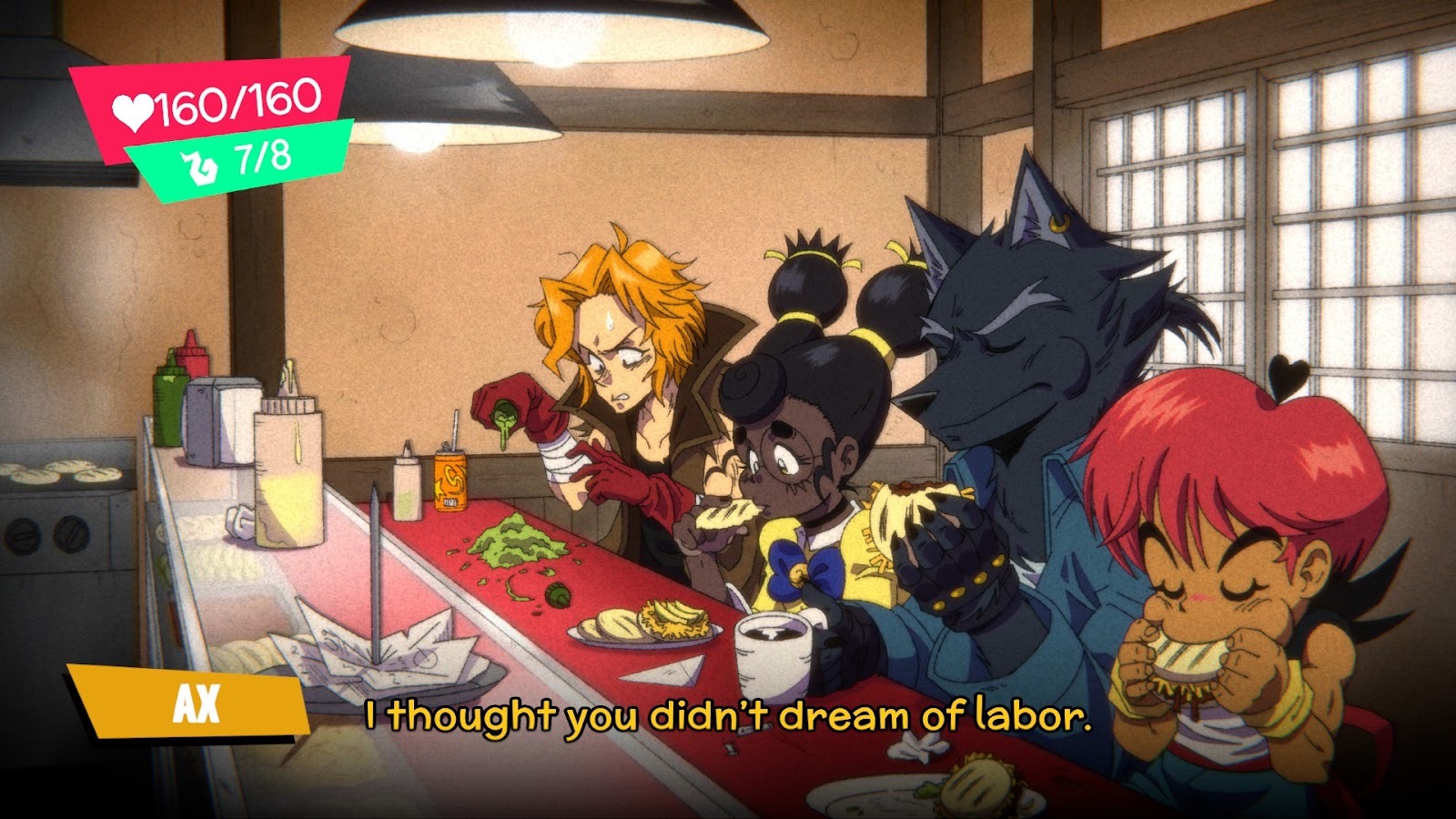
The story is a high point, with competent writing (if a bit tropey at times), cute dialogue, and characters whose adventures I care about. It’s a traditional type of narrative that complements all of the other stylistic elements – hyper and intriguing, a strong focus on the strength and trust that builds between friends and loved ones, and the power of believing in oneself. And kicking and punching, and big explosions, and the slow burn from humble journey to cosmic battles.
First of all, my problem is decidedly not with the queer wolf and his spurned ex-turned-pirate, it’s the fact that their inevitable reunion and rekindling felt like it happened half off-screen. One deep conversation cut short and several inside jokes later, and they’re basically good. It would have been nice to see more of the parts of their dynamic that draw them back together rather than the parts that continue to hurt. The emotional constipation is palpable. Though, it was also nice that a story of reconciliation between those two ran parallel to a budding affection between Canela and Ringo.

The ending also leaves a little to be desired. After a few twists and turns, the group catches up with Ringo’s brother, Nashi, and the actual, for-real-this-time big bad – their father. This is – generously – hinted at and then swept away with his demise. It would have been interesting to elaborate on some kind of motivation other than he cares little for his kids and loves the pocket dimension (the dreamscape, where dreams are born) in which he has tormented his own son to the point of the two of them being locked in endless animosity. Ringo lives with their grandmother, what would she have to say about it? Upon being introduced to the idea that they could all just Stop This and Go Home, their father says something along the lines of “why would I want to do that? It rules here.” and becomes so powerful the only way to defeat him is to Shooting Star Spirit Dream Beam his ass. It’s a very funny development in the game about love and friendship and mercy, and if absolutely nothing else it’s at least breaking the cycle of tropes. I would have liked to know why he turned out to be such a miserable jerk, but hey, some people are just Like That. And after all of that, Nashi is accidentally left behind during the dramatic exit, having barely said anything this whole time.

All of this is to say that the story was enjoyable, if lacking some elaboration. If anything, it sets up Wander Stars for a sequel, a second season if you will, pretty obviously. The writing, the jokes, and character work, all solid. The many, many winks to 90s anime, also solid. Given the chance to continue their stories somewhere down the line, I would hope for some tweaks to the combat, but otherwise would put up with that mild struggle to see it through to the end.
Friendship and Kicking and Punching
Wander Stars is an episodic adventure that blends deckbuilding turn-based combat and touches of roguelite dungeon crawling, with charming characters and evocative visuals. It’s fun and fresh, though ultimately it falls shy of being a uniquely fantastic experience.
