Let’s take a second to talk about your dead body. What do you want to happen to it when we inherit it from you? Shall we keep it simple and bury it? Or maybe something special? Maybe you have plans in mind, something to make the journey ahead spiritually fulfilling or purposeful.
But that’s just what you want, what about your inheritors? Will they see you through their grief? Will they see your wishes through their need for you?
When you’re just a body made of meat, bones, and fat, how big could that need become?
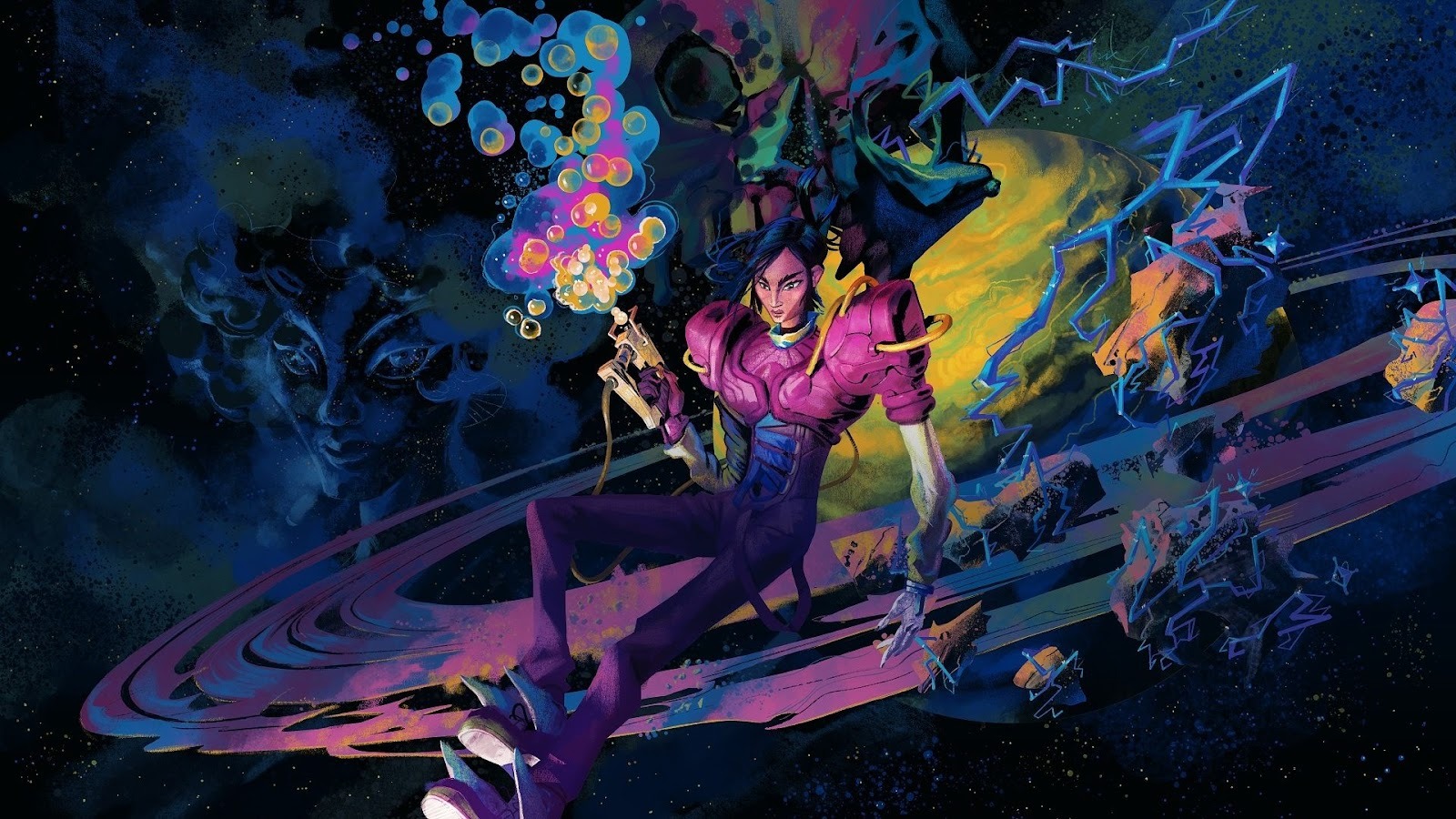
This year I played through Ambrosia Sky Act One. It’s a visually striking immersive sim with obsessive cleaning elements, an upgrade tree, and all too familiar grief. Death is mounting: the Cluster (a space colony orbiting Saturn) is still in the wake of catastrophe. By the time you get there, it’s already too late to stop it.
What Ambrosia Sky is in dialogue with is not the catastrophic event, but rather the aftermath. As you read the text logs of strangers, friends, and family, now either dead or missing, you start to notice there’s a lot of disagreement about what’s happened. What should be done? As a member of the Scarabs (a sect of morticians armed with squirt guns) your presence is central to the question. After all, you’re here to collect dead people.

In Ambrosia Sky you are a researcher concerning death. You go into areas post-disaster and try to reclaim the dead in hopes of finding “The Panacea,” the mythical cure to everything. To do this you have to take the bodies of the dead and destroy them, breaking them down through a process called bioremediation. It’s not very graphic, it’s less harrowing than seeing a cremation, but it’s still a bittersweet service.
Your character does have a bit of history with the people here, but not everyone. As you uncover bodies and riffle through people’s electronic diary pages, you will begin to find the game is less interested in grief, and more interested in morbidity.
As the ravaged condition of the station becomes increasingly clear to the player, any hopes of salvation for these people are dashed. You aren’t here to help these people, rather, you’re a ghoul poking at their bodies. And it’s not always welcome.
Not long into Act One, you will encounter a character that specifically requests her remains not be utilized for what the game calls “the Ambrosia Project,” the ongoing attempt at achieving human immortality. You wouldn’t be blamed for thinking her selfish, conservative, or even just squeamish. “People are meant to die,” she says. You may respond with “how could she possibly opt out? Her body is destroyed and rotting, she may as well let us have it to help people.” It brings to mind people who put “no” when asked if they want to be an organ donor on their driver’s license. I was repulsed by her wishes, but I didn’t feel that way about them forever.
In Act One’s final mission, you go to a graveyard and the protagonist informs her remote observer that the Cluster’s leadership “wasn’t big on burying our dead.” Most of the dead aren’t in the graveyard, because their bodies have been repurposed, their organs given to someone else, their bodies used to make fertilizer. This is when I had a realization: to these people, a refusal to die must seem like a kind of greed. If your life is yours forever then so is your skin, your heart, your kidneys, the air you breathe, the bed you sleep in, everything that’s yours is held in perpetuity. Forsaking death would seem to also mean forsaking the people that come after. If we refuse to rot, are we scorning the soil that feeds on death? Who are the architects of the Ambrosia Project to stop time and say “this world, these people we have now, they’re enough.”
In Ambrosia Sky, we’re not the only ones who’re dying. Earth, the planet we call home, has reached its ecological end state. In response, humanity has scattered to the far planets and asteroids. The game takes place on an asteroid around Saturn, but as the main character already knows and the player is quick to discover, the asteroid isn’t just rock. It’s dead. It’s the meat of some large creature, caught in the gravity of Saturn like an interstellar whalefall. We don’t know a lot about this creature, but we know it’s dead, and we know the rot of its meat feeds the crops. Through this “Leviathan” we become aware of another theoretical organ transplant: our very planet. The world we had that was alive, the organ that failed, has been replaced by the dead meat of some creature that could not refuse our need for it.

Now this is where the matter of consent gets dicey. It’s a matter the game is very interested in, because the subjects for the Ambrosia Project must be willing. Regardless of the fact that one person’s DNA could be used to save infinite lives, consent for the process must be given. There’s no final request for the Leviathan, who was found dead and adrift. It suffers a fate akin to that of wood or oil, the need for it is so fundamental it transforms from animal to mineral. It ceases to be dead, it’s just something that isn’t alive. It’s just another pound of land, more wood for tables, another world that never asked to be destroyed.
At the start of Ambrosia Sky, the Cluster is just another space station with a fantastical infestation for you to fight. But as you learn more about the Leviathan, you start to actually see the creature. You see fissures of flesh in the floor, you see tendons and bone holding rock together, you even stare into its big, dead eyes. The Cluster has only ever known the Leviathan as a land to colonize, but it takes only a moment to start seeing the people of the Cluster as what they really are: scavengers. Decomposers breaking down detritus like worms under leaf litter. Of course this colony of refugee earthlings see no problem with death; they had no problem repurposing this corpse, this vast unknowable being that probably had its own will, perhaps its own intelligence. And god forbid you make these pests immortal so they can do… what? Ruin more planets? So they can wait out interstellar travel and find more bones to gnaw on?
This is, of course, a world where human consumption has already reached cataclysmic scale. Ambrosia Sky is entirely post the destruction of Earth at the hands of humanity, “a metaphorical benevolent mother that forsook humanity when we killed her.” But it begs the question: if we choose to respect a corpse because it is “our dead,” where do we draw the line of which dead belong to us? If the dead outside that border are just “dead matter”, who are we to protest when something else decides our dead are too?
One thing we can glean from Act One is that the downfall of the colony has a singular origin point. They were outcompeted by a better decomposer. The fungus that the colonists were growing along with their crops reached a point of sudden, explosive growth. The spores eventually choked them all, using their bodies to grow in turn.
The bodies we find in Ambrosia Sky are already broken down by the fungus. Without organs or much tissue, we take them in their entirety, breaking them down for their DNA. It’s a rather touching and visually striking sequence that utilizes the environment and two-dimensional art to tell you the story of how the body is found and how it’s treated.

Rather than organ donation, what the dead bodies in Ambrosia Sky give to you is more akin to whole body donation. When you donate your body for study, you are embalmed and preserved. You are drained of blood and treated with formaldehyde. You are, in straight forward terms, made to last.
Ambrosia Sky presents it poetically. It shows you strands of DNA breaking down into a flower, a body wilting into leaves. But in a sense it’s no different from exsanguinating a corpse so you can learn more from it.
Not a lot of people are comfortable with this kind of treatment. But not no one. In the article “Gifts from the Dead” from Boston University written in 2009 (most of the images in the article now lost to time), Caleb Daniloff states the college receives 40 bodies a year. Anatomical Gift Coordinator Robert Bouchie says that “Whole body donation is a wonderful gift…. Without the whole body, modern medicine would take a step back.” [1]
The sample of whole body donations is relatively small, and from a very educated background that likely understands what they’re getting into. A study found 87.2% [2] of whole body donors attended at least some amount of college. But organ donors are more common, and commonly run into issues fulfilling their donations. An audit of potential organ donors in the UK found 10% of donations go unfulfilled because families overruled the donation [3,4] despite the donor’s dying wishes.
In that same Boston University article, the photographer, Kalman Zabarsky, warms to the idea of body donation after seeing the examinations in person. Citing the continuity of life into knowledge, “You’ve achieved something that’s probably priceless. It’s becoming something more than fertilizer.” [1]
…But what about the fertilizer? You can’t donate an organ you’ve preserved for research, and surely the world needs more food than bodies to examine. The rub with the worms is that you’ll be food one day, regardless of what you choose. As long as there is an earth to reap from, there will be an earth to return to. No matter how far you go to run from death. No matter how many bodies inherit your guts. No matter what distant star you drift to. You will sow what you reap.
In one of the first sections of Act One, we find a willing participant for the Ambrosia Program: Gerald Parker, a farmer, the man who’s been growing the asteroid’s food off its rotten flesh. He’s stubborn, his death likely could have been avoided, but he chose to stay behind. When you find his body, nothing is left but bone and the fungus that consumed him. But as you search his suit, you find a recording of his last words.
“…I don’t care what happens to my body. Heck, I’ll be dead. Make moonshine or save humanity… It’s yours now.”
Ava is a writer and illustrator that draws colorful robots and writes gross, visceral literature.
1. Caleb Daniloff, “Gifts from the Dead: Exploring the anatomy lab on the Medical Campus,” Boston University, June 18, 2009, https://www.bu.edu/articles/2009/gifts-from-the-dead/.
2. David Shaw et al., “Family Overrule of Registered Refusal to Donate Organs,” Journal of the Intensive Care Society 21, no. 2 (May 7, 2019): 179–82, https://doi.org/10.1177/1751143719846416.
3. “Potential Donor Audit Report,” ODT Clinical – NHS Blood and Transplant, n.d., https://www.odt.nhs.uk/statistics-and-reports/potential-donor-audit-report/.
4. Lauren K. Bagian et al., “Giving a Voice to Our Silent Teachers: Whole Body Donation From the Donor Perspective at One Donation Program in the United States,” Anatomical Sciences Education 17, no. 4 (March 22, 2024): 893–908, https://doi.org/10.1002/ase.2410.

Damn, I gotta play this, too.