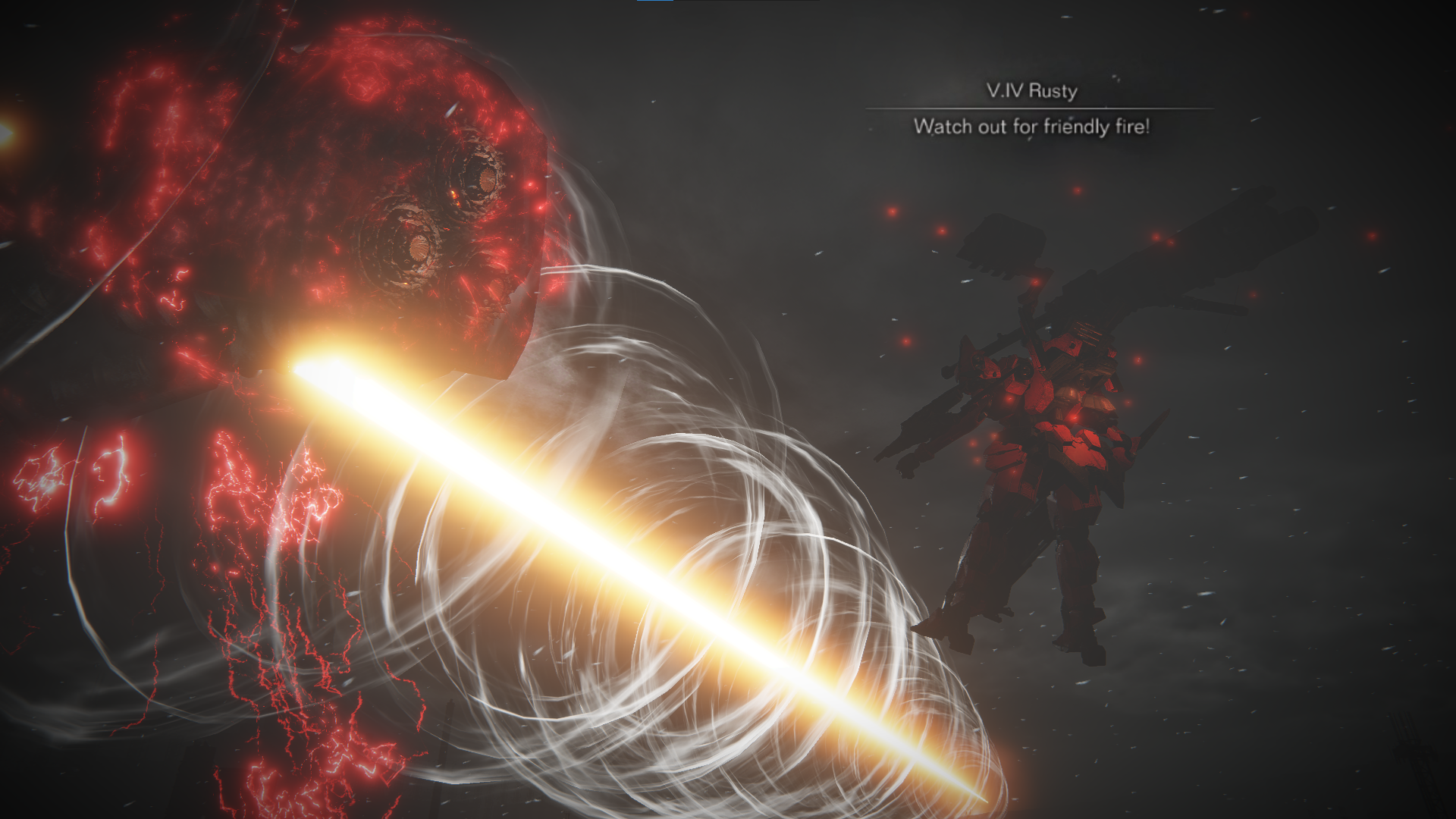
This article contains many plot spoilers to the game Armored Core 6: Fires of Rubicon
Violence is a dominant means in fiction, where conflict is a fundamental need. Force is certainly not the only resolution, but frequently, if there is an evil king, in an evil castle, in the evil lands where everyone is conveniently just so evil, there’s probably going to be a sword to swing, and a throat to cut. Violence in video games is a common means to an end—one could say the default, by most standards. Unless the game is specifically designed around it, no, you cannot talk to these creatures; you must super shotgun, chain dash, ice grenade, meat hook, chainsaw, rocket launcher, rocket launcher, rocket launcher, etc. There are many theories as to why this is, but certainly a contributing factor is immediate visual and mechanical appeal. Violence is flashy, fast, visceral, and many other ten-dollar game review words.
Nowhere is more apparently indulgent in the power fantasy of violence than the AAA gaming space. Space marines were especially popular for a time; proud soldiers who exist in omnipotent armor tear through disgusting foreign “xenos” and this is the way things are, spoken uncritically with lesser or greater levels of self-awareness. This was replaced in time with the morally grey dad: a choleric older gentleman who can only seem to resolve his problems with a .44 magnum and a drinking problem—trying to justifiably deal with the loss of his daughter/wife/dog/car. This also came to a point of saturation in which people could see it for the trope it is, and grow tired of it.
In all these stories, violence is expected, justified. It fulfills a reactionary belief in the healing power of destroying your enemies before they can deliver the same unto you. In the revenge fantasy, they have already wronged you once, making you a perfectly justified force of violent righteousness. Such violence in turn comes to reinforce the already violent cultural norm which walks hand in hand with performative, reactionary masculinity.
“Protect what is yours; destroy what threatens your way of life.”
The unsophisticated and one-dimensional violence of such works breeds the counterpoint video game. Stories where the entire thesis is about the unproductive destruction that is murder. What began as deconstruction, has in turn become just as common and as stale a trope as violence in the first place. A game where the character all but stares into the camera, realizing that the people they deliver violence unto are just like them, heavily saturate the same space as the righteous violence.
It’s easy to hate this kind of thing. Making a game where it is fun to shoot someone in the head with a sniper rifle while an impact font “you are a bad person” burns in on the screen, only gets so far as an examination of violent behavior. A game where violence is fun yet discouraged is annoying when anyone with problem-solving capacity can understand that violence is the only method of resolving problems when programmed that way. My irritation at games like Off calling me a bad person for committing violence—the only solution the game affords you—would not be quite so pointed if there were any other way.
Violence is meaningful when presented as a choice; one you’re making with intention. As much as Kojima receives—for good reason—a massive amount of criticism, I’ve always been impressed by the degree with which violence is a negotiated action in his works. Shooting someone in the head is always an option, frequently a convenient one, but it’s almost always just that—an option. Death Stranding shows us how easily choices can be reweighted. Violent options are given in spades yet I used virtually none of them. The inconvenience of dealing with my bloody aftermath was just not worth it. Rather than being as easy as I was used to death being, with pacifism being something of a challenge run, it was interesting to see the script flipped; killing someone being such a harrowing act that I screeched in terror if someone jumped out in front of my truck.
We’ve seen the opposite side of this coin articulated with much more bluntness, one frequently more evident in indie and lower budget titles. The disempowerment simulator, manifesting typically as horror games and other pointed-message games. Games like Pathologic come to mind, where an attempt to be an action hero is met by seven people beating you to death while you clutch a six-round firearm. The flipping of the script feels contemplative by comparison; suddenly, you are the victim of circumstance, and the forces of righteous indignation are no longer on your side. You scavenge, you survive, and you watch as the forces which would victimize you only seem to grow in strength. Yet, in just as much an extreme, it too can become tedious.
My feelings on this matter are complicated. I am often repulsed by the indulgence in the simplistic conservative violence which many games present as uncritically as any other hegemony-approved ideological framework. I’ve reached a point where the heroic action man genre of military shooter only disgusts me. In a world where I can see all too real images of genocide and death, I fail to find the heroism–the catharis–in any of this. At a certain point, such games are yet another recruiting arm for the military industrial complex and fuel for its resultant self-justification.
Just the same, I frequently utter my annoyance with games which seek to make you small and disempower you. I am already disempowered, doing my best in a world which wants me to feel small, unconnected, and constantly under pursuit by shadow people in my mysteriously red-lit apartment. A game can receive critical acclaim for its removal of the power fantasy, for its commentary on the nature of strength, and I am left feeling nothing. My eyes roll at stories with moralistic blanket statements about the perverting nature of violence, especially when the people who applaud such stories tend to feel substantially less of inequity’s boots than I do.
Sometimes, I think this is a me problem: I’m some kind of indoctrinated violence pervert. Clearly, something wrong has happened in my brain to make me desire violent resolutions to life’s problems. Catharsis, in this way, evades me. Just as often, however, I felt anger, a resentment for people who endorse a status quo that may not be physically violent, yet still reeks of blood.
Such thoughts stuck with me. I struggled with the feeling of cognitive dissonance that comes from enjoying violent entertainments, while immediately cringing at what such entertainments endorsed. Does enjoying the mechanical act of putting a bullet in someone need to carry your soul as a price tag? Does espousing non-violence need to come with an inherent acceptance for the way things are?
Metal-Jacketed Body Farmer
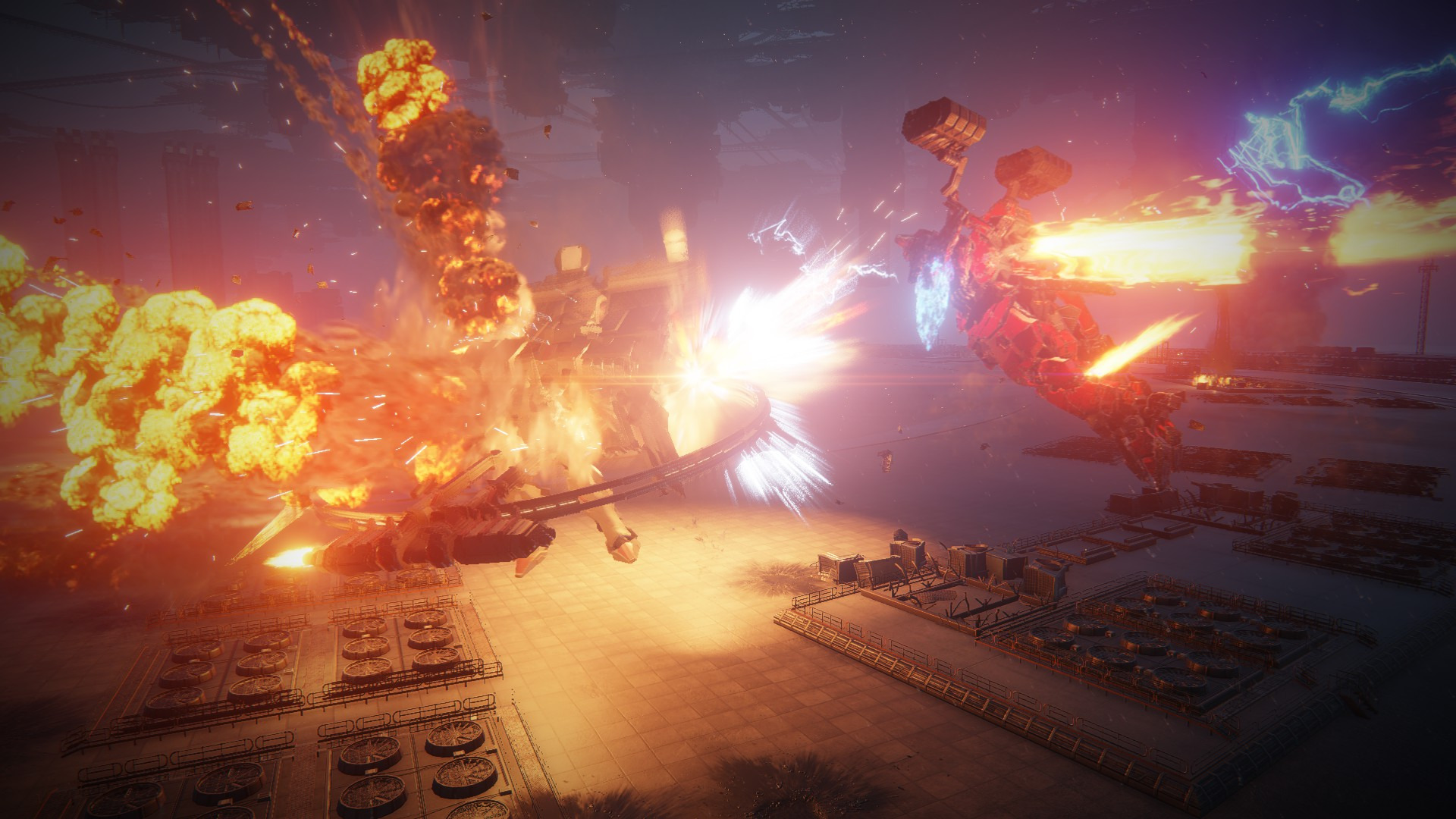
Armored Core 6 is not a game where you get to be a pacifist (okay, except like maybe the one time, but who is going to spare Swinburne, are you fucking kidding me?) You are an AC pilot and, as such, a murderer. You are a war opportunist, killing for credits. The most heinous act you can imagine is ultimately just part of the job.
All of Armored Core 6 is couched in what one could loosely call a power fantasy. As the pilot of a monolithic steel icon of death, rare is the occurrence which meaningfully threatens you. Most casualties tend to be MTs—the AC’s less glamourous, less armored, and less deadly cousin. You destroy these by the dozens in salvos of missile fire on the way to more “mechanically interesting” targets. Yet, even as I repeated the missions through the game’s three routes, I was fascinated by how differently these engagements felt.
Your first playthrough is–even if you attempt for better–the most corporate-controlled route, with minimal options to deviate from the script. On subsequent new game plus routes, previously hidden options present themselves. In the third, and typically final, route, the status quo of the original story shakes itself further and further apart. You are given the option to shirk the corporate factions altogether, betraying and breaking ties where necessary, before finally going MIA. Your protagonists forge an alliance with a predominantly metatextual AI. Through its procedure, it comes up with what it imagines to be the best possible ending, one which kills most named characters, and leads to a new state of being for humanity. Even it, in the end, is an authority you must shirk.
Killing for a corporation feels fundamentally different than killing for an underdog, or even for yourself. The Rubicon Liberation Front, when acting as your opposition, frequently makes calls to your humanity, demanding justification for why you kill them for nothing but money. For an empathetic player, these certainly sting; but given the elevator pitch of the game, you take them on the chin and keep going. Engaging in corp-on-corp warfare often has them making yips of audacity: how dare you bite the hand that feeds? Killing for an AI feels like an optimization game; ones must become zeroes; it’s the only way to avoid a worse death in the future.
One path feels like fighting a hopeless battle against insurmountable odds, in the faintest, dimmest hope of making a better future; the other like being another firearm for a jackbooted authority. It impresses upon me what I’ve come to see as a truth to the nature of conflict: all violence is not born equally. When the Rubicon Liberation Front fights, their violence is born out of desperate necessity, to protect the only home they’ve ever known. When the corporations fight, they battle to strip-mine a planet of a living and thinking resource to continue fueling a needless capitalistic forever war. When the Planetary Closure Administration fights, they fight as authoritarian thugs, even the worldbuilding of how their firearms work reinforces a belief that they will always be firing from upon high, and come crashing down the moment something stands at eye level.
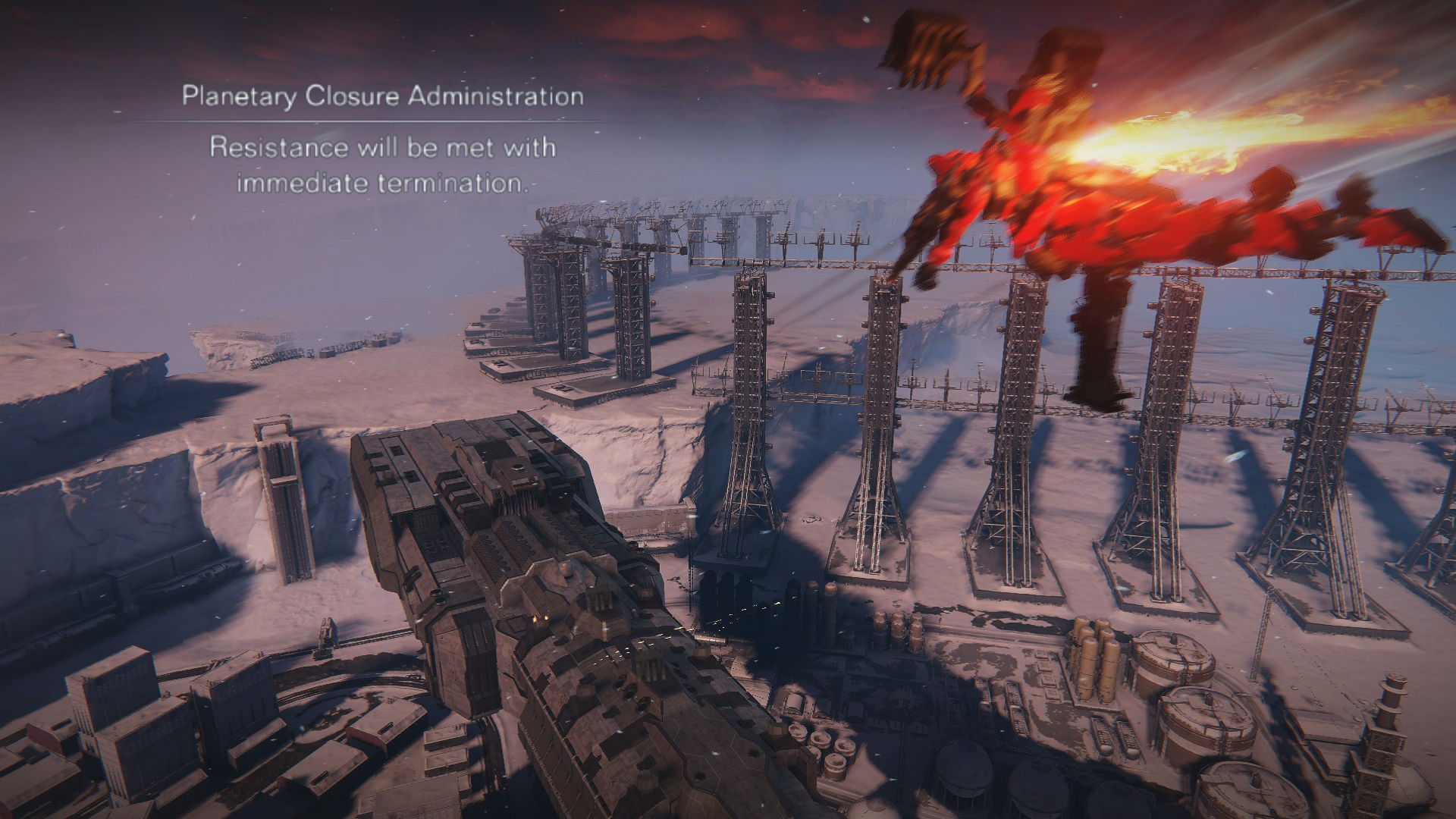
Armored Core 6 does not advocate an idealistic platitude that all violence is unilaterally bad. I think its story simply understands that systems which inflict violence—and this includes the bloodless political violence of authorities—are devoid of humanity. When survival is on the line, violence becomes a necessity, especially when the political position of your opponent requires your death. Someone feeding on mealworms while being shelled from orbit need not tolerate a lecture on how their violence is unattractive or incapable of changing minds—clearly, the minds have already been made. The violence of an authority which can mark you a persona non grata, bloodless depersoning and disenfranchising, yet it is just as murderous as a gun barrel to the head, and it is an aggression which often comes first. The unattractiveness of retaliatory violence should then be understood as a product of necessity; they simply cannot build towers as high as their opposition—it was never allowed.
There is additional textual commentary on this when you realize that options to work for the underdog were obfuscated from you, only made available in those new game plus playthroughs. By the achievement percentages on Steam, we can see a substantial portion of players did not complete this journey; they followed orders, and let Rubicon burn. Frequently, people do what the natural curvatures of inertia prime them to do–taking the easiest path. People do the work of monsters because better options did not come intuitively, or were made inapparent. In this, the game seems to believe, “I was just following orders” is a phrase uttered by cowards, unwilling to find a way. The simplest path is walking forward when you are told to, unwilling or unable to make choices for yourself. Even if the most individualistic path kills the most, it is a choice, not death born of passivity.
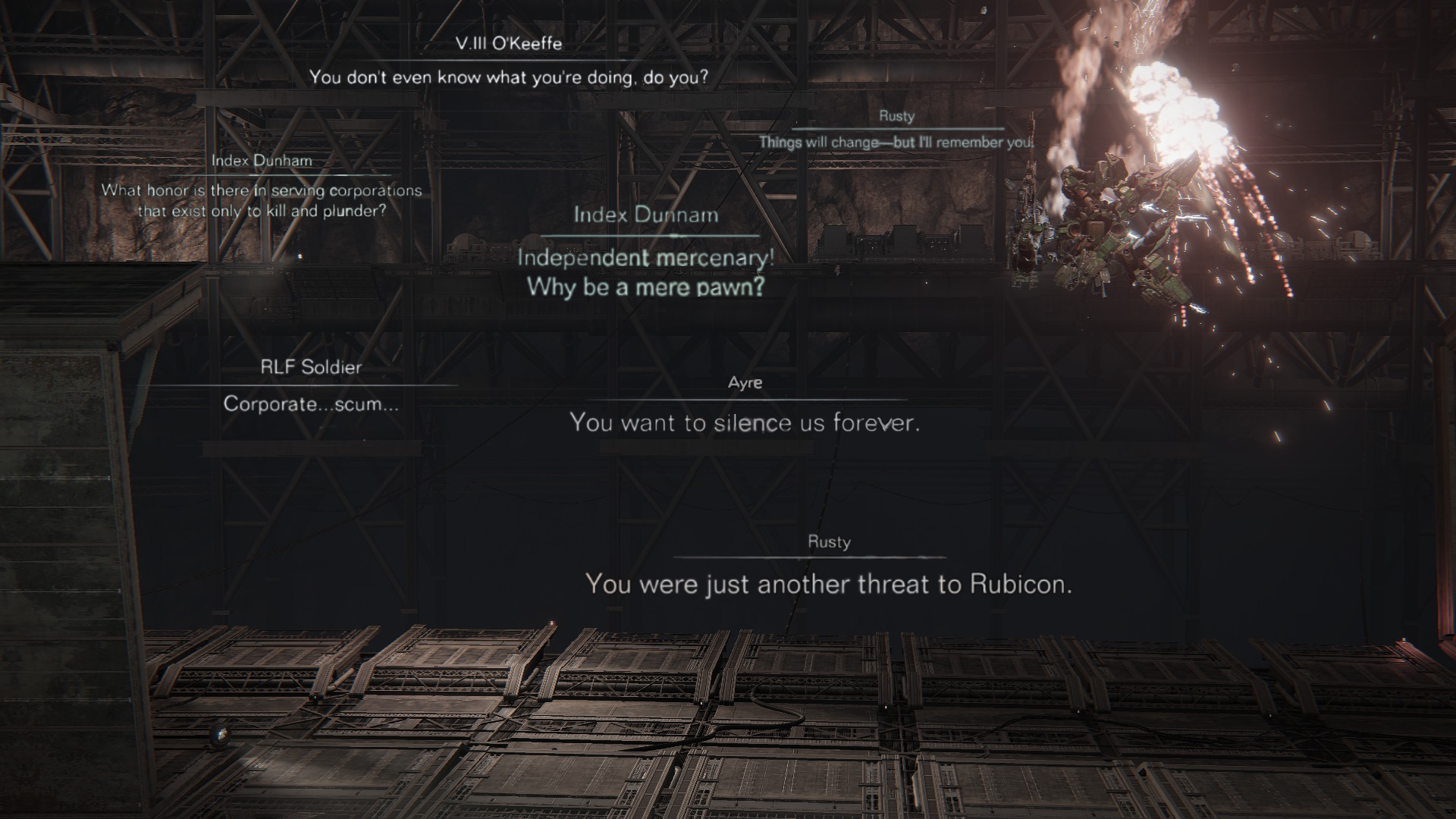
This is the element I find most compelling about AC6: the violence is never optional. You must kill; but it is the why which makes you. Every route features the death of named characters, some of whom you might be quite fond of. Conflict and the differences of ideology will cause bodies to crash against one another time and time again. Some labor against you for simple greed or pride; while others fight you because they do not believe your dream is possible. To many, whatever heaven you attempt to construct will only be their hell.
You are denied a clean answer, one which perfectly saves everyone you wish to save. It is your answer. The blood on your hands is yours to decide, but there will be blood nonetheless. Choosing to stand perfectly still only makes you an ideal tool for the one who wishes to wield you.
Morality’s Firing Solution
The power fantasy of being a moral arbiter is not new to video games. RPGs have long lost their monopoly on deciding if people live or die. The amount of leash a game gives you to be a monster has an immense amount of flexibility depending on what game we’re talking about. I’ve complained before about the binarism of morality and the seemingly unslakable need to paint options morally black or white. Evil red-flavoured morality for boys and good blue-flavoured morality for girls, etc. Yet, here, I speak specifically on the tendency for morally grey stories to paint all sides as equally monstrous in their magnitudes.
A morally grey story frequently has an obligation to make sure you understand that the people fighting for freedom might be “fucked up” to make their retaliatory violence appear more morally nuanced. A grievance I have with efforts to peddle an “emotionally mature” story is that they frequently need to paint the downtrodden as just as deserving of retaliation as the people they fight back against. Worse, when war is depicted with no victims, and the world simply becomes a conflict of factions devoid of people.
I appreciate then that Armored Core 6 allows for people victimized by the way things are to fight back without having a morality fairy in your head wondering “ah… aren’t we just as bad as the people we’re fighting?” I say now what might be a contentious opinion, but I’m tired of stories which feel the need to undercut their own morality in the name of alleged equality. It might seem morally nuanced, but you’re only making excuses for why the oppression was valid. An angry person might be frightening, but you don’t get a license to kill just because you’re scared. While fighting alongside the Rubicon Liberation Front, it’s hard to feel mercy for the people who gleefully shoot civilians defending their homes from the safety of their $75,000,000,000 death machine. Even then, the status quo destroyed Rubicon before it was lit aflame.
What value does it add to a story, to scold people driven to endure the unendurable? Sometimes, the fairest thing you can do is simply comment that the scale was never balanced to begin with. I understand, of course, that such decisions come from higher up, from people uncomfortable with games having any beliefs at all, but it’s the only way I can be comfortable with such stories.
Armored Core 6 understands that violence is not glamorous. Death is ugly and it comes in screams and gunfire; war is filled with people who don’t get a moment to have a catchy one-liner before dying. But, depending on the route, that same violence can be cathartic. I’ve said it before: the aesthetics of death and violence are loud. Blood is bright. Some emotions are too loud to whisper. A story where a violent regime is overthrown by the downtrodden is not the same power fantasy where you uncritically protect the status quo. Both stories are violent, yet that violence is not equal.
I am a pacifist. I love violent media. This is a contradiction which exists within many people. I adore the sensation of cathartic violence. Being able to see the highest possible authority and having the fictional catharsis of saying no, to have the power to refuse, is liberating.
In times of great moral turbidity, it’s understandable to hunger for stories where good and bad are easily demarcated, but I think for many, that is a privilege. As someone who is frequently victimized by the status quo, my expressions of directed frustration are not compatible with a desire for life to get simpler. Life, unfortunately, is complex. Morality is always a consideration when interfacing with other people, and this should carry over to our interactions with stories. We must ultimately ask if this morality is simply easy and convenient, or if it represents what we actually believe about the world. Violence can be fun, but understand too if that desire causes you to encode odious beliefs in the name of your pleasure.
I would not want violence to depart from the media I engage with. Games which allow for non-violent problem resolution are welcome, but violence too has its place. I simply ask for a more nuanced portrayal of the nature of violence, of its necessities, and the way this reflects the tumultuous world we live in. I would ask that we understand that violence does not manifest exclusively in glory kills and quick-time-event dismemberment; it manifests too in policy, in culture, and in norms. I would ask that we do not equivocate the violence of the oppressed with the violence of the oppressor.
For the audience, all I can ask is this: if you must live life as a bullet, be one that always knows its trajectory.