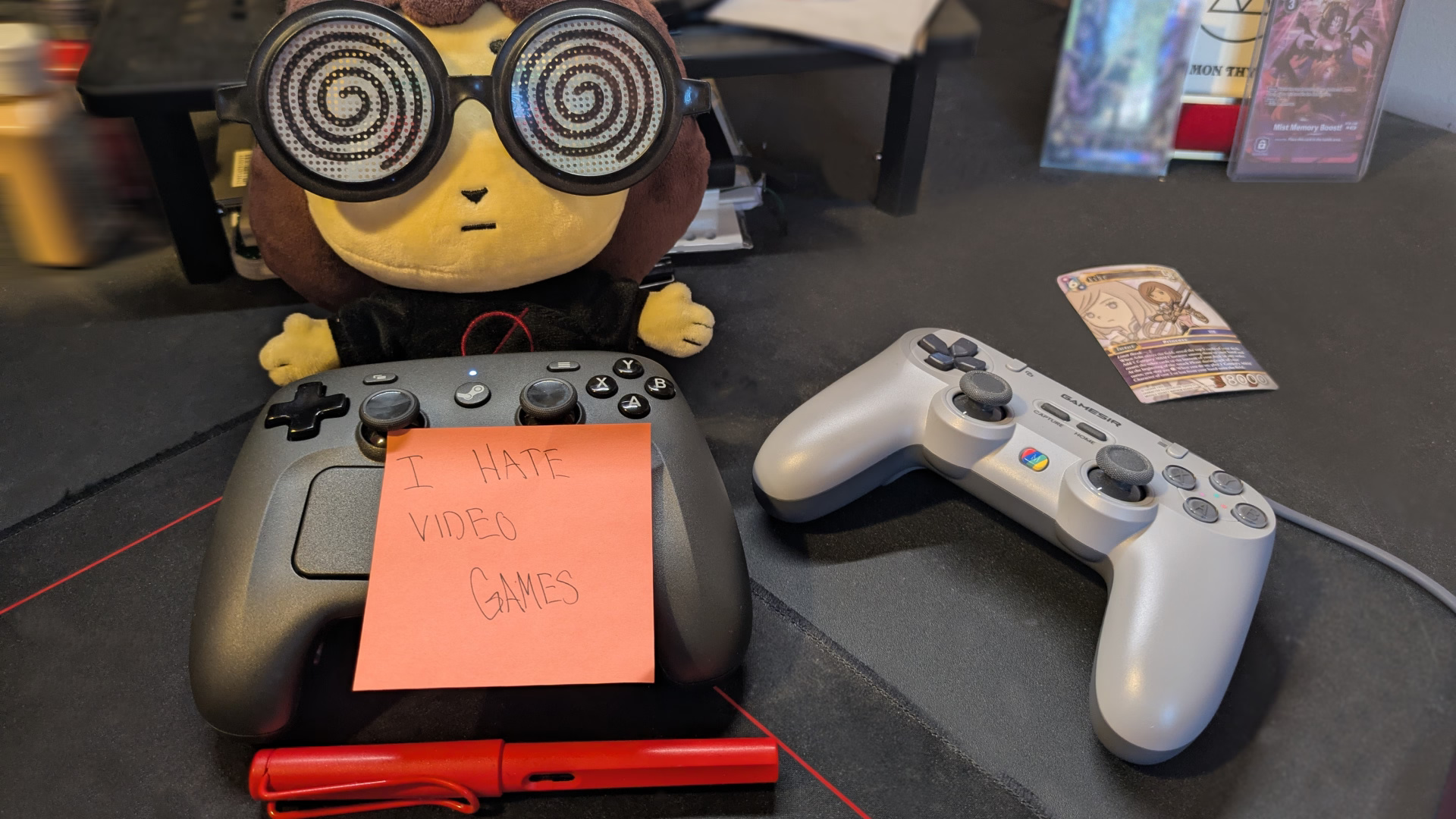
The tactility of video games is a big part of why I enjoy them. Here we are, connected to virtual worlds by tenuous tendrils of cables, plastics, and metal; connected to other lives by an electronic umbilis. The means by which we connect is just as important as what we choose to connect to. The palpable feeling of inputs becoming action is what I fell in love with in the first place.
There hasn’t been much innovation in the format of these tactile interactions in quite some time. The Wii came out twenty years ago and what innovations have been made in the realm of VR haven’t quite filled living rooms in the same way the white monolith did. The Steam Controller managed to attract my attention because, regardless of how small, it has attempted to recapture a feeling of innovation.
I am pretty particular about controllers and interfaces at the end of the day. I love a well-lubricated machine honed down into something hyperspecific and intended for one use. I’m a freak who predominantly writes with fountain pens, types on mechanical keyboards, and uses a DAP—a digital audio player—to contain my music. I love a mechanical switch.
This comes, without going into too much detail, from a chronic condition which heavily limits the amount of sensation coming from my hands and arms. Touch screens and non-tactile inputs are my enemy. So, yes, me ruining your Discord call with mechanical clicking noises is due to a very sensitive medical condition. This, in addition to my chronic baby hands disease, means I care a lot about the ergonomics of my interfacing technology.
Such interfacing has been structurally homogenized over the years as games have less and less incentive to be truly exclusive to one platform. Nintendo, Sony, and the other one have found a shape that works and stuck with it; you don’t truly get a ball controller to play Half-Life 2 and Portal with that vibrates and throws all your shit off your desk anymore.
So, this new contender, back again from Valve’s prior experiment in 2015, is having another hack at it. How’d they do?
Others Have Prevented me from Calling It the Puck
Just about everything with the Steam controller at first blush was pleasant, down to opening its minimalistic packaging. A single cardboard box contained within another cardboard box and a pull tab was all that kept me from my new plastic son. Its contents: a cable, a manual, and the charger/dongle (my partner requires me to type chongle at least once in this review, you are welcome, it is now your turn to make dinner.)
Holding it in my hands, I could appreciate the subtle intricacies of its curves, weight, and shape. A single twirl of both of its joysticks told me all I needed to know: this controller feels pretty good. It lacked its predecessor’s airy weightlessness and disconcertion that it could be twisted in half by a sufficiently determined newborn. This impression held water after the immediate four hour breaking-in period, subsequent, equal length breaking-in periods, and a Twitch stream; anything to procrastinate from actually writing about it.
After a brief updating period for both the controller and the chongle (two dinners, keep up), I finally got to the software side of things. The sheer number of windows, menus, submenus, could kill the elderly; but I think this is a good thing. In the case of electronics with so much modularity, having the ability to actually get in deep and play with everything really makes the controller what it is—a tool to create a futzer’s paradise.
Playing through Blood, a classic boomer shooter, was eye opening. Seeing the detail with which the community offered control solutions for a game never intended to handle this way was amazing. Input layers for maps, rotating sub menus designed to sort through the myriad weapon choices of a classic FPS, and quick-save and quick-load were all bound with enough intuitiveness to easily grasp in less than a level or two.
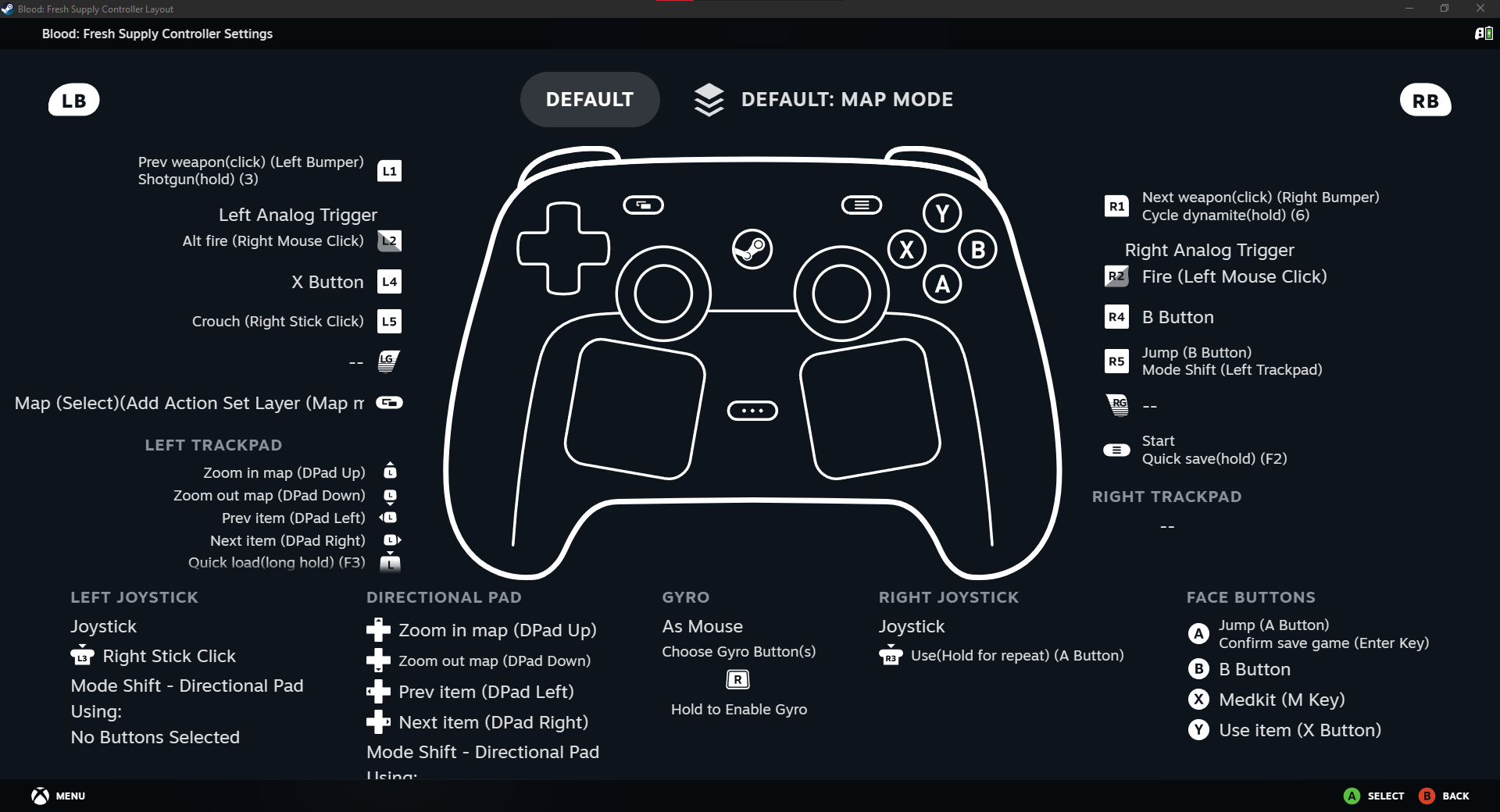
With so many optional buttons—some not even apparent if you count the grip sensor as an input—you can make a controller the weight of a plush toy into a helicopter cockpit. It isn’t technically praise owed to the Steam controller in particular, as you can utilize the various bits of customizability inherent to Steam itself on any controller, but the way it integrates and interacts with such modability immediately makes you feel like you can tailor the play experience to whatever you want.
The tiny innovation the controller has, in the form of the twin touchpads, makes for an immediate interest point. The haptic purr of the pads feels pleasant and, once the sensitivity is properly dialed, shockingly accurate. From a person who could pen several strongly worded letters to the creator of the laptop trackpad, I am just as shocked to be saying it. Both on stream and on my own, navigating around games typically associated with mouse and keyboard control never stopped feeling strangely novel. I am probably never going to be a professional 4X or RTS player on them, but it made the games feel immediately more comfortable and approachable.
Ultimately, the ergonomics of simply holding the controller are pleasant. My particular issues aside, I didn’t ever feel fatigued or like the controller was anything other than lovely to use. A small detail I felt pleasantly about was the detailed haptic vibrations; once tuned correctly, I could feel them appropriately, something I often feel left out on with games, as silly as it sounds. The amount of times I’ve put down a controller during an important scene, only to scare the absolute piss out of myself upon realizing it was vibrating the whole time, is too many to name. It’s a minute detail for most, but it’s nice to be included.
Overall the controller is great, and offers new ways to engage with games I previously thought I had “solved.”
Where I feel the problems start are things entirely independent of the controller. Namely, Steam itself. Without the connection to Steam, the controller is basically useless. Steam Support suggests adding any non-Steam game to Steam as a means to ameliorate this problem.
Now, it may seem petty, stupid, insipid, etc, to mention that a controller called the Steam controller requires Steam to function, but the fact that it is practically a brick while not working through their frontend sticks in my craw. The PC game space is cross-pollinated by many game front ends and avenues for playing games. The limitation of these means, even if rectified with a minute of effort, feels wrong. I’m sure if the controller has any actual staying power, someone, someday, will mod in general use; for now however, it makes me uncomfortable.
My biggest problem with the Steam controller admittedly comes from a personal place—the actual price. At $100, it is far from the most inexpensive controller on the market. $100, to me, is a large amount of money; that’s nearly 50 asset-flip hentai games! That’s too many hentai games for anyone to own.

Economics, Plastic Baubles, and Joy
Once again, I risk being a little foolish, standing on a soap box to say something that has bothered me since acquiring this lump of plastic and circuitry. When the Steam controller’s price was made public, my immediate gut reaction was that it was simply too much to spend on something like this, on me. There are so many other things $100 could go to. My personal guilt complexes about receiving any amount of money aside, there are reasons I bring this up.
I generally avoid talking about pricing or any kind of economic value in my reviews. I don’t like games being reduced from the art I see them as to something I need to justify; the same way I need to justify a fourth gas station energy drink run in a single week. A controller is not necessarily immune, despite the different kind of art that goes into crafting it. I am sometimes struck with awe: any given object on my desk is the product of thousands of people’s efforts to deliver me a piece of plastic that I am annoyed by owning.
I am not a particularly insightful voice here. I cannot tell you why the Steam controller is $100. I am not a R&D specialist, logistics specialist, or even single-celled businessmen determining what the ideal bottom line for a product is. What amounts to a “fair” amount of compensation for such a product is not something I feel comfortable stating. I do not know how many sleepless nights and arguments went into making this controller.
I don’t imagine that pricing is congruent with quality, in truth. Many many material factors construct a reality where basically everyone I know has experienced some kind of stick drift or catastrophic failure of an integral piece of technology; I can only tell you that they happen, and no price point has ever seemed to stop it from happening.
I can spend $20, $100, $300 on a desk chair and I will still find myself collapsed on the ground wondering why my chair decided the middle of Marathon’s Cryo Archive was a good time to explode into Ikea shrapnel(småbitar, if you prefer). The price of what constitutes a good, well-made product always seems to be approaching a vanishing horizon.
“Oh, $300 isn’t what a desk chair costs; at minimum you need to spend around $1500, get like a Herman Miller or something.” It seems like hyperbole, but it’s a repeated sentiment with a changing price point and a changing noun depending on the particular hobby or need; yet it always seems to be far more expensive than one would prefer to pay. Ultimately, it is a willingness to pay the price point which determines what the price point shall be. I am one of the rubes who will.
But then, here I am, too, on the opposite side of the spectrum. My old controller, the GameSir Tegenaria Lite, casts gloomy stares upon my new acquisition. It is grey, sturdy, and cost me $12. It has comfortable sticks, chunky triggers, and reminds me of my beloved Playstation 1. I plug it into my computer, and it controls games. I love it.
For the low price of $12, you can have 80 percent of the Steam controller’s features. If you are so inclined, you can do the exact same amount of fiddling and futzing in Steam’s menus and create an elaborate chain of controller commands, making a twelve to fifteen button controller the equivalent to a Steel Battalion command console.
The adage “you get what you pay for” feels less true in matters such as this. I have had $600 pieces of tech explode upon coming free of their packaging; a $5 nameless knock-off bauble has lasted me nearly a decade. I am unsure if a $100 controller is worth it, no matter how nice, attractive, and scream-filled it is.
The key thrust of my argument here is not that the Steam controller is somehow a moral problem, an economic problem, or even a problem most people should even care about; my consideration is personal. How much controller do you actually need? Is any new gadgetry enough to fill a hole of materialistic deficiency? Did I get exactly $100 worth of joy out of this new piece of plastic obscuring yet more surface area on my desk? I think your answers will determine if the controller is right for you.
So, in the attempt to reassert this is a review and not yet another anti-capitalistic spiel: is the Steam controller worth your money? It depends on your needs and use cases, as many things are!
Will it change the face of gaming as we know it and take us to a new golden age of controller interfaces yet unheard? Probably not, but that gyro is pretty neat.
Should I buy it from a scalper for $200 not including shipping and handling? You should absolutely never do this, for this controller or any item.
Should I buy approximately 50 hentai games on Steam? Sister, you are the master of your own destiny.

For as cool as the features in the steam controller seem, I do miss the days of the crappy $20 wired logitech controller.
I feel like the companies that make controllers have gotten so obsessed with including as many “features” as possible in their controllers at the cost of affordability, when you really don’t need most of the stuff in there. And it sucks!