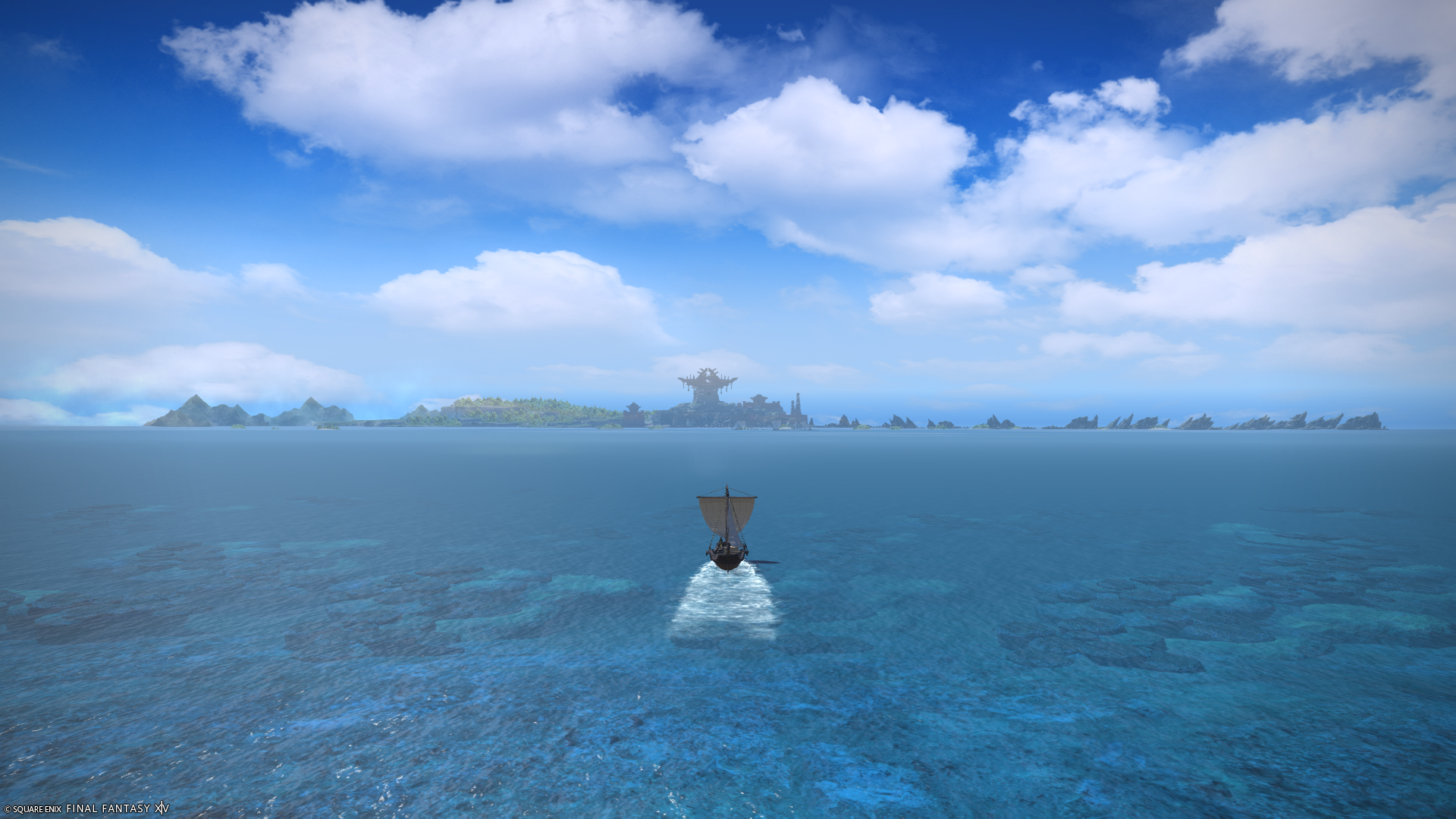
I didn’t write a review when Dawntrail came out for a few reasons. I wanted time away from the hype of its launch so that I could look at it more clearly, without allowing myself to be swept up in the festival spirit that often accompanies new expansions. I wanted more story patches added so that I had a more complete picture of the expansion’s writing and pacing. I wanted to give everyone time to voice their opinions and criticisms, and draw their own conclusions on Dawntrail, be they high praises or low estimations, so that I might have a broader understanding of where it sits within the cultural landscape of the Final Fantasy XIV playerbase.
In the weeks following Dawntrail’s launch, there were hundreds of thousands of voices talking about it on social media, on YouTube, in Discord servers, and on in-game chat channels. People shared their impressions and opinions about its story, pacing, characters; everything you’d expect. I cannot give a comprehensive portrayal of these myriad voices, at least not without conducting innumerable surveys and interviews, but broadly speaking, what intrigued me the most was how there was no consistency on which part or parts of Dawntrail were “good” or “bad.” There were players who liked the first half, but found the second half bizarre and jarring, and there were players who found the first half boring but thoroughly enjoyed the latter half. There were players who strongly felt that it did not have enough voice acting, while others enjoyed the performances and were highly enthusiastic about characters old and new. Dawntrail has certainly been a divisive installment, to say the least, something that I haven’t seen since the Stormblood days.
With the whole of Dawntrail’s story completed, and the narrative now shifting gears as it leads us into the next expansion, I feel ready to talk. I will only be touching upon the story of this expansion, as an all-encompasing review of its new gameplay additions, features, quality-of-life updates, and such would widen the scope of this piece to the point of losing focus. Furthermore, many such additions can and already have been altered from their initial state at launch, whereas the writing of the Main Scenario Questline is very rarely altered outside of typos or errors. I also won’t cover the story in its entirety so as to remain as spoiler-free as possible; this will make sense in a bit when I get to one of my criticisms.
[There are minor spoilers for Heavensward, Stormblood, Shadowbringers, and Dawntrail in this article.]
Dawntrail is an expansion that excels in the details. Sure, it has a grandiose plot with mystery, drama, and epic set pieces the likes of which we’ve seen all across FFXIV before, but that’s par for the course, that’s what players expect. It starts with the uncovering of a mysterious letter from her grandfather, mentioning a “golden city,” and quickly leads into a Rite of Succession for Tuliyollal, a nation spread across two continents. In any of the other expansions, the whole story would revolve around the trials involved in that Rite, but Dawntrail concludes that arc halfway through its runtime, and for the first time in any expansion in FFXIV, the road is left open without any signposting about where the story will go. The northern continent is made accessible, and players go on a whimsical non-sequitur questline about troubles in a wild west frontier town. There’s a saloon, there’s a catboy sheriff, there are tumbleweed crabs, there are dinosaurs; it’s a whole thing and it’s incredible.
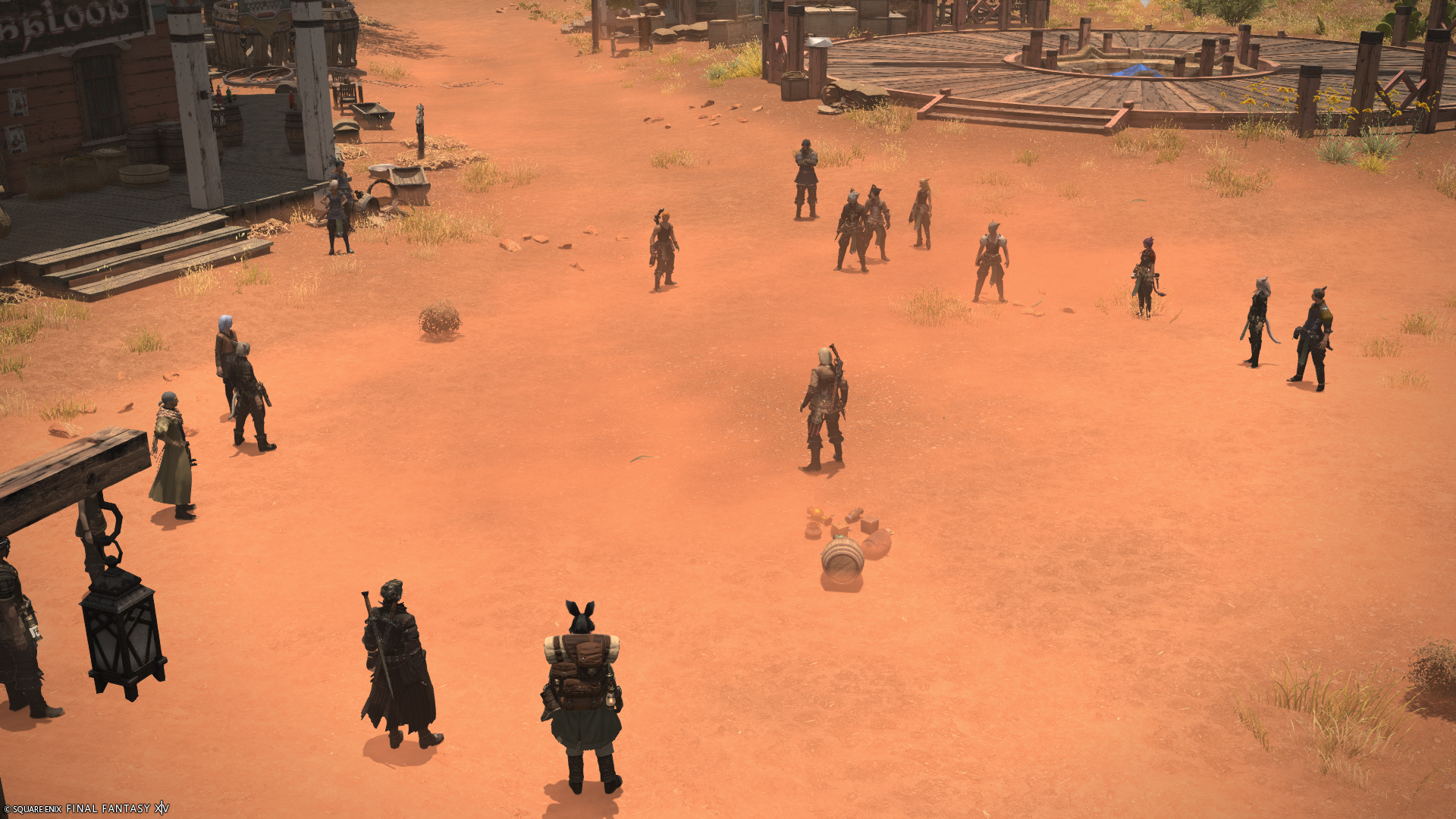
The first time I played it, I briefly forgot I was playing Final Fantasy XIV, the MMORPG. That’s how well the story drew me in. It felt like a breath of fresh air, like I was experiencing what this game would be like if it were taken off the rails and allowed to descend into the Beast Road; that is, allowed to break free of its constraints as a railroaded storyline and be a truly open-world experience. It still was a railroaded storyline at that point (hell, it even becomes a story about a literal railroad later on) but one could see, however faintly, an alternate version of this game where exploration and discovery were the driving force behind its story, and not the other way around.
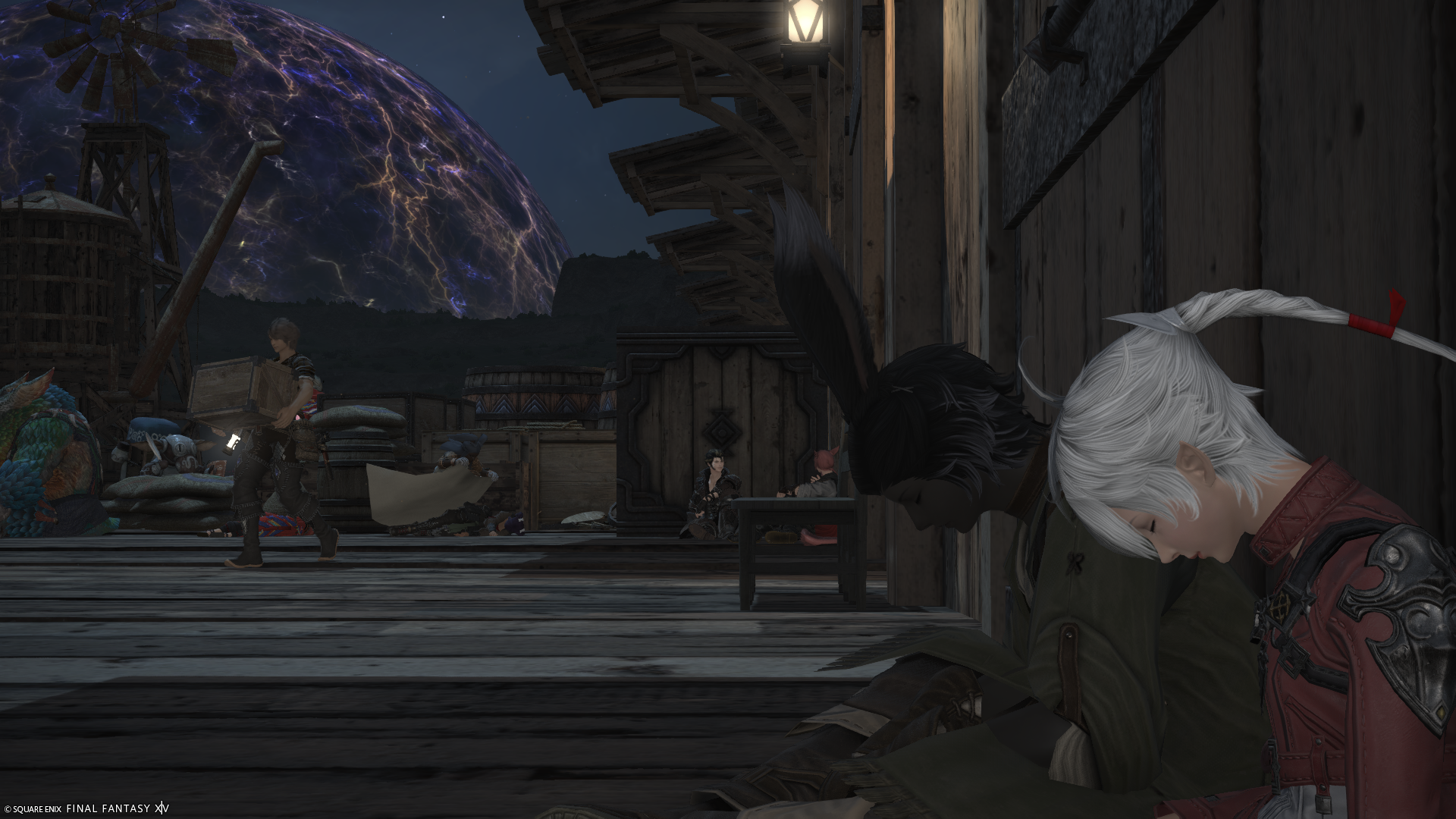
Right at the conclusion of this leg of the journey, there’s an explosive earthquake that’s foreshadowed so lightly, you’d miss it if you weren’t paying enough attention. A giant purple dome suffused with lightning appears on the horizon, and flying futuristic airships start pouring out of it, heading for the capital city of Tuliyollal. This leads into the second half of Dawntrail, which goes into the mysterious dome, its denizens, and the conflict between them and Tuliyollal which seems all but inevitable.
One of my criticisms of Dawntrail is that what’s in the dome was spoiled in some respects through pre-release material. There’s a city in there that is unlike anything in FFXIV, and feels wildly out of place even among the more science-fiction locales of the game. It’s stunning and impressive and extremely cool… and it was shown off well before Dawntrail launched, denying tuned-in players a chance to experience it fresh and in its proper context. It’s the sort of thing that should’ve been kept secret, and FFXIV has often withheld certain locations in upcoming expansions from pre-release material to keep them as surprises. This city should have been one such surprise.
Be that as it may, this dual-nature of Dawntrail serves to reinforce many of its narrative throughlines and messages. Stormblood has been the only other expansion so far to be split in some capacity, but that story was still unified in its overall themes about the impact of war on people and land, why liberation is a cause worth fighting for, and how even the mightiest of foes, be they constructs of faith or machines of empire can be toppled and dismantled when pushed with many hands. The split was geographical, but not textual.
This is not to say Dawntrail has two different messages, but rather that the first half tackles and searches for what it means to be a good leader for one’s community, and how communities can be strengthened within themselves and made even stronger by building bridges to other communities, and the second half begins by taking one possible answer to those questions and accelerating it to its logical extreme, with all of the horrifying consequences made manifest. After all, your communities, your people, need land and resources to survive and thrive; running out of either would mean that you did not take proper care of your people and thus are a bad leader, so it is only righteous and just for you to find new lands and new resources and claim them for the sake of you & yours. Even if they belong to someone else, the needs of your people must come first.
It is this duality which makes Dawntrail fascinating to me, as players have mentioned disliking one half or the other. The story works best when intertwined as it is, and yet some are quick to bring up complaints I haven’t heard since Stormblood. Stormblood itself was split between the region of Gyr Abania and the eastern continent of Othard, and several voices following its launch in 2017 expressed preference for something more monoptic. They wanted either an expansion solely within Gyr Abania, or one solely within Othard, and didn’t like that the story was separated across these areas. These old complaints always struck me as odd, because they seemed to dislike the presentation and not the actual story, as Heavensward did not receive any such criticisms despite being split across the regions of Coerthas, Dravania, and the Sea of Clouds (i.e. it wasn’t solely about Ishgard, from the Ishgard perspective). Echoes of these sentiments have resurfaced for Dawntrail, and while they do address the narrative more than just the setting this time, they still come across as being arguments on the principle rather than the material. All of the expansions and thus all of FFXIV’s story has been told through the connection to a wide variety of different cultures and peoples across all kinds of places, and this is why one of the prime questions that pop up in conversations about upcoming expansions is “where are we going next?”
This drew me to an understanding of Dawntrail which may explain why there are so many differing perspectives on it. I believe that Dawntrail is an amalgam; a combination of every previous part of FFXIV combined and condensed into one single expansion. It has the slower pace and worldbuilding emphasis of A Realm Reborn and the earlier parts of Shadowbringers; it has the trek into enemy territory and reconciliation between opposing nations present in Heavensward; its dual nature I’ve already likened to Stormblood, but it also has a bit of the “war story” and leadership soul-searching present there. To cap it off, it takes the triumphant, defiant answer given to The Question posed at the end of Endwalker and immediately perverts it, twisting it into a nightmare scenario that has far-reaching implications for the universe of FFXIV. It’s got a bit of everything from everywhere.
This admixture is necessarily diluted as a result. One of the antagonists of Dawntrail has a backstory that is all but absent, which makes his motivations flat and uninspired (especially in a game with impressive villains.) While this narrative lacuna was addressed in a post-launch patch, it would’ve had a more lasting impact if shown before his demise and not after, as it makes his final moments comical to the point of absurdity. There’s a historical faction introduced toward the end of Dawntrail, who are only brought up as a matter of trivia in the base expansion. This faction ends up being very important later on, so their mention serves as foreshadowing, but given the extent to which they impact the narrative, it again comes across as something that should’ve been addressed in the base storyline, but was held back in favor of ending the initial story on a high note.
There’s also a case to be made that Dawntrail tips its balancing act too heavily toward the latter half, leaving the nation of Tuliyollal and many of its denizens (like the ever-charming Wuk Evu), who are the focus of the first half, out to dry in favor of the thunder dome and the many loose threads trailing out of it. Many of the threads left open regarding its first half are addressed in side stories and activities, but to put things into perspective for the main story: the thunder dome and the history behind it are responsible for five of the currently six major boss fights, with two of them taking place within the dome, two of them in a place previously attached to the dome, and the latest one in the region the dome came from.
It’s not that Dawntrail has a bad story, however, or that its foibles are particularly unique in FFXIV. Heavensward kills off two major characters through self-sacrifice, and while one of them is afforded intimacy in a tender final moment, who is remembered by fans over a decade after their death because of said moment, the other is blasted out of the sky to die a lonesome disintegrating death, and who isn’t afforded the same ceremony or reverence by fans all these years later, and you get three guesses as to which character is a woman. Stormblood arguably has the worst writing in the whole Main Scenario so far, with the baffling decision to bring in a comic relief gillionaire-type character to ask him, in earnest, how to help an ailing nation recently recovering from imperial occupation, to which his reply is “well you can’t just give them money because then they won’t develop the working mindset needed to make it in this economy!” Even the beloved Shadowbringers has some pacing issues leading up to the end of its second act, and while I can appreciate that crafting a mountain-sized golem takes time and many hands, that questionable pacing is why Dawntrail turns its homage to this exact sequence into a quick and cute montage.
One could argue that Dawntrail’s story tries to do too much in too short a time; it has to introduce several new characters, locales, and story hooks; it has to follow up on the impressive finale of Endwalker; and it has to set the stage for the next major story saga. All things considered, I find it was more than merely satisfactory, but impressive in its own right. From my viewpoint that Dawntrail is a combination of every other part of the story blended together, the result is something familiar yet refreshingly new. It’s still Final Fantasy XIV as I’ve known it. It’s still keeping in form and function with both its connection to the rest of the MMO as well as its place within the Final Fantasy lineage. It’s just told in a new light through a new perspective.
Previously, the story of FFXIV has built up the player character as The Warrior of Light; champion of the wronged and the weak, seeker of truth and justice, and ender of apocalypses. Every major story beat has been punctuated by a formidable foe who bars the path or threatens the innocent, who must be laid low by the player character. Often, the Warrior of Light is the only one powerful enough to contend with these adversaries for one reason or another, and while the powers of friendship, sheer determination, and hope do much to bolster efforts in vanquishing villains, much of the narrative is built around small acts of kindness, favors, and chores.
Much and more has been said and bemoaned about “the MMO fetch quest” wherein a player is tasked with collecting some amount of items and delivering them to someone, but even in the earliest days of A Realm Reborn, FFXIV has always used simple quests like these to provide context, build out the world, flesh out characters, and inform the player of details. Skip through the dialogue and you’ll miss that the bucket of water a bar’s owner asked you to fill up and dump on a rowdy patron, was done so because he was being incredibly racist to someone else, behavior which the bar’s owner tells you is unfortunately common in these parts but which he forbids in his establishment.
There are hundreds of examples like that one in the multiple quests throughout the game, and they serve to build up the player character as a true hero. The Warrior of Light isn’t someone who only appears when a battle needs winning, who is only known for violence. They’re renowned for their incredible acts of selflessness, kindness, and communal love, too. It is this focus on building up someone to be a champion of the people, who is driven by action and a burning desire to do right by their neighbors, which sells the concept of the Warrior of Light. This resonant fiber is stitched throughout every chapter of the Main Scenario Quest, and this extends into Dawntrail as well, only this time there’s a twist and it comes in the form of Wuk Lamat, the deuteragonist of Dawntrail. Even calling her “deuteragonist” doesn’t do her character justice, as Wuk Lamat’s journey is a core aspect of Dawntrail, and why she is one of the game’s most interesting characters.
Introduced at the tail of Endwalker, Wuk Lamat approaches the player character with a proposition: be her ally in the upcoming Rite of Succession for Tuliyollal’s head of government. She is the underdog (undercat?) of the contest, and the exploits of the Warrior of Light compel her to seek them out and request their assistance. She is earnest and eager, but out of her depth, and aware of that fact. While she has no selfish ambition to take the Dawn Throne for herself, she is driven to counteract the frontrunner contestant who plans to plunge Tural into a war with nations across Eorzea and beyond. She’s not strictly in it to win, but he must lose at the very least.
The Rite of Succession requires contestants to connect with several communities across the southern continent of Yok Tural, completing their requests as decided by community leaders in whichever manner they see fit. Some leaders use the Rite as a means of educating the participants in their local culture, while others have pressing concerns and see the Rite as an opportunity to have an urgent need met. This Rite is analogous to A Realm Reborn, wherein the player traveled around Eorzea meeting leaders of various communities, towns, and organizations, doing favors and services for them in exchange for information, cooperation, supplies, and support. The context is different but the motions are the same. There’s even an undercurrent of mystery; A Realm Reborn had the looming threat of the Garlean Empire and the shadowy machinations of the Ascians, while Dawntrail’s primary mystery surrounds the “golden city of Tural” and how to locate it, which is actually the final objective of the Rite of Succession.
It is through this Rite, and all the trials and challenges that come with it, that Wuk Lamat is sharpened and shaped into the leader she wants to be for her people. Much like how the Warrior of Light was forged from a simple adventurer into a true hero over the course of A Realm Reborn, Wuk Lamat is built up in the same manner. One of the earliest complaints about Dawntrail was that its story defocused the player character in order to put Wuk Lamat centerstage. While it makes sense that some players would have that takeaway, especially after how intensely Shadowbringers and Endwalker made the player character the central focus of their stories, such a perspective fails to realize the role the player character is given and how it complements the narrative of Dawntrail.
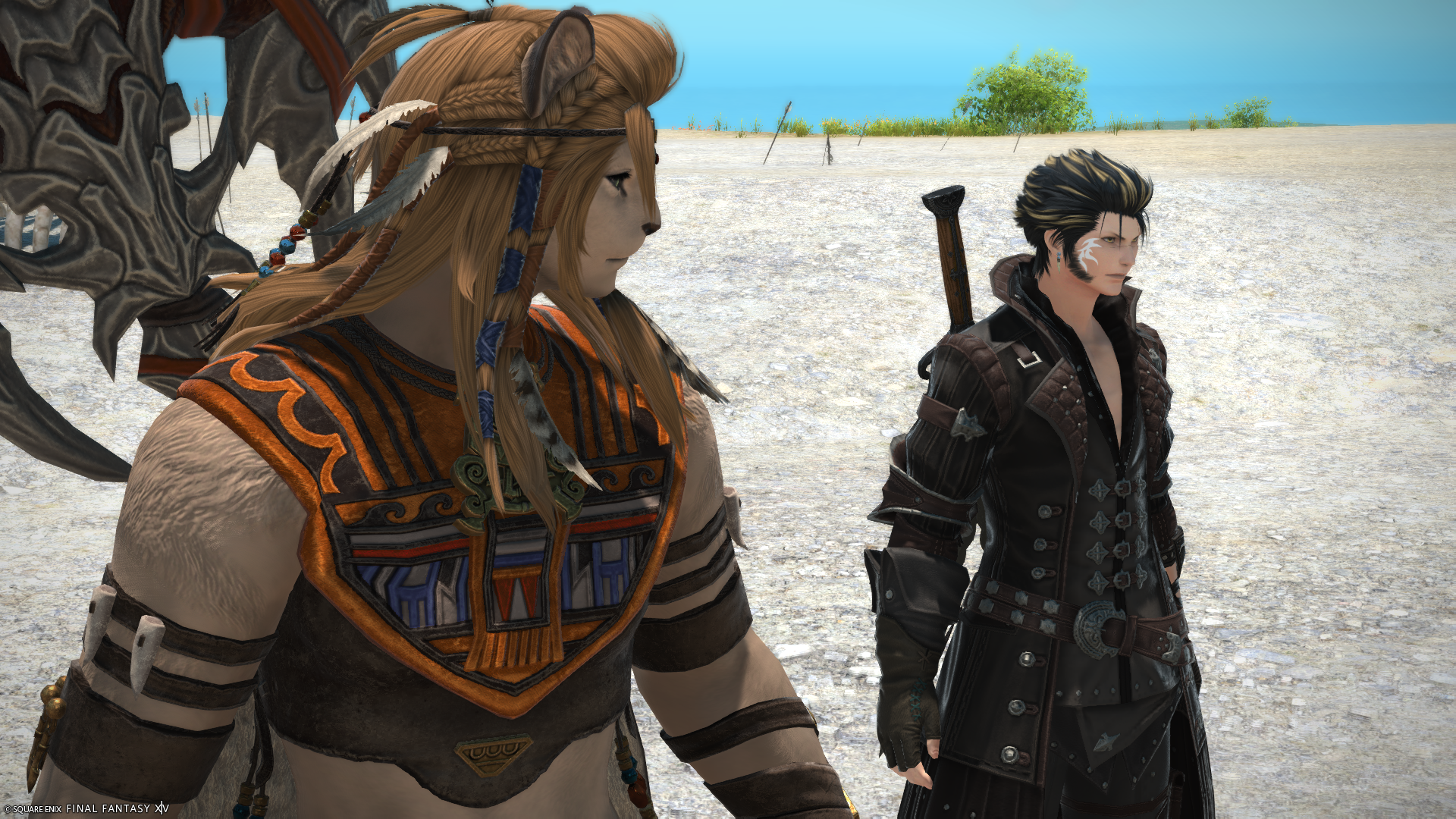
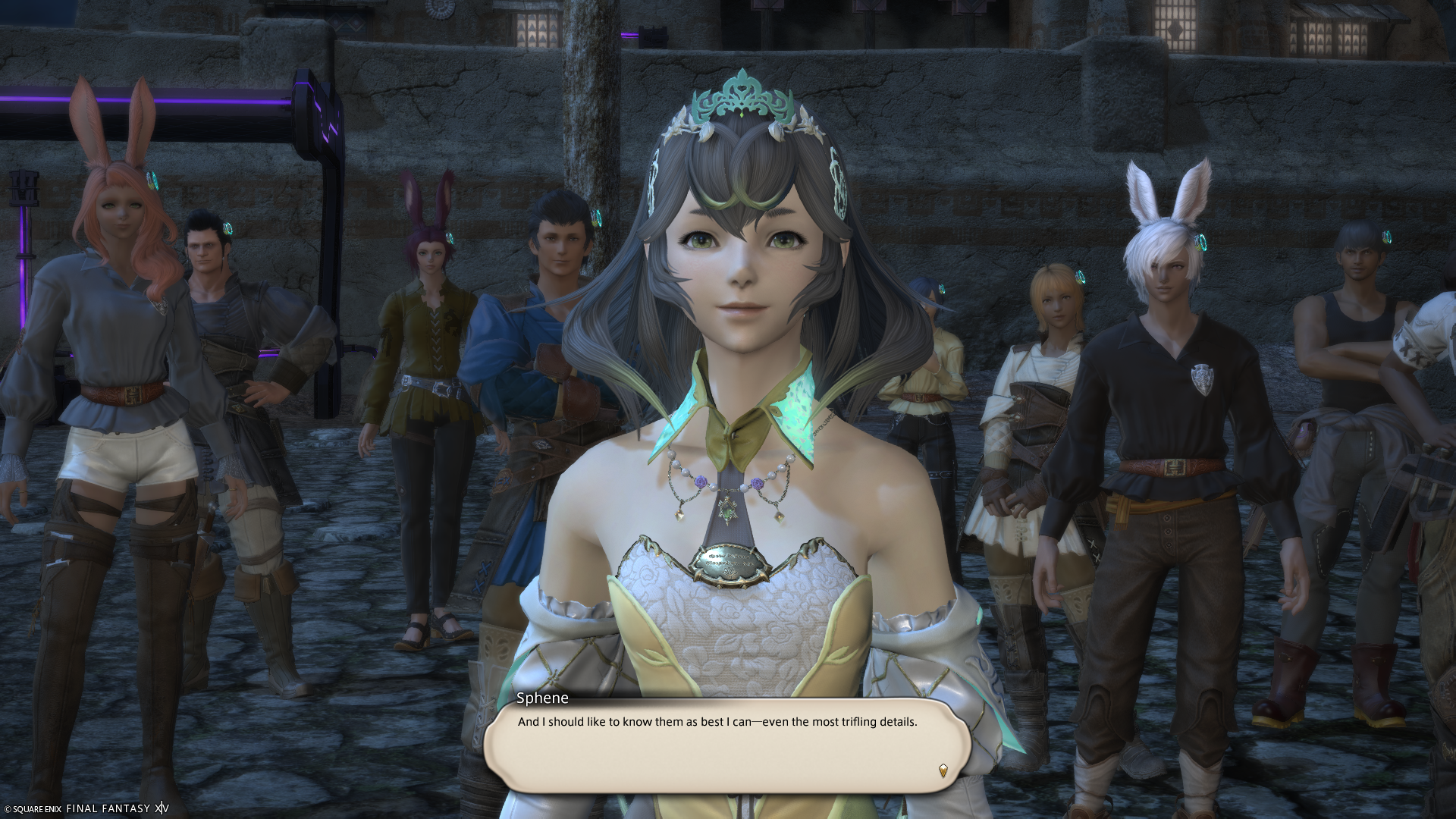
The Warrior of Light’s role in Dawntrail is that of the mentor. The example I’ve been using for over a year now is Auron from Final Fantasy X; an older, more experienced party member who can be relied upon both for their combat prowess as well as their wisdom and worldly insights. Dawntrail’s story is refreshing and exciting because it makes another character the focal point, allowing the player character to run support for them, and then maintains that shift throughout most of its runtime. Riding shotgun for another character’s story is done plenty of times in and out of the main story of FFXIV, but Dawntrail capitalizes on the concept by focusing on Wuk Lamat, Krile, Erenville, Sphene, Gulool Ja, and a few others all throughout. This paradigm shift enhances Dawntrail’s messages on communities and families and coming together to build a better tomorrow, by allowing the characters who can best convey those messages the proper attention and narrative respect.
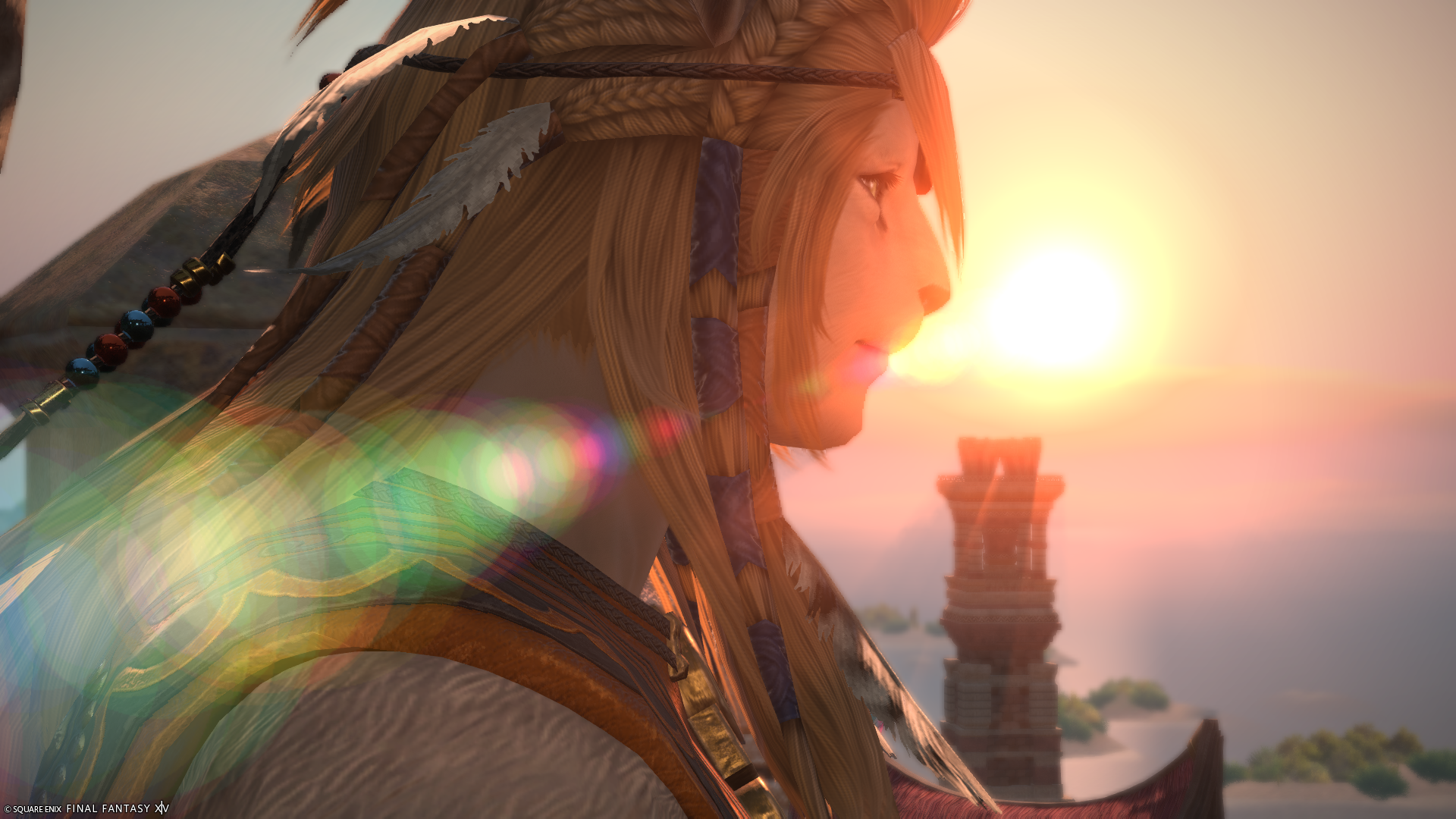
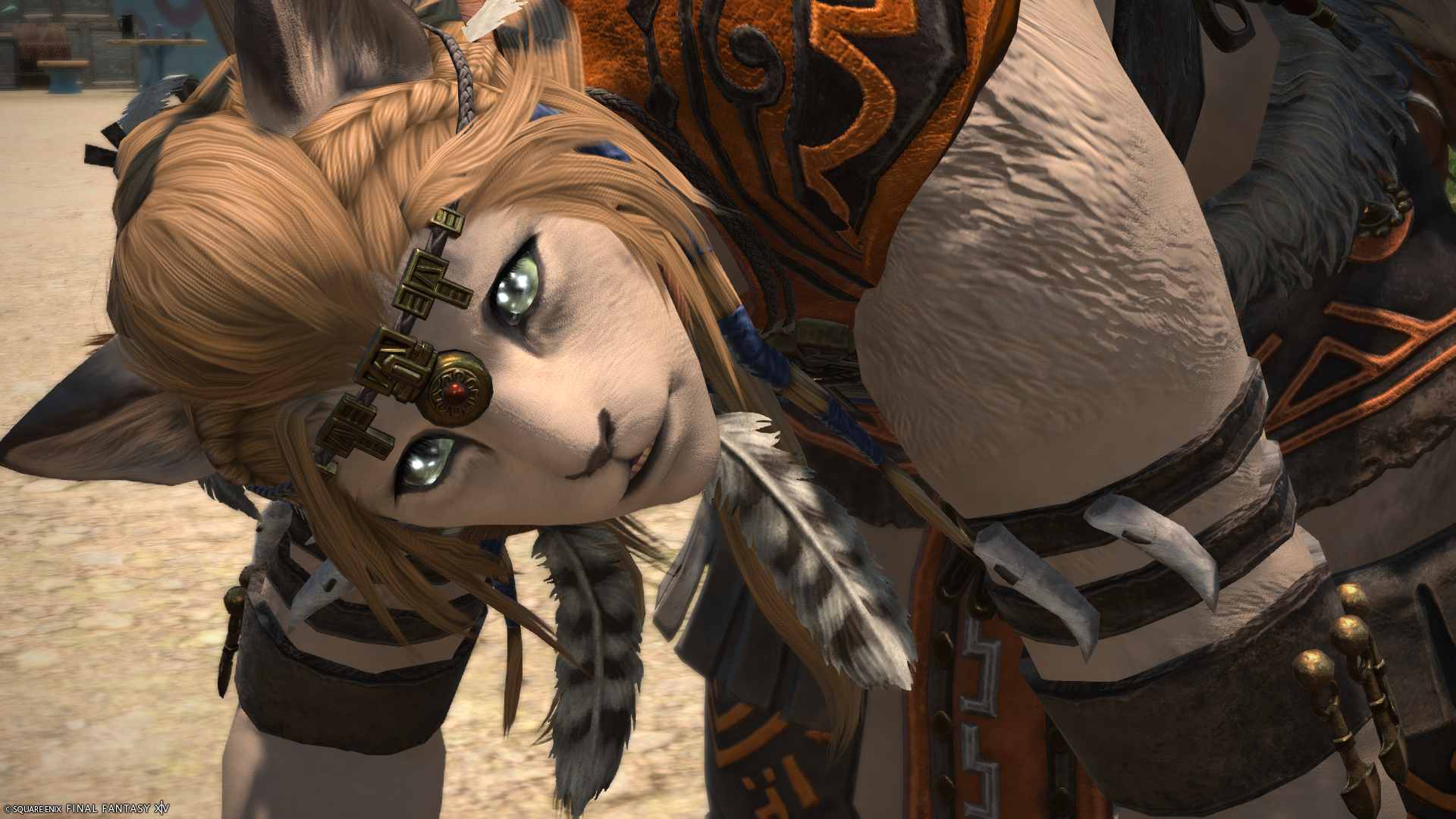
But I want to focus on Wuk Lamat in particular, because this mentorship role the player character has with her left a lasting impression I still think about to this day. I said Dawntrail was a combination of every other part of FFXIV, and I see that in Wuk Lamat too. From her introduction and all throughout Dawntrail’s story, I see myself in her. I see a fledgling me, nervous about playing with random players but eager to learn how to tank so I could be ready when I got to Heavensward and could unlock Dark Knight. In Wuk Lamat, I see every new player; the ones to whom I’ve given advice, or assistance, or just some words of encouragement. As she grows throughout the story, I see the growth of every player, myself included. You see her confidence grow, her doubts subside, and her resolve crystallize, until she’s a warrior in her own light: A Warrior of Dawn.
There’s a part in Dawntrail where the crew has to board a hot air balloon to fly deep into the jungle, and Wuk Lamat is embarrassed but finally admits to the player character that she is nervous about the flight, and asks if they can hold her hand. Now, I’ve made several alternate characters in FFXIV, and when I come to dialogue options in the story, I’ll pick the ones that seem appropriate for the character I’m playing, or I’ll pick the options I’d never pick for my main character just to see the alternate dialogue. I have never denied Wuk Lamat a steady hand to hold. I cannot speak to the performances in other languages, but Sena Bryer does such a phenomenal job portraying Wuk Lamat as a character brimming with kindheartedness, strength, and sincerity, that my calcified skeleton heart is immediately incinerated with warmth when she asks for help.
That is what makes Dawntrail special to me. It is a story about what makes family and community important to us, and how to strengthen our ties to them. It’s about how to forge new bonds and reinforce old ones which are wavering or even broken. It’s about how to weather change, and to possess both the reason and the resolve to identify and act when the only sensible option forward is to sever the ties that bind us; be they to the past or to people who have wronged us. It builds up these ideas bit by bit in the first half, and then uses the second to test them, twist them, and ultimately make them more resilient. It’s not content to simply state “Wuk Lamat is a good leader because she cares about her people and that’s why she wins the Rite of Succession!” It demonstrates the strength of her character by building her up in the same manner as the Warrior of Light, turning the perceived weakness of her reliance on others into one of her greatest powers—a staple message of FFXIV at this point, but the perspective shift given to the player character makes it shine because she learns it from us—and then playing her off of another character who shares her virtues but who has taken them too far.
I believe Dawntrail to be an expansion story with flaws like any other chapter in Final Fantasy XIV. But for all of the divisiveness it’s seemingly instilled, I also believe it’ll be looked back on fondly. When we’re further on into this saga’s storyline, and the Dawntrail callbacks start hitting like waves of nostalgia; when Wuk Lamat, my third-favorite Dawntrail character, shows up with Mr. Baby President and Shale from IT to help us out of a jam, that’s when people will realize what I’ve known all along. Dawntrail was an excellent tale, and a solid foundation for the future of Final Fantasy XIV.