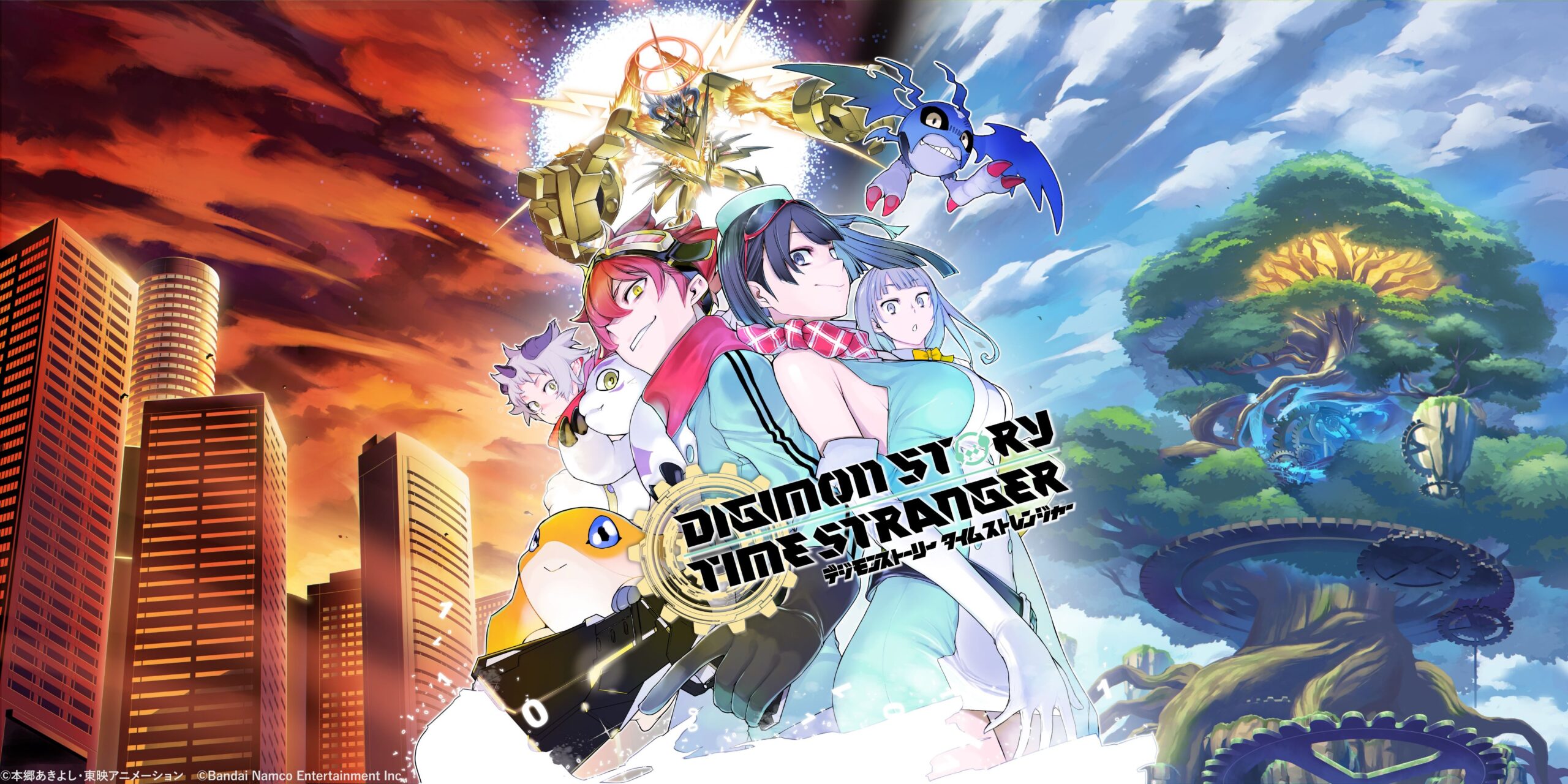
Historically, it’s been difficult to recommend Digimon games to newcomers. They’ve never been dreadful for the most part, but at best they’re overly complex (World 1/3) and at worst they can be outright slogs (World 2/4/Dawn/Dusk). More modern games like Cyber Sleuth and its expansion/sequel Hacker’s Memory are better, if still grindy, and in Cyber Sleuth’s case riddled with translation errors, but they tend to be the first choice for casual entry into the franchise. Digimon Survive, the previously most recent release, was marketed as a tactics game but ended up being mostly a visual novel, much to the chagrin of fans who hate reading.
Digimon needed a high quality, polished, smooth experience the average person could enjoy to break back into the mainstream. Pokémon has started to experiment with the Legends games, but there’s still a concept of “Pokémon” that all other games have been built on. I think Digimon needed something to build off of in the future, and Digimon Story: Time Stranger is that game. It’s an overall good time, but I would describe it with softer adjectives like “solid” and “decent” instead of “exemplary”.
Time Stranger’s combat is by the book at first blush. You go into battle via running into foes on the overworld, and use your team of six Digimon (three active, three in reserve) to do damage and reduce their HP to zero. Each Digimon is one of three types that fit into a sort of Fire Emblem weapon triangle; Virus beats Data, Data beats Vaccine, and Vaccine beats Virus. There are also secondary elemental types such as fire, water, darkness, etc. Being a type of Digimon that is strong against your foe’s type and using an attack that is strong against their type can lead to a huge power increase, and ends up being the primary focus in combat.
Your party levels up with each battle, but you also grow a vast amount of backup Digimon. As you do battle, you can generate your own copies of the foes you defeat over time, adding them to the reserve. Reserve Digimon gain EXP, but none of the extra stats or effects your party receives. These bonuses are tied to your Digimon’s Personality as well as its Bond and Talent stats. It’s similar to how your Active Pokémon gain EVs from battles but the ones you don’t use do not, but on a wider scale. It feels good to see a ton of Digimon level up at once, and it lets you experiment more as your new monsters catch up to your current team’s levels.

A Digimon’s Bond increases as you use them in combat, and their Talent increases as you Digivolve them. Personalities work similar to natures in Pokémon, where each Personality/Nature gives extra stats to specific aspects over time, such as a Hasty Pokémon gaining more speed and having less defense, and an Adoring Digimon having higher Spirit and Defense. After a few battles, Digimon will want to speak to you, and depending on how you answer the questions they present, their Personality may change. This is cute for the most part, but sometimes a question will only give you two response options: One will shift a Personality towards a certain aspect, the other is rude and doesn’t shift anything. It sucks having to basically tell Greymon to go fuck himself because I don’t want him to start gaining stats in magic because he’s a physical attacker! Give me another option, or at least make the responses less off-putting.
Personalities can also give a passive ability to your Digimon, called a Personality Skill, but each Personality assigns them randomly. If you want a specific skill, you’ll have to shift back and forth between two Personalities until it decides to give you the one you want. As your Digimon battles, it will gain more stats in blue next to their current stats, and a percentage of those stats will be passed on when the Digimon takes a new form. Their Talent stat raises the Digimon’s level cap up to 99, and is raised by Digivolving and De-Digivolving, so jumping around a Digimon’s evolution tree is recommended.
That being said, an issue arises with this system. There are a ton of facets to training, and the bonuses are not something the average player will care much for. Raising your Digimon’s Talent and Bond fully is trivial, and finding a good Personality and Personality Skill is definitely worth the effort; anything beyond that, however, is far too grindy. It’s possible to fully max out your Digimon’s stats if you put the time in, but without using an exploit or buying the grinding DLC, raising one Digimon can take hours or even days. If you are only playing the game a single time on Normal difficulty, don’t worry about anything beyond setting your Digimon up with a good stat spread and a good Personality Skill. Your stats will grow just fine with leveling up. You’ll only need to stress about raising your stats further if you’re planning on doing another run on the hardest Mega+ difficulty.
The ability to raise your stats so freely is interesting on paper but removes a Digimon’s individuality. Initially, each Digimon has specialties in each stat; a big-ass dragon that does physical fire damage or a plant monster that can heal as well as dole out poison. However, since you can shift where stats are allocated, use items and the DigiFarm to raise stats as much as you want, and can also use the Bond-related extra stats to feed into everything more and more, it takes away a lot of each Digimon’s sense of self.
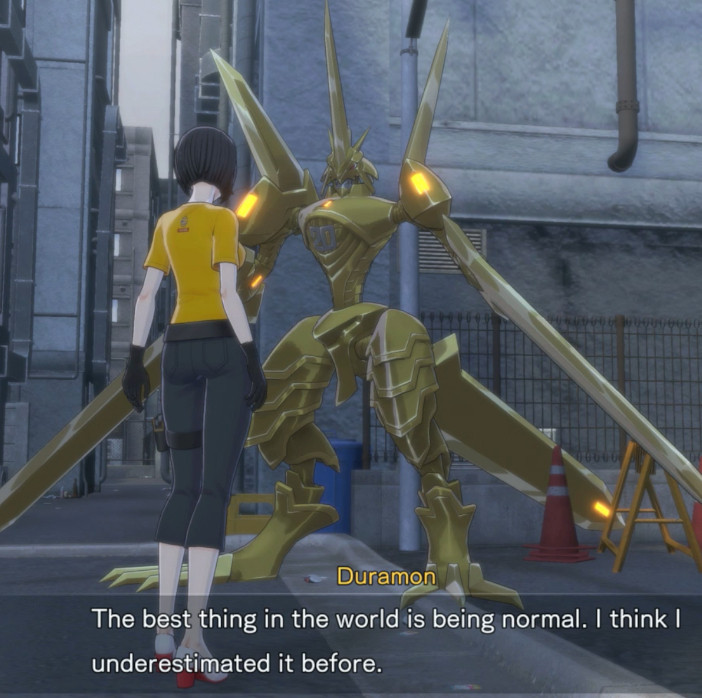
Digimon can also have new attacks equipped to them, and there aren’t any restrictions on what moves you can give to any Digimon. This allows for a lot more freedom in builds, but each Digimon’s identity is weakened by this. It doesn’t help things when you factor this in alongside how freely you can raise stats, because now every Digimon has coverage for everything and can be a mixed attacker with physical and magical defense, so each Digimon is only defined by its signature moves in combat. It makes it easier to just use your favorites, but when my Diaboromon is able to use a magical water move, it clashes with the series’ flavor.
All of these mechanics are similar to Pokémon’s Natures, EVs, and IVs, but in Pokémon there are limits to how high you can raise stats and what moves Pokémon can learn. Making a balanced team is a challenge in Pokémon, but it also allows for a good amount of personal expression. In Time Stranger, there are only a handful of right answers, especially near the end of the game when most enemies are dark element Virus types.
Another aspect you may upgrade is your Agent Rank, which rises when you complete missions. You gain points you can assign to passive boosts, such as a 1% increase in attack for certain Personality types, higher EXP yields, and lowering requirements for Digivolution. You also unlock special abilities you can use in combat, such as party-wide stat buffs or huge nuke attacks that do massive damage to adversaries. These skills can be used once a meter is filled by your Digimon doing damage and getting hit, so they can be used multiple times over a fight if it goes on long enough.
The Story part of Digimon Story: Time Stranger is simultaneously simple and overly complex. At first blush, it’s a standard good guys vs. bad guys tale about heroic Digimon fending off a group of invaders called the Titans. This conflict takes place in Iliad, one of the three “servers” that make up the Digital World, the realm Digimon come from. Iliad is, as its name would imply, based on Roman mythology, with the leaders of each town on the server being based on a Roman mythological god or figure. The war spills into the real world and causes the end of the world via an event called the Shinjuku Inferno.
The player controls either Dan Yuki or Kanan Yuki depending on your preference, an agent of a group called ADAMAS, who are tasked with taking care of various anomalies around the world. Think the SCP Foundation if their uniforms were designed by Shotaro Ishinomori, specifically Cyborg 009. It’s quickly posited that most famous anomalies such as Bigfoot or UFO sightings are actually Digimon visiting the real world. Your chosen Yuki is sent back in time via mysterious means to potentially stop the events that cause the Inferno from taking place.
Your character is joined by Inori Misono, an ordinary girl who is wrapped up in the events of the game after trying to help an injured Elecmon. Elecmon Digivolves into Aegiomon to protect her, and Inori takes an immediate shine to him since he looks like her younger brother, who died alongside their mother during a previous Digimon incident. Their relationship is both a highlight and a detriment to the game, as it’s endearing to see them grow closer and for Aegiomon’s goals to evolve over time to help Inori, but late game reveals muddy things up and make for a mess of frustrating turns.
I fully believe the Agent shouldn’t have been the player character, as having Inori and Aegiomon’s relationship front and center without this odd extra player in the mix would’ve made the plot far cleaner. I won’t say what it is exactly, but Aegiomon gains powers related to time as the story progresses, and the “truth” behind how his actions mess with the timeline and how the Agent is involved at all made me groan and roll my eyes. Digimon as a franchise is built on normal humans going on adventures. Why does this game need a special agent to handle things when Aegiomon and Inori learning to help each other is far more interesting?
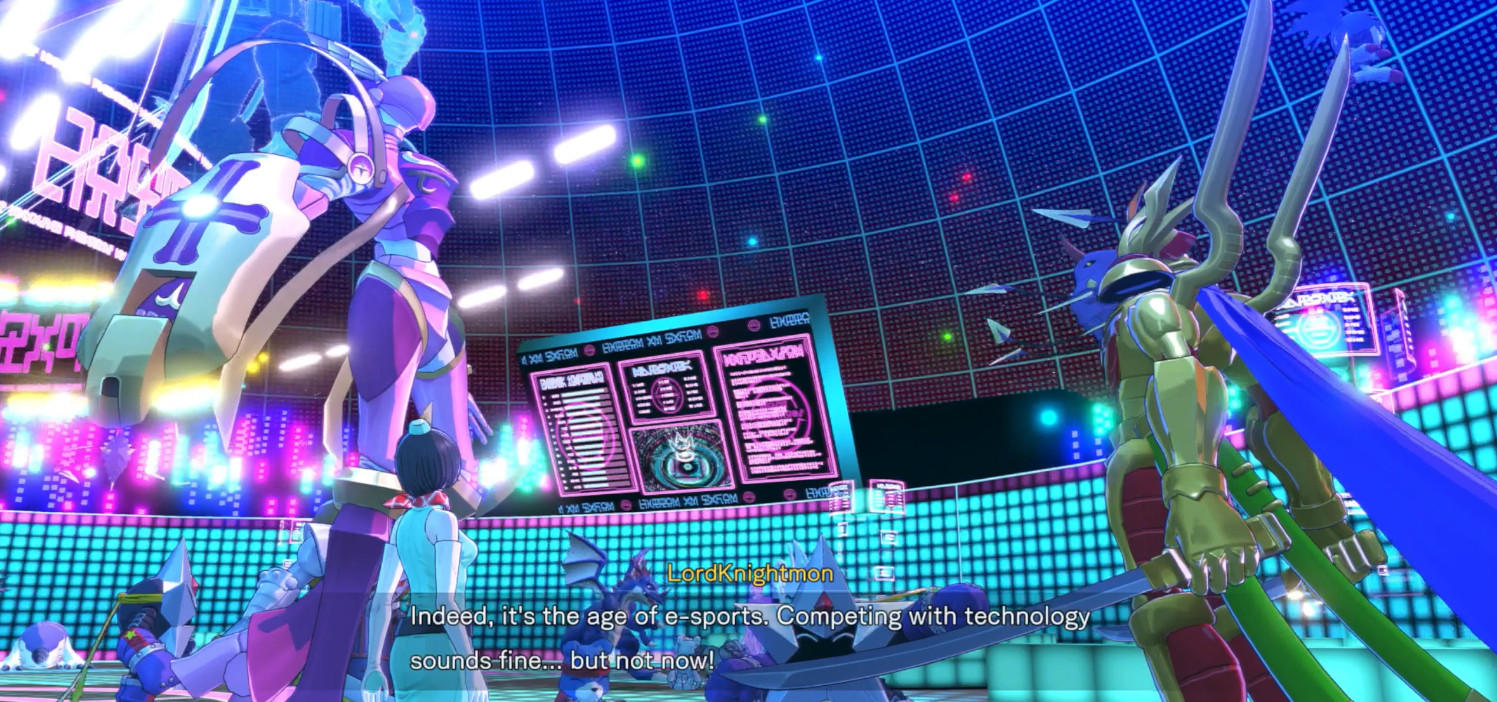
The opposite Yuki you didn’t pick spends the game as your operator, keeping you updated on the state of the world as you progress. They do this constantly, and it’s one of the worst parts of the game. Once you’re in Iliad, they’re calling you every other minute to remind you how bad the anomalies are getting on Earth. I’m shocked that there doesn’t seem to be a mod to remove them from the game for the PC version as of writing. The player character already feels a bit forced into the story, so having your gender-swapped self barking at you about preventing the Shinjuku Inferno every ten seconds is frustrating to say the least.
The story’s pacing is a mess, and a lot of characters drift in and out of the plot without much fanfare. For example, Inori’s father is initially presented as an important figure when you meet him alongside her at the start of the game. After you go to the Digital World, he’s not mentioned again until the last bit of the game, and even then he’s spoken of more than actually interacted with. Most of the major events take place in the last fourth of the game, with the beginning doing a lot of setup for events that don’t get paid off in a satisfying way. While it makes sense that you’d be thinking less about the human cast while in the world of Digimon, it makes it far more difficult to give a damn about anyone you’re catching up with once you’re back on Earth. At the very least, most of the incidental dialogue is very funny, as seen in many of the screenshots I used for the review.
When you’re not working on the story, you’re doing a few side quests. Side quests are for the most part pretty generic, but some do feed into overarching plots with the people and Digimon you come to know, and those are the ones that stand out. I especially liked a few quests involving the Bearmon brothers, who are two rascals who get into trouble throughout the story. As time progresses, they attempt to become more involved in the main conflict, and then promise each other that they will continue to grow stronger together via a buried note in a time capsule.
Later, another duo of sibling Digimon called Drimogemon take up their mantle after the Bearmon have grown up and had tragedy change their lives, but these new fighters are inspired by the note and capsule that they find, and promise to fight for good in the future like those before them. The game’s time travel aspects add to the events that transpire between a few of the characters, but otherwise it’s a lot of “uh oh someone died we gotta stop that” a bunch of times in a row.
Many of the best side missions are not given to you until later in the game, which presents a host of issues in itself. For starters, the game ties Digivolution level to your Agent Rank. You are able to use Champion and Ultimate level Digimon in a timely manner, but Mega and above take until you’re on the path to the final boss to use. Your agent rank, as stated before, rises based on how many missions you complete. So, how do they limit your rank from going too far before it’s appropriate? Around half of the game’s side missions are dumped into your lap right before the final boss. The multiversal threat sits around patiently while you do errands. It’s Mass Effect 3 all over again.
Of course, you could ignore them and go wrap the game up, but I wanted to use Armageddemon, dammit! Most of the coolest Digimon are Mega and above! I don’t think you should have them for the entire game, but the pacing is off big time. There is also a spoiler-related reason why I dislike this side quest dump, but I’ll leave it at “being told that we should move forward in time and then almost immediately being given the ability to go back and do side missions you missed” is a bit dissonant to say the least.
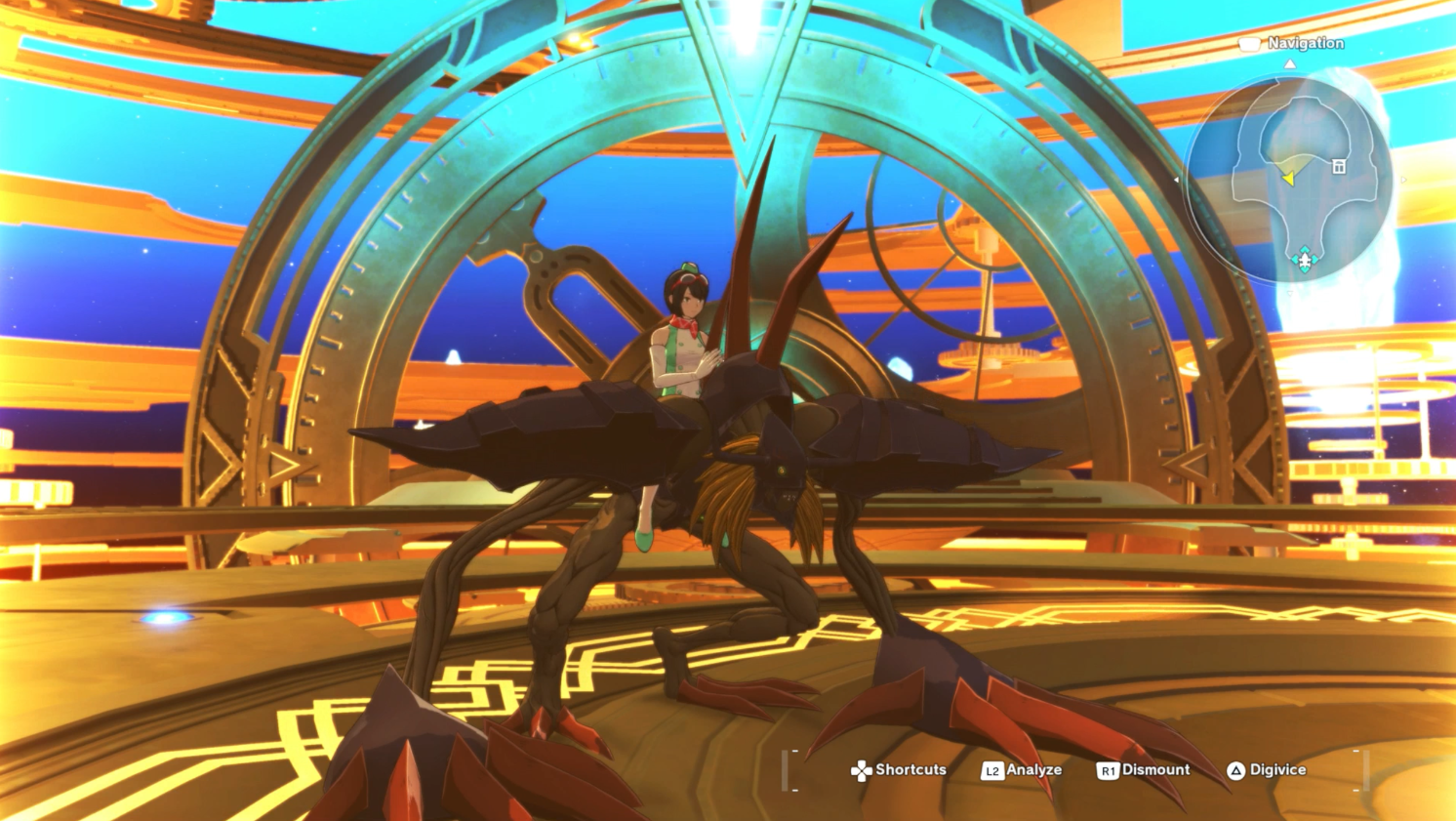
There’s some supplementary material, but it varies from “acceptable” to outright bad. Near the end of the game you unlock a colosseum of challenge battles, and that’s alright. There’s also a card game, which, unfortunately, is dreadful. You can collect cards by winning games or buying them from vendors, and all it does is add to your pool. You do not craft a deck. When a game starts, you draw five random cards from your entire collection and use those against your foe. You go through five rounds, choosing one card per round to fight.
Evolution level and the weakness triangle for Data/Virus/Vaccine are supposed to be involved in the match-up, but sometimes the victor will be chosen arbitrarily. I’m not being hyperbolic here, sometimes the game decides a weaker Digimon defeats a stronger one, even if the stronger one has an elemental or type advantage. Sometimes you’ll just randomly miss, sometimes a KO will be reversed. No reasoning! There’s only a single side mission associated with this game, so it’s fully optional, but comparing this to the extensive card battler in Digimon World 3 feels shameful. I’d have to imagine they did this so it wouldn’t eat into the physical TCG or the upcoming online TCG simulator Digimon Alysion, but this is almost worse than nothing, it’s random and boring. I never expected a side mode to be as in-depth as the real card game (which I adore and think more folks should try!), but this has less depth than rock-paper-scissors and sometimes makes you lose for no fault of your own. I know it’s supposed to mirror simplicity the V-Pets’ battles. I don’t care. It sucks.
Iliad is an aesthetically pleasing locale to explore, even if it is a little linear. Each area is a town with a few items to buy and locals to chat with attached to a dungeon or two at either side. The areas are lively, but there’s not a ton to do. You can buy JRPG standard healing items as well as equipment and new attacks to slot onto your party, but you’re finding just as good if not better equipment while roaming the dungeons. You’ll end up sitting on your funds for the most part unless you need to restock on HP/MP refills. Using items in combat doesn’t eat up your party member’s turn, so spamming healing items early on is not an issue if you’re struggling.
Masafumi Takada is back on the soundtrack for Time Stranger after working on Cyber Sleuth and Hacker’s Memory, and he did a bang-up job here. A few highlights for me are the theme of the In-Between Theater, “Enjoy The Fight” which was used in all of the trailers, and the music that plays when a certain group of legendary Digimon are fought. (That group really didn’t need to appear in this game and have so many of those late side missions tied to them, but their music rocks so I’ll forgive it.) The voice acting is also overall good, but I do think some of the Digimon party members you can get have mismatched voices. My precious Diaboromon line all sound…kinda heroic at times? The beings of pure destruction and malice? It’s fine if they don’t all use the same VAs as the anime, but at least make the voices match their vibe!
Time Stranger is a game that we know was in development for around eight years. With the loss of the game’s producer Habu Kazumasa in 2023, and such a long development time, it’s a safe guess to say things might’ve gotten lost in the shuffle. What was built on such a strong foundation falls apart when put under a microscope, too many plot and character threads that fray and splinter. It’s a bit frustrating that after such a long wait, we’re left with a game that feels like the start of a stronger franchise instead of an incredible experience a long wait could have led to.
I overall enjoyed Time Stranger, and am looking forward to whatever is next for Digimon video games, but I don’t think this is the perfect game everyone has been pining for. Instead, I think this is just the most balanced experience the series has had yet, by default making it the easiest entry to recommend. Most of this review is criticisms, but I must stress that I like Time Stranger! What I like about it is just held back by such a vast variety of little issues that I’m left with my list of gripes being far longer than my praise. If you’ve been looking for a way to get into Digimon via the video games, this is the entry point you’ve been waiting for. If you want a JRPG that you can customize fully and experience a unique world in, hop on in. Hell, even if you’ve read this and feel like you do want more from a Digimon game, I still think it’s worth a shot. I will be looking forward to the next Digimon game with a lot more excitement, because even with all its flaws, Time Stranger is the foundation the series has needed for quite a while.
Good
"Still In-Training, Somehow"
Digimon Story: Time Stranger is a fantastic foundation for the future of Digimon's video games. There's still MANY compounding flaws, however.