The gameplay footage in this article contains flashing lights and gore. Please be mindful if you are sensitive to either.
Out of the many FPS released in the past decade, Cruelty Squad is the game which had the most impact on me. It’s made me ponder my own writing, my relationship with the genre, and my personal relationship with aesthetics and what they say about the art you make. It is also just a rollicking good time. Naturally, this is high praise coming from someone such as myself who spends a lot of time being drafted into first person shooter engagements at the behest of numerous people. I could wax poetic but, in this instance, I think I will simply show you.
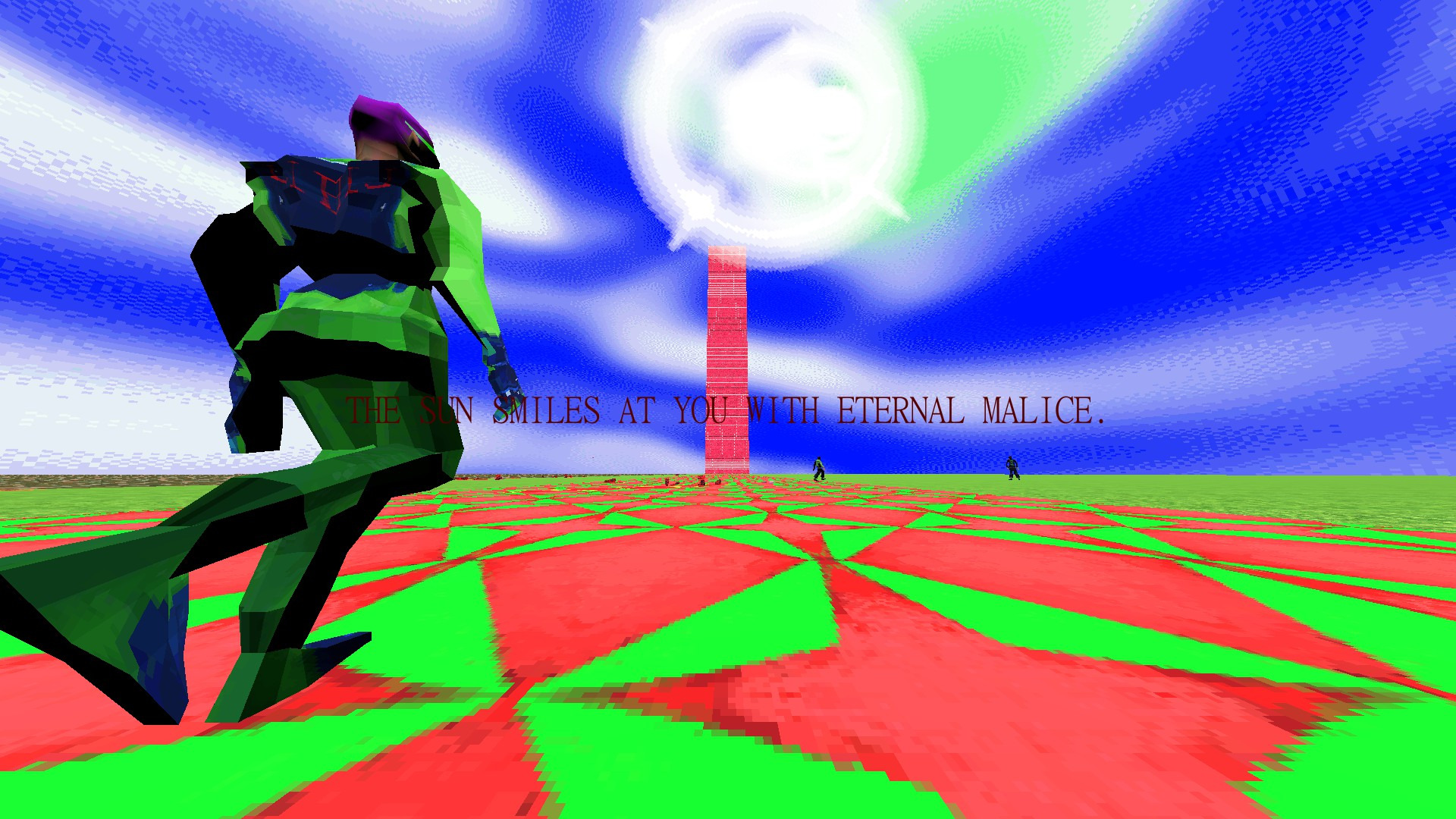
This is what an early run of Cruelty Squad—a 2021 first-person shooter and organ commerce simulator made by Consumer Softproducts—might look like.
And here is what a late game playthrough of the same level looks like.
Understandably, your first reaction to those two clips will likely be “what the fuck?”, but I assure you I will endeavor to unravel the tangled ball of nonsense I just plopped in front of you. Cruelty Squad is one of my favorite games, dominating my thoughts and resonating with my own anxieties and pessimism surrounding the world I occupy.
I will abstain from indulging in my first instinct, which would be to prattle on about the natural beauty and rhythm of the gameplay mechanics. Instead, I will engage with what an immediate first impression would be, and the reactionary negative response therein. So, in my urge to give the best possible impression of this game which has captured my heart, I have an obligation to disabuse some notions.
Let’s talk about why Cruelty Squad looks like that.
Visions of a Puke-Choked World
Immediate responses to Cruelty Squad’s aesthetic sensibility can be described as “divisive.” The presentation of Cruelty Squad, from its menus to the first combats, feels like an audio-visual attack. Many responses to the game ultimately culminate in saying the game is good despite what it looks like, or reveling in its appearance as a sort of in-joke—a game which refuses those not capable of seeing past its surface level. I don’t particularly identify with either of these ideologies. The aesthetics are not aiming for a refined peer-reviewed art style or sound. It can be summed up in a single word: ugly. Yet, this is not the condemnation it sounds like; intention is the difference.
My enjoyment of the putridity of the presentation of Cruelty Squad feels like the manifestation of a contention within myself. I enjoy dark, frightening, abrasive things. Often, this results in interrogation from other people.
“What is there to be gained from enjoying something like this?”
“Why do you do this to yourself?”
Then, from there, it becomes assertions.
“You are lying if you say you enjoy something like this.”
“You only enjoy this for attention; it isn’t possible to enjoy something like this.”
All comes to a spoken or unspoken conclusion.
“There is something wrong with you for liking art like this.”
People who appreciate such art often spend many dozens of words publicly performing self-awareness; a ritual of showing they too are aware of the grisly, unsettling, or unsightly nature of the media they partake of. Perhaps it isn’t immediately inaccurate: as someone who dumps all her music into one gigantic “liked songs” granfalloon, shuffling from rebarbative death metal to insensate baby music for evil gay people, there are probably more than a few things wrong with me.
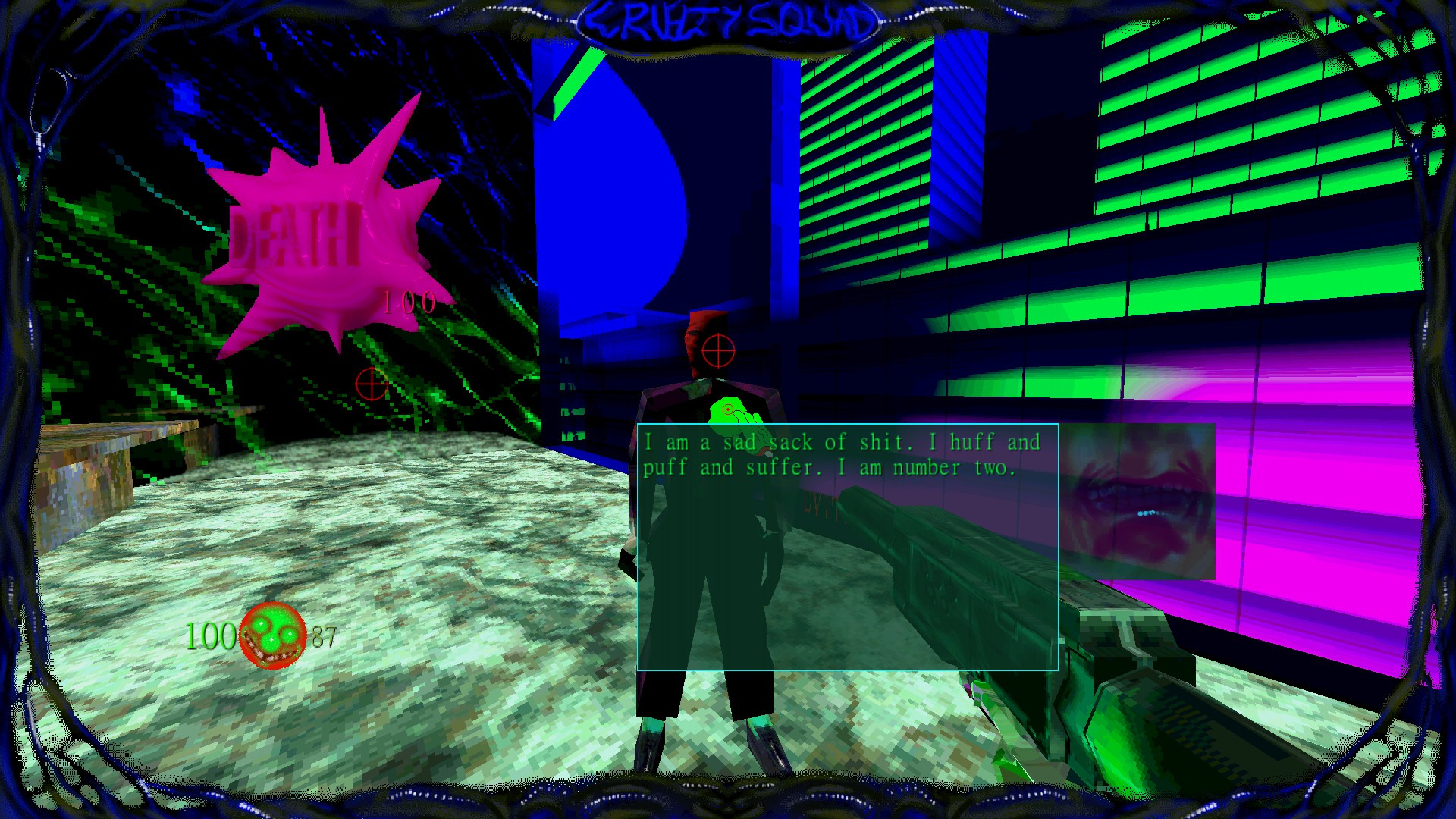
Despite saying that, I refuse to deliver an insult upon an art style I genuinely find compelling just to have the appearance of being “in on the joke.” Yes, admittedly, there is an enjoyable teenage-boy-showing-a-classmate-a-particularly-gross-bug factor to repulsing others with art you enjoy. Just so often though, it is isolating. Around the third time someone asked me if my mental state was okay upon streaming this game publicly, I stopped being amused and started thinking those people were incurious at best, and fucking dumb at worst.
No matter how many times I’ve written and rewritten this passage, some level of acrimoniousness creeps into my words. The college professor who lives in my mind is presently shaking their head and reminding me that insults to the audience are generally not convincing; and they’re right, I know that. I have no obligation to defend this game from other people because of the strength of my own convictions—yet I seem to over and over. Even within the words of this supposed “review” I find myself treading the same path I walked in my review of Beyond Citadel and even my more personal works. But such defensiveness feels necessary, months have passed and I still see thumbnails, articles, reviews, all asserting derangement from the art I love. Once more I feel compelled to articulate what seems obvious to me: an inability to understand art does not make it incorrect, “psychotic,” or the spontaneous generation of an intoxicated artist.
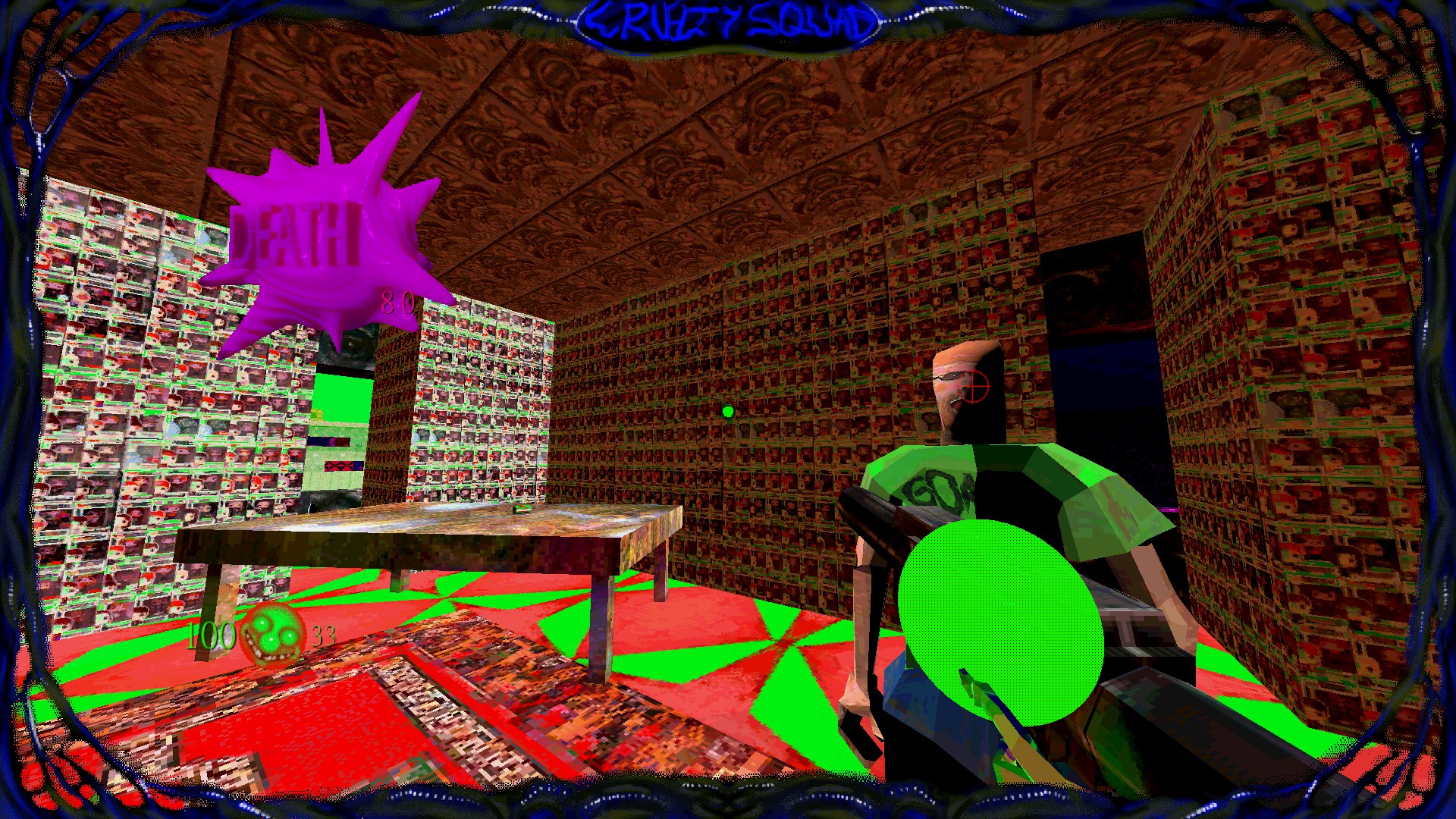
Then, I won’t pretend and I will simply say, now many paragraphs in, Cruelty Squad’s aesthetic is both hideous and flawless. Art has no obligation to show you only beautiful things, and the world of Cruelty Squad with its unchecked capitalistic transactions and violence is far from beautiful. Contending with a stock market which runs on human organs as easily as it runs on business acquisitions would not work if the world looked like Cyberpunk 2077. Cruelty Squad’s world is adorned in noisome beiges, nightmare gradients wielding the word PUNISHMENT like a sword; the mall of Cruelty Squad is just as likely to have a zombie-infested meat crypt as a Gamestop containing no games and only selling funkopops.
The music is just as dissonant and frictive as the visuals yet enjoyable enough that I’ve carried it out of the game, much to the chagrin of anyone in proximity to me and an aux cable. The tracks are noisy, unpleasant, and immaculate, from the pulse-pounding “Combat Cocktail” to the menacing yet serene “Divinity of the Office”.
In all the aesthetic presentation of Cruelty Squad there is violence. The rejections of normalcy, of representation of life turned off kilter, is a reconstruction of what is; You are then forced to see what you took for granted from a new perspective. Contained within are sights which I cannot claim to have seen anywhere else. Novelty can be powerful—I have certainly never seen a swamp-themed casino run by a screen contorting cognitohazard—but I also think there is a loudness to the way it rejects normalcy. Some aesthetics, like that of extreme horror, are loud as to be unignorable. The aesthetics of satanic metal are loud; the aesthetics of Cruelty Squad are loud; and so too are the aesthetics of violence.
Seizing the Iron with Your Own Hands
Violence is Cruelty Squad but not in the sense one would traditionally expect of a first-person shooter. Violence pervades every system, the world building, and the architecture of the story itself. The first cutscene prior to picking a mission consists of your protagonist dispassionately watching a mass shooting outside their apartment window before being headhunted into some violence of their own—a gig economy of assassination.
The repulsiveness of the aesthetics immediately becomes apparent within the mechanics themselves. Instead of the traditional push-button reload, a staple of the FPS for decades, you are asked to hold down the right mouse button and sharply pull the mouse backward and then back up again. This realization and the subsequent clumsiness will likely result in your first death; after which the game will politely inform you that you are a flesh automaton animated by neurotransmitters. You resurrect from the inconvenience of death at a flat rate and then go at it again.
All missions follow the same structure: you have a target—wallhackingly displayed at all times—which you must murder to progress. Most of the time, they aren’t even aggressive; you can strike up a friendly chat about their world views and then discharge a firearm into their head which sounds like it was remixed by Merzbow.
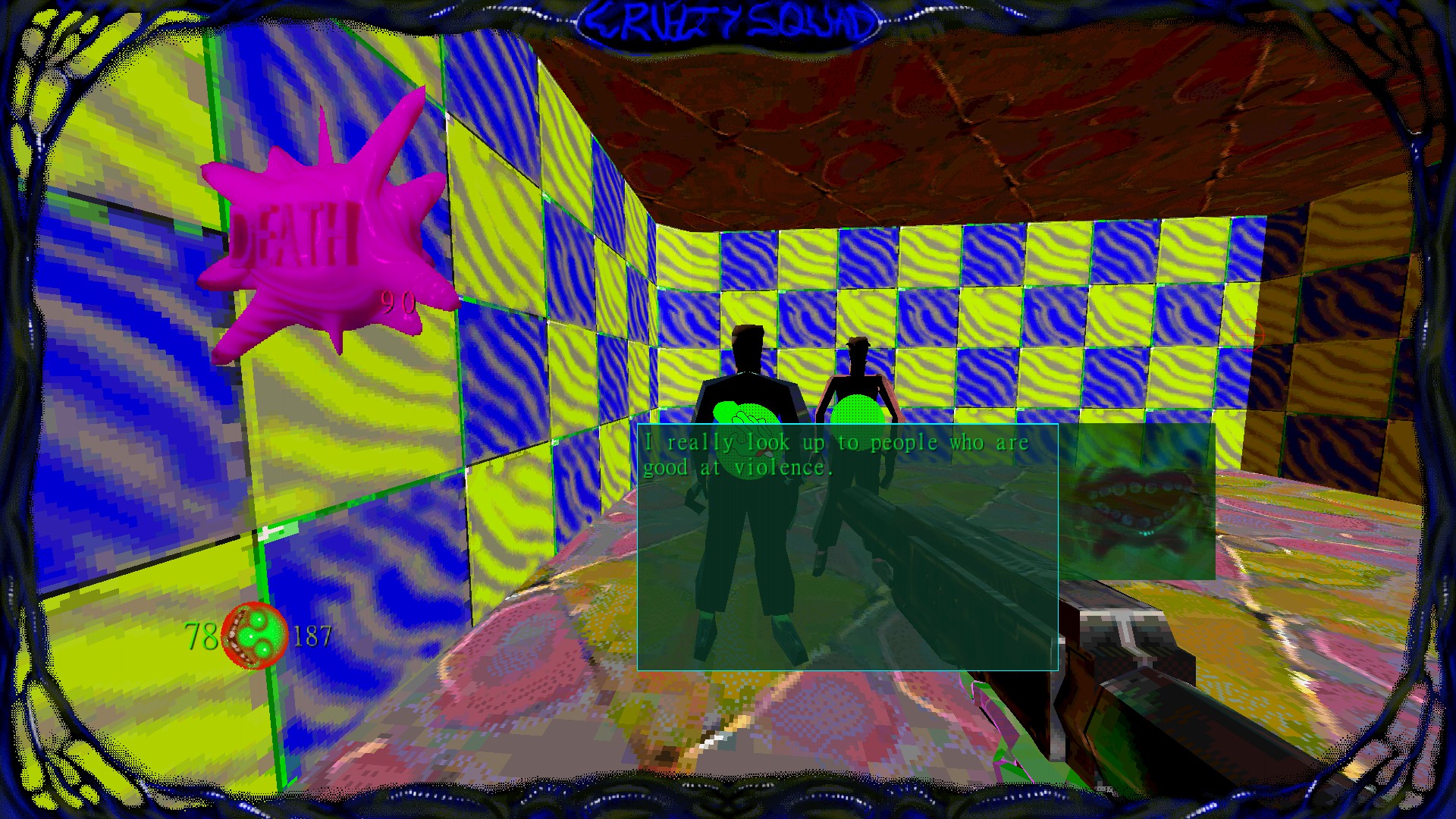
Hitman, this is not. There is no particular reward for precision, no complaints for misapplicated bullets. Nameless victims get in your way and the only real impact on gameplay is a minor annoyance, bodies blocking bullets meant for more relevant targets. Often this results in their meaty and hyperbolic explosions into viscera, bone, and organs—a monetary windfall to be sold on the stock market.
This is what I alluded to before. Violence is Cruelty Squad in ways beyond the dispensation of firearms. The business of killing is a transaction and so too is the aftermath: to kill someone is to gain the net worth of their organs, and the rest is someone else’s concern. The stock market can be opened, traded on, and manipulated in real time. One can intentionally manipulate the market by watching the targets line up with businesses in game, then flooding the stocks once they react to your murders. One mission, requiring you to kill a political figure, causes the stock market to rapidly inflate with no upper bound. Leaving the game on while this occurs nets you an essentially infinite amount of money and renders the game’s monetary progression meaningless. Wealthy players can purchase everything they want, acquire all resources, and then never need to think of money as anything other than a high score.
This is both exploit and commentary. The paltry death-inflicted sums of $500 mean nothing when you can generate infinite wealth from someone’s spinal cord. The only real punishment from death is in the form of irritation from your handler; they turn you into some kind of flesh-eating slime beast which lowers your difficulty setting. The cheapness of resurrection, and of life, is also the canonical explanation for mission replayability: the wealthy resurrect and your duty is to cause them to suffer the repeatable inconvenience of death.
Much like the real world, the rich live sheltered lives; they build themselves in cocoons of lavish, unimaginable wealth, sheltered away from the suffering of lesser people. Death, too, is rendered meaningless in the infinite avarice of the high wealth individual.
Meat Grinder God
The story of Cruelty Squad is completely unobtrusive if you allow it to be. On a mission-to-mission basis, you are given a context-establishing text crawl. The missions themselves often provide context-building dialogue either from targets or random NPCs wandering around the location. Generally however, the plot, the reason for your actions, is intentionally obscured and distorted, whether it be through multiple layers of intentional deception or just the way people talk in this universe.
This is not an obstruction to the actual gameplay in any way. You can plunge deep into the gore of Cruelty Squad and not once pay a single thought to the why of it all. With the previously established target-seeking wallhacks you have, a person uninvested can ultimately play through the entire game gathering nothing but the essentials and still see an ending. You can speedrun death until it is as transactional as the stock market ticking away in the background.
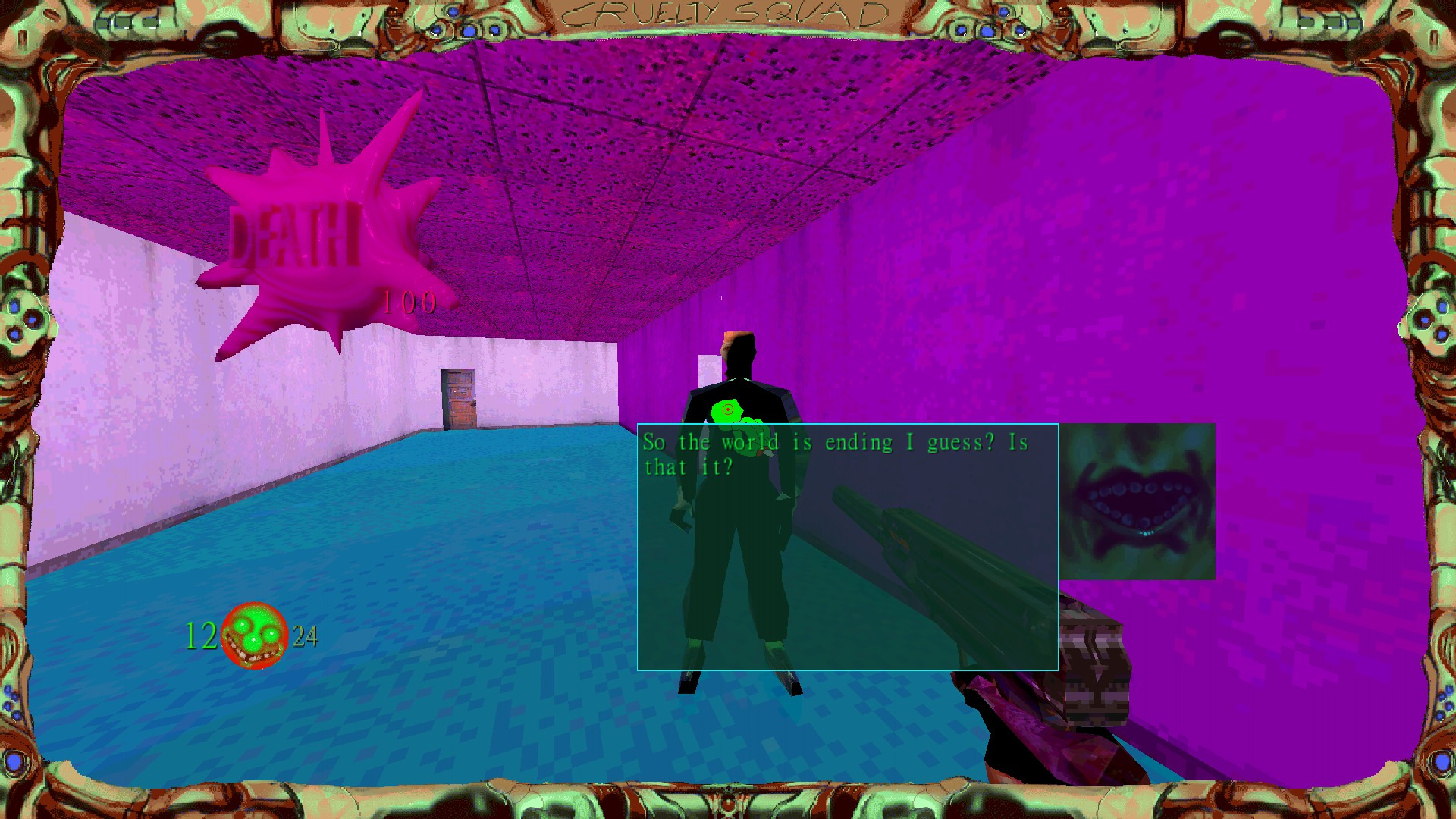
Cruelty Squad is a game where its mechanics tell the story. The mechanics tell you of a world where someone can endlessly resurrect, have a menagerie of firearms and organ-replacing biomods, and murder people in a way which only meaningfully affects stock prices; this is storytelling of a variety where nobody needs to explain how the world works. What lore messages there are tell you of weapons meant to cope with this reality, firearms which scramble DNA to make resurrection harder or other technologies. You live in this world and shoulder the discomfort as a person not made for it; when you see a cruise ship powered by engines made of flesh or a rich neighborhood configured in the shape of a pentagram, it is the player who must understand, not the character.
That isn’t to say there isn’t a story to dissect. The endings in particular have intrigued me since I 100%’d the game for the first time. There are three; each ending is a response to the world at large. The first one is the most immediately obvious: you simply take the easiest path, free, liberated from context and just following orders. Walk ever forward on the leash your handler tugs, pull your triggers, and then go home. Second, is the hateful path: climb this pile of undying bodies, stand atop it, and feel pride in yourself for being one of the few who makes it. There are thousands beneath you, but this is beyond your concern: you won the game, the economy is yours. Last, you can take the hard path, doing what nobody else can. Where many others roll down this endless hill, you stand up and end it. You break the system nobody thought was breakable. Like a god, you make a new world and everyone else is forced to live in it; through divine idiocy, you bend the world to your individualistic whims.
Thank goodness; finally, after all this time, the first nonpolitical video game.
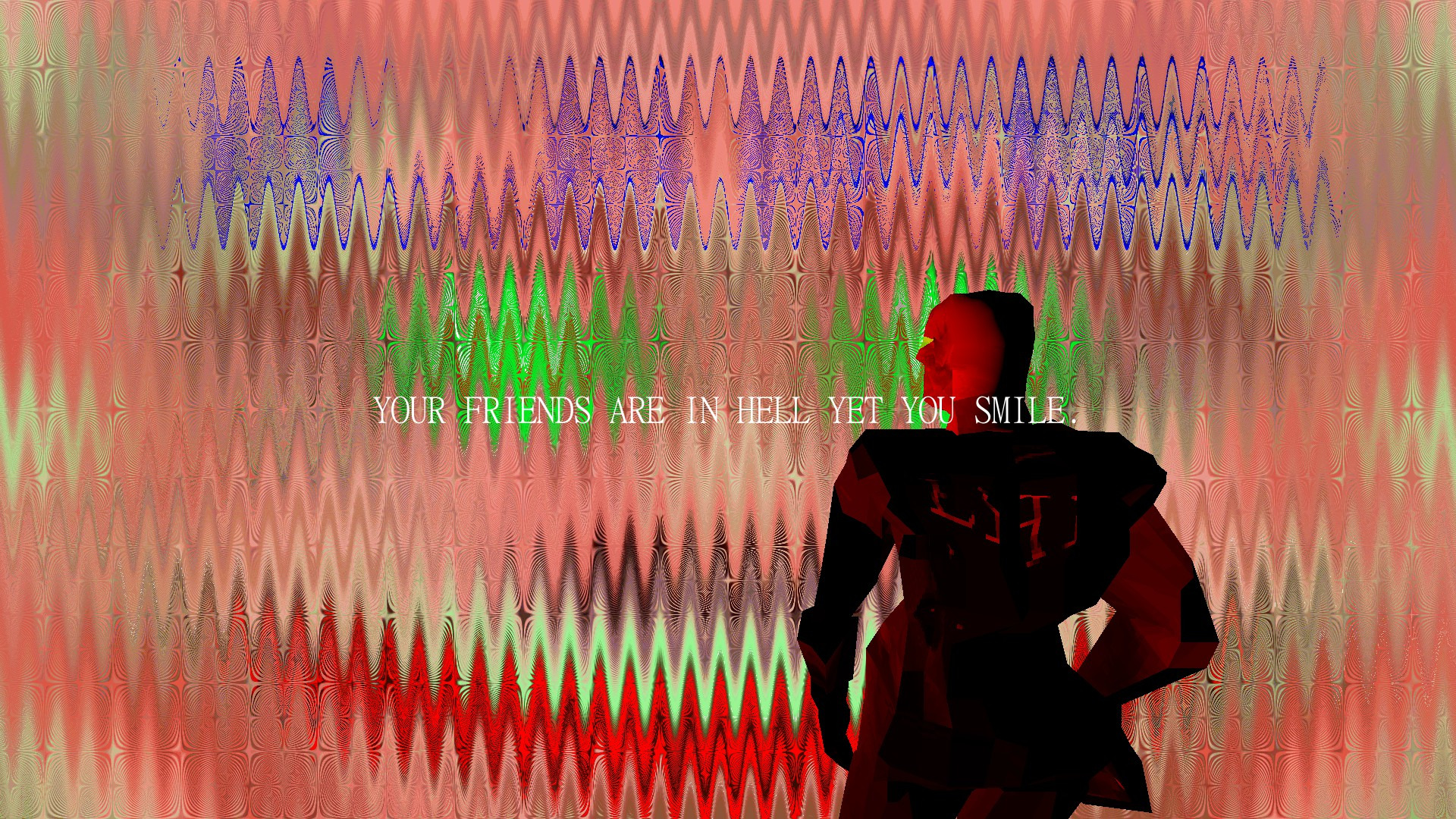
This is a breathtakingly stupid video game if allowed to be. It is exactly the blind violence aging parents of numerous generations have declared video games to be. Violence for entertainment, pointless and therefore—to many—harmless. This is a viciously cynical video game if allowed to be. A nihilistic story where the world is without death, endlessly wasting its time on banal amusements to no end. A story where nothing matters; make the number go up because skinner boxes have replaced actual value and the stock market ticker is the only thing still moving. In the world of Cruelty Squad, Death, like a transaction, is value. A deathless world is one where life becomes meaningless, an expectation, forever for the sake of forever. Thus, I can find hope in a bleak message. To restore death is to give life weight and have the finite life mean something.
Gutter Cruiser
I have been critical of the genre of cyberpunk for a long time. Once something with teeth, a prophetic critique of the terror of untamed capital, now just empty aesthetic. Neon tubes, rain on city streets, the distant sounds of firearms popping, and corporations which rule everything. This is no longer fantasy, or even a prediction of the future—it is just reality.
I was shocked by Cruelty Squad’s ascendance of the Cyberpunk aesthetic. It made a world I would absolutely on no level want to live in, yet I must acknowledge its similarities to our own. It eschews paths which would have made for an easier story to tell, an easier pill to swallow. The mechanics are intentionally rough, the story opaque. Its aesthetics are abrasive and avoid the comprehensibility of much more “put-together” games.
I initially played Cruelty Squad at a time when the capitalistic pressures of the world were utterly suffocating me. Healthcare and its bureaucracy were grinding me to nothing while I watched people with more net worth than I can ever dream of pay to avoid the lethality of the world. The bodies piled in the streets, and I found this game, harshly cynical and putridly honest; it resonated. When I first saw the trailer, with its aggressive grinding music and despair-inducing messages, I felt something. It was not positive, nor negative, just a fragment of my soul echoing. Just then, the trailer gave a message, like it was just for me.
“Does this even make you feel something?”
I can answer now, in full honesty, that it does.
I felt the crushing despair of capitalistic grinding teeth. I felt the hollow joys of a power fantasy: perhaps if there are a thousand evil people with guns, one good person with a gun could solve some problems; the same delusion which has ruled American media for centuries. I felt a quaking shadow of a future where one can choose to accept falling down the mountainside, letting the machinations of others define your life trajectory. And I have felt Cruelty Squad.
Superb
"The pancreas has been unfortunately outmoded due to advancements in food technology"
Cruelty Squad is an abrasive yet engaging game with more than enough to dig into if you are willing to meet it in the dark places it dwells.

Unfortunately, I think I am one of those gamers who had/has a less-intellectual appreciation of Cruelty Squad. My enjoyment in the game is from the mechanics, and I certainly find myself adopt the behavior of one who takes the piss regarding the game’s art misdirection. But there is some genuine appreciation there that I don’t think I can articulate — it may be a latent understanding of some of the themes which only now have popped into my conscious as a result of someone else articulating them (ty Lilith), but that sounds like cope; I’m probably just one o’ them basic b*tch gamers who likes it when I, the chad protagonist, makes the target, the virgin capitalist, go explodey (in a reversible manner).