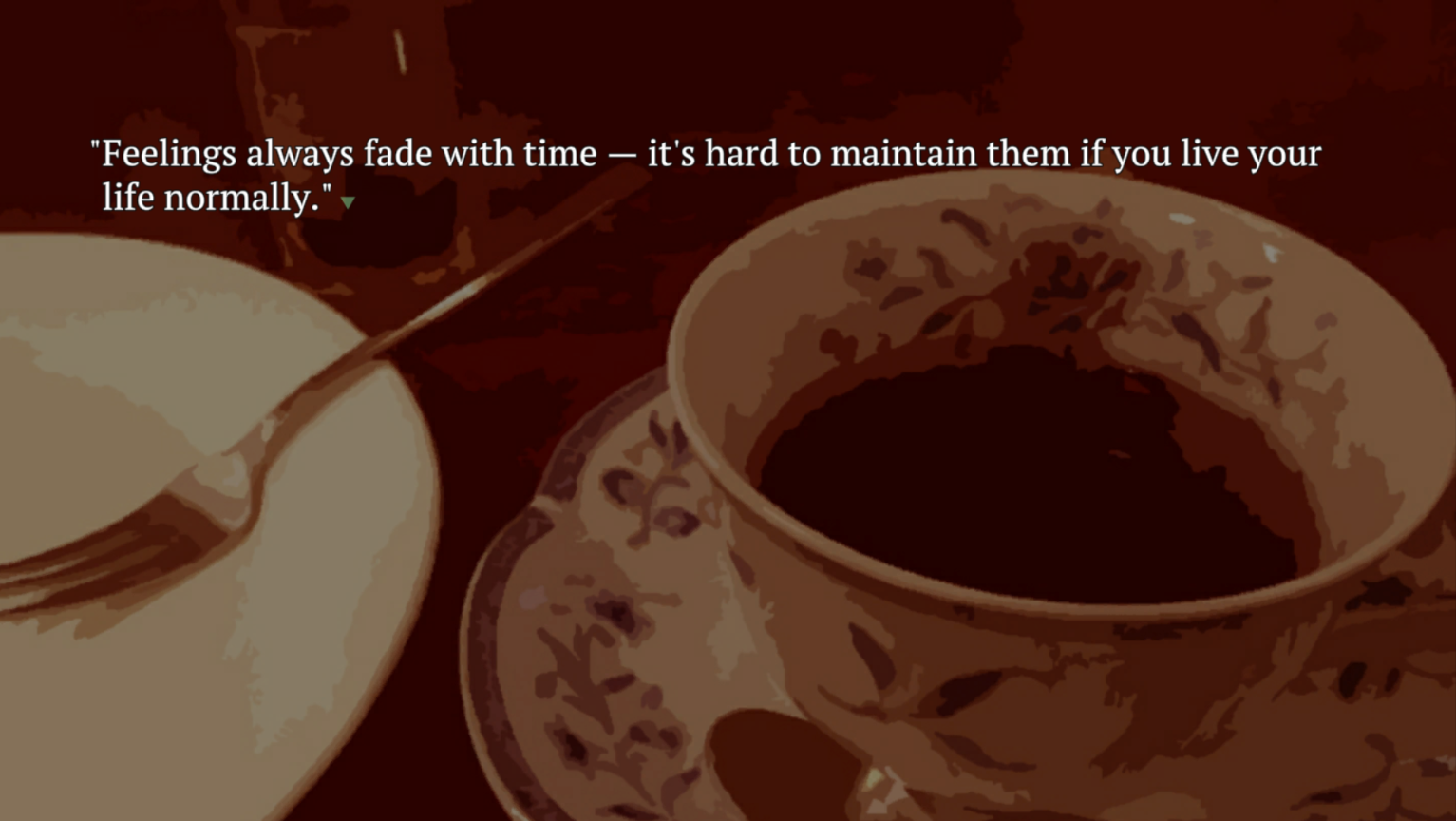
I’ve been rather out of touch with myself as of late.
Human memory has been on my mind a lot. It feels like on the internet it’s almost impossible to escape talk of nostalgia. Everyone seems to want to do things that will remind them of when they were a kid. In February The Pokémon Company announced the release of minorly updated ROMs of FireRed and LeafGreen versions, games from 2004 that are themselves reconstructions of games from 1996, and that they are seriously for real genuinely charging money for them. Endlessly we watch games get remade, remastered, rereleased, reimagined. I look at this and think it must mean there’s a demand for the chance to relive the past.
I don’t really relate to feelings of nostalgia as I see them described. Replaying a game is extremely rare for me, as when I’ve tried, I’ve typically found nothing of value. Maybe my knowing what happens saps the appeal out of a game. Maybe for those ones I forget I’ve just changed so radically that I couldn’t even figure out what younger me saw in this thing. When I do replay a game, I usually find my attention is caught most by the parts I hadn’t remembered, and just how much there can be, even in only a couple years since putting a game down.
And yet I have my own ways of trying to hold on to the past. I maintain not just a backloggd account, not just a letterboxd account, not even just a Rate Your Music account, I also dutifully fill out a Google Sheets file with details on every game I have played or am currently playing, a numeric rating of what I think of the games, to reference at a glance, and the dates on which I both started and finished them, going back four years. This is not so I can write reviews, it’s because in recent years I had found myself more and more disquieted by how little I had committed to memory of the art I was experiencing. I had hoped a more active form of engagement would encourage me not to sleepwalk through my own life. I don’t want to think “what the hell was I thinking with this one,” I want to be able to recall what those thoughts might have been.
This hasn’t really worked that well. Especially with music, so many albums tucked away in my Spotify likes mystify me. When did I listen to or enjoy At the Drive-In? Apparently, I thought fondly of that one Brave Little Abacus record with the long name. Records tell me it was less than two years ago I listened to this album and liked it enough to hold on to. Couldn’t tell you what I was thinking because I don’t know what any of the songs sound like, or are about. If I pull at the foundations I uncover one thought: their vocalist sounds like SpongeBob. Very well done.
In my fervor to make my time spent living and breathing mean something, to pull feelings out of art and chew on them for longer, I have played and loved and hated quite a few titles by now. My poor, poor screenshots folder is now absolutely packed with things I wanted to keep with me. In an effort to better understand my habits, and learn to mediate with these feelings I hold, I find myself now writing a few words about a few games that, to me, did something that mattered, that stuck with me, for better or for worse.
Long Season
A few years back I played through Boku no Natsuyasumi 2 with my girlfriend, via the wonderful fan translation put out by Hilltop. We committed to syncing Boku’s life to our own, playing one day at a time, through the month of August, passing the controller back and forth each day.
I think part of what kept the game alive in my heart was this consistency over a long period of time. Had I binged it alone, it may well have been a footnote on my backloggd account. But more so than the matter of pacing, Boku no Natsuyasumi 2, in keeping with its predecessor, is a game that encourages you to absorb it. Time only passes in game when you move between different areas, and if you want to stay somewhere a little longer, you can. Stare at the river if you like, it’s not going anywhere.
The knowledge that time will stand still as long as you do works to discourage the player from leaving a scene unless they’re certain that’s what they want to do. You immerse yourself in the mundane because there is no penalty for doing so—only a limit on how many different things you can do in a day. I find it quite counter to a lot of other games’ philosophies. Xenoblade Chronicles was made by sick, sick people. But even something like Persona, something made to limit how much you can do in a way that comes across as a “carpe diem”—they’re still, at the end of the day, something to the effect of ten billion hours long. Those games are jammed full of Game to be Played, and while I don’t think that’s inherently a bad thing, I find the Boku approach much more emotionally liberating.
Central to this, in my mind, is that our main character, Boku, also keeps a journal. Every night, just before he crawls into bed, he writes an entry about something he did that day, accompanied by a cute little drawing. On many occasions in my life, I’ve tried to take up journaling. It’s never stuck, the book will always find some forgotten crevice to sink into for years at a time, but that meant it fascinated me to have this little record of what I’d done that I could reference whenever I wanted to. I think part of what captured my heart was the game’s system for deciding what your journal entry will look like—even if you shape his overall adventure, Boku is the one deciding what he will remember. And while the game tries very hard to ensure you get an entry each day, if you do nothing it deems technically noteworthy, it tells you this:
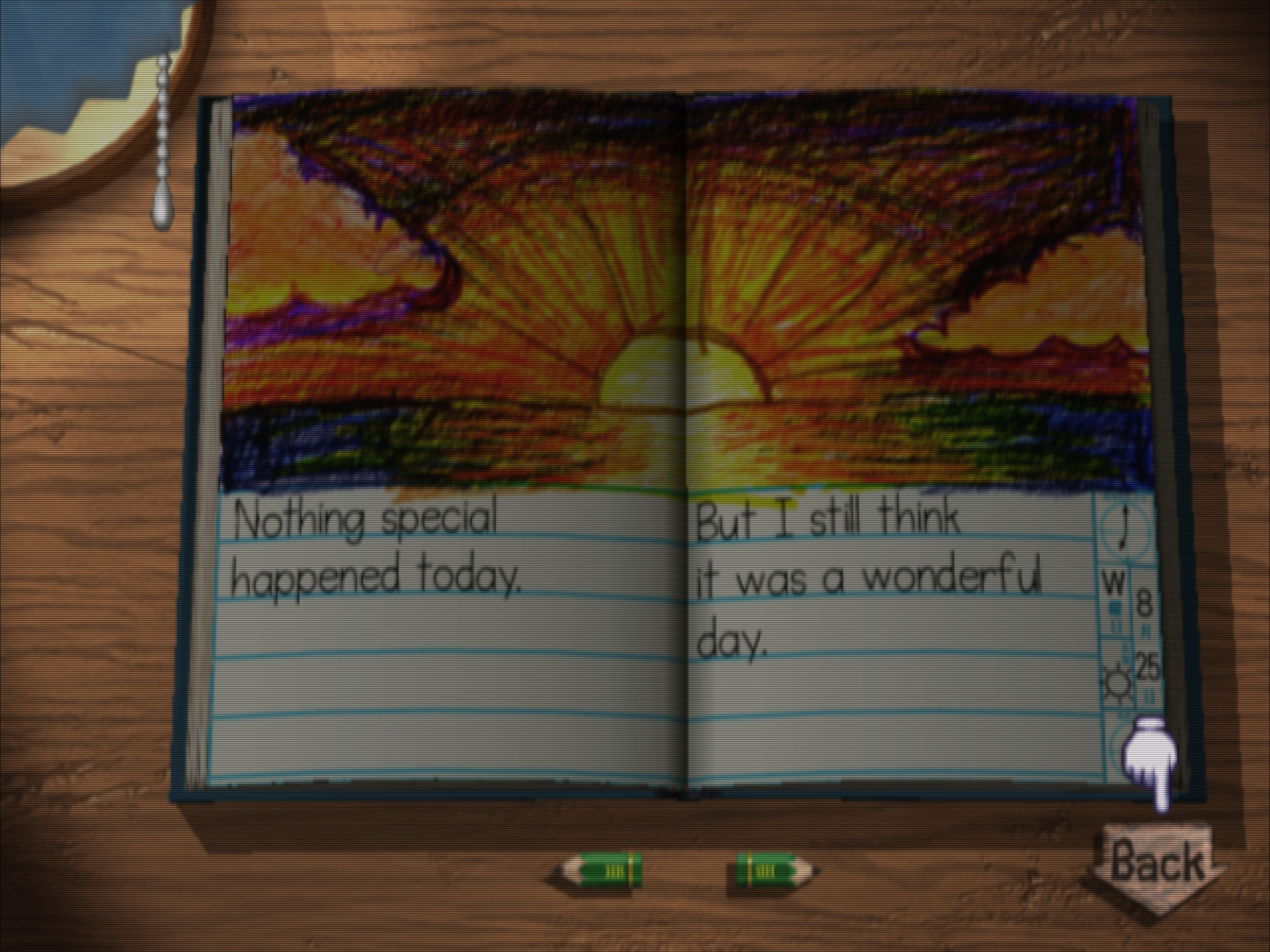
The way that Boku cultivates deliberate slowness in the player is beautiful to me, it makes its environments truly sing. You begin to understand, and feel, someone else’s memory. If you can believe it, I was never a little Japanese boy growing up in the countryside by the sea, I never made beetles fight or anything like that. I’d never even seen a firefly until I was in my 20s. This is what I mean about creating a sense of time and place, though. Through the game I was able to be so engrossed that there wasn’t any incongruence to be felt. I could almost imagine what the sea breeze must have felt like. I grew attached to the little emotional arcs of the various characters. Towards the end, when one of them said, “I don’t know when it happened, but at some point I fell in love with this town,” I felt the game was talking right to me, the player.
Of course, these games never left Japan, not officially. I think this is also a vital consideration. The dialogue here wasn’t really written for someone like me, necessarily. If anything, Boku no Natsuyasumi is itself a deeply nostalgic work. This game had strong staying power—I even still remember what I named my first truly accomplished beetle wrestler: Red Lightning. Perhaps, then, the trick to making me feel is not tapping into my past, but rather, showing me yours.
The Summer Ends
A few months ago I played Umurangi Generation, a photography game that positions you as a courier during the end of the world, equipped with only a camera. I had expected a slam dunk; I’m very fond of my own silly little instant camera, personally. There’s an easy appeal to having a physical memento like a picture, something so much sturdier than human recollection. Having had this essay brewing in my head, and recalling the praise I’d heard for Umurangi Generation, I booted it up and found something unexpected.
At first, I really wanted to root for it. I thought I was on board with what it was doing. You get placed into these little vignettes—a rooftop gathering, or some commotion going down at an intersection, or a vigil for someone we’ve never met—and given a list of things to find and snap photos of. I felt that by being forced to stay in one spot, I was encouraged to absorb details. I wanted to know the story of this world and the people in it; the minimalistic storytelling was really working for me. And then the game and I stepped out of sync.
After a couple of stages of contemplative stillness, the game pivots towards action shots. Battlefields with soldiers bleeding out and kaiju fighting giant robots. Suddenly I found it all tonally dissonant. I wanted it to be over with. Where once I saw a tasteful degree of restraint, I now felt I was wandering through a world that had failed to reach my heart, being asked “isn’t it so sad what’s happening?” Objectives that used to give me reason to linger in a space were now actively forcing me to search for graffiti with the word “boomer” on it while the world was meant to be ending. Maybe there’s commentary in that—the atonality of life, negotiating with yourself over your continued existence in a time of strife—but for me, it broke the spell. “There is no one right answer,” I thought to myself. “Weren’t you just telling me I won’t be told what’s right or wrong? That art is subjective?” The pictures I took ceased to have meaning when it occurred to me they would be roughly the same as the pictures everyone else took.
Even if I was sad to be fighting with this game, I still did see it through to the end, and something really interesting happened. After you complete all 8 stages, you get dropped into one final area, with no camera this time. There’s no pause menu full of objectives. I breathed a sigh of relief, that I could freely explore, take in my surroundings without being pushed any which way. I stared at the starry night overhead, lit up crimson. I thought about the game’s mascot telling me that Umurangi is a Te Reo word meaning “red sky.” I saw birds and flowers that seemed to be made of stardust. I saw something great and terrible, perched atop a mountain, blocking out the moon. The game handed me a camera again, and with irritation, I didn’t check to see how much film I had, didn’t think about making what was to be the last shot really count, and,
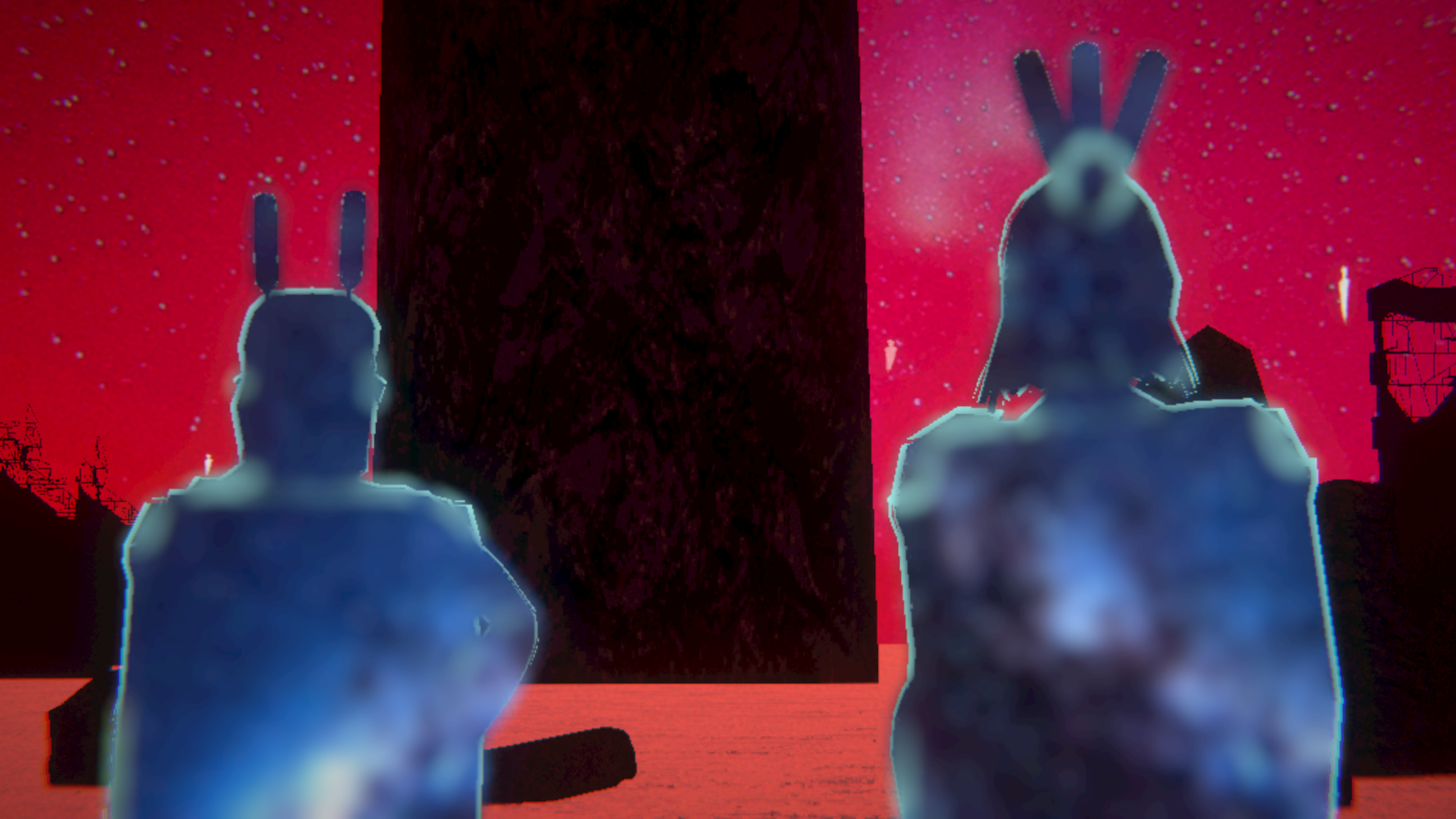
The game didn’t continue, didn’t chastise me for looking at the wrong thing. It showed me a mirror, and saw itself out.
The thing that I haven’t really been saying here is that part of what I wanted to find in Umurangi Generation was that special quality that I think a photograph has, that feeling of a particular moment, something normally fleeting and ephemeral, cauterized to staunch the flow of time. Even if I didn’t personally resonate with most of it, I kind of love how it ended, for me. This is a permanent symbolic impressing of my thought processes, encoded in zeroes and ones, that any computer screen can replicate. Whether or not I think Umurangi Generation is good means nothing to me—it told me something about what I value, and this final captured moment is far more interesting to me than any critiques I might have.
Fresh Flowers For All Time
This section will spoil critical plot details from Seabed. I think spoilers can work to give you a reason to enjoy a piece of art you might otherwise not have, but I also recognize that Seabed is a mystery novel. If you want to preserve your modesty, go read it and come back. I promise my words aren’t going anywhere—they will last until entropy takes them, like insects in amber.
Beginning to pull apart my feelings on Paleontology Soft’s 2016 “yuri-themed mystery visual novel” Seabed feels something like trying to split the atom with a butter knife. But we will try all the same. I’ll start with the age-old adage: women can do anything. Unfortunately, sometimes this includes suffering greatly.
Sachiko, our protagonist, is an amnesiac, unable to cope with the sudden loss of her life partner Takako. The entire visual novel traces a record of her winding path towards recognizing the symptoms of her trauma as they manifest in response to Takako’s death. In all but explicit terms, the novel is clear that she has DID, and the shock of that traumatic event destabilizes her and causes an increase in symptoms: dissociation, switching, hallucinations, and other sensory phenomena that might be classified as Not Super Normal. She realizes she had forgotten Takako was dead at all, and had lived her life talking to a ghost for years. What I want to take a look at is how she tries to cope—she flips through her old journal. Records of time spent with Takako. She hopes to find a passage that might cover her lost memories, and make it all make sense.
I will be forthcoming: it reminds me of my own experiences. Sometimes you find an old journal entry was torn out to protect you from knowledge you weren’t ready to process. Sometimes you find one you once wrote, and then later angrily scrawled out, in thick pools of ink, as if trying to measure out in millilitres your sense of disavowal for feelings you had earnestly held before. “Not even I will know what it said, when I’m done.” I may be so fixated upon journals, photographs, these physical records of life, because I know how easy it is for those memories to be stricken from the record while you’re not looking.
Seabed bills itself as a mystery, though its approach is not so direct as I think that might imply. If you ask me, I think it fits more into the iyashikei subgenre. It is Slice of Life, sharpened to a fine point, a knife’s edge to twist into your heart, and leave you feeling a little better and a lot worse when some of your humors are on the floor.
There are dozens of scenes of mundanity. In that same way Boku asks you to contemplate, Seabed ensures it. Sachiko makes her breakfast and talks to the innkeeper about how she likes her eggs. She goes to the inn’s library and talks to a child that reminds her of her younger self. She gets pounced on by the innkeeper, drunkenly confessing her love for Sachiko, who proceeds to get up and go for a walk. Every suggestion of a fast-paced, forward-moving plot is snubbed by this novel. Prose is matter-of-fact and simplistic, and taking all of that along with the way the soundtrack will loop in these scenes, whether mundane or emotional, while the core mystery is mostly left to simmer, it works to pull you in like quicksand.
And so it really does something to me, deep in my core, when I listen to a song from the soundtrack, and it reminds me of my favourite scene in the novel. It makes me feel every bit of heartwrenching pain Sachiko does, as she discusses with her alter how she may never meet another person who could so easily understand her as Takako did, juxtaposed against the quiet of the hotel room she’s staying in, and the gentle thrum of life happening just outside her door. Scrolling through my phone’s camera roll helps me remember when and where I’ve been—but even recorded videos don’t put me into my old headspace the way this game can transport me into the heart of a grieving widow. It’s some kind of magic, to me.
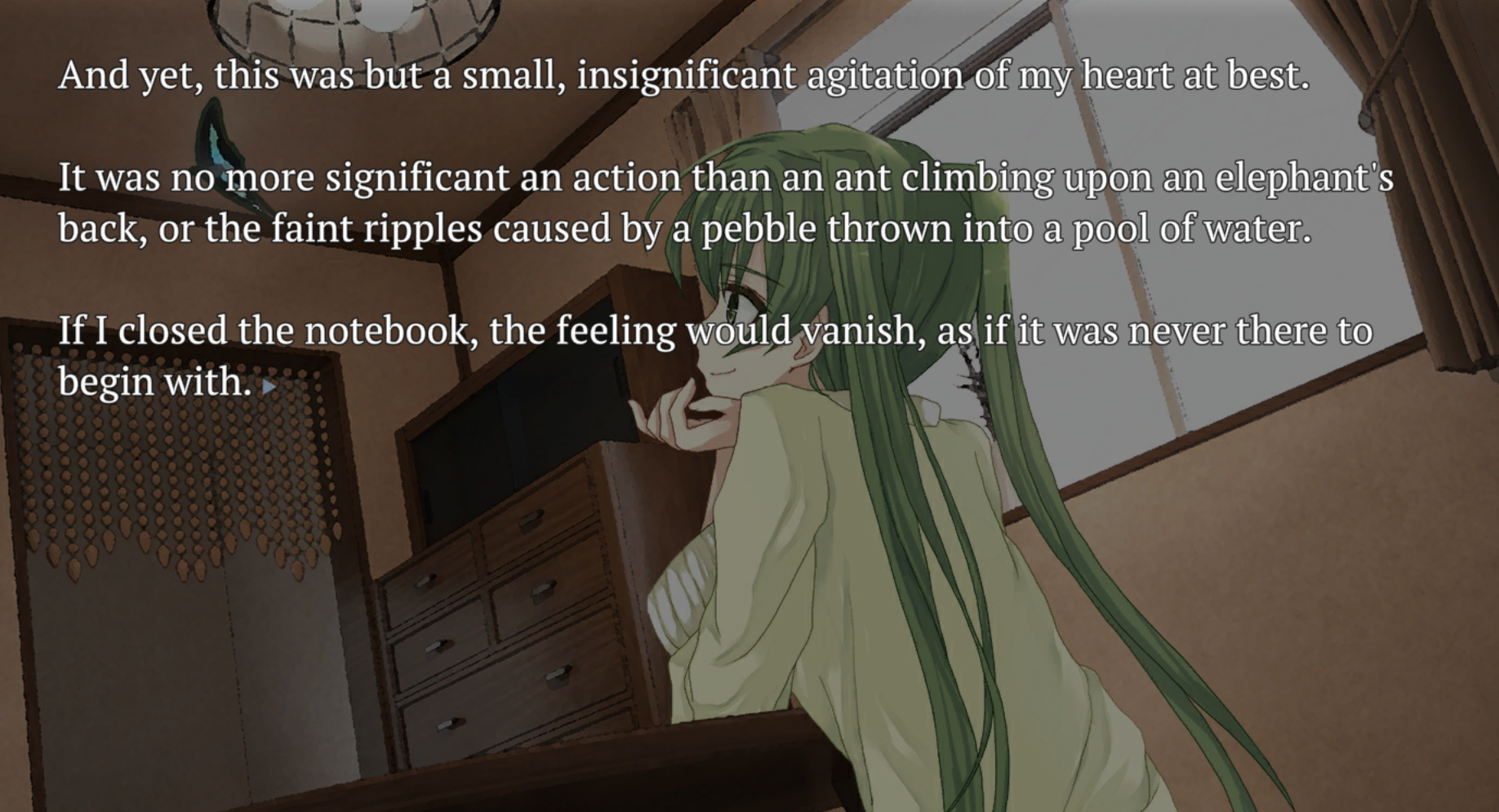
But I mentioned I played through it twice. Over and over throughout my second reading I was struck by the same familiar feeling. “I don’t remember this part,” I would say to the friend I was reading alongside. “I thought this happened, like, WAY earlier.” It seemed despite my love for Seabed I still couldn’t really commit all that much of it to my mind. Not even the broad-strokes sequence of events. I had felt like I was somehow letting myself down—how can I be this bad at remembering things that matter to me?
I had to get worse before I got any better. My curious bookkeeping habit metastasized, over time, and became a need to record everything. My spreadsheet became a backlog, hundreds of titles long, paralyzing in its breadth. I dutifully held myself to finishing everything I’d started for the sake of some elusive, truer form of understanding. In this state I set so many arbitrary rules I had to follow—I would not start a new JRPG while I was on a break from Trails, because what if I came back to Trails and forgot everything? No, better to turn this hobby into homework for myself than to keep forgetting things. I hung a sword over my own head and called it discipline.
Fingernails on a Chalkboard
This leads me to my time with Final Fantasy 7. This game may have been the single worst victim of my compulsion to treat the hobby as a responsibility. When I see that something is critically acclaimed, historically important to the development of the medium, and even has Vincent Valentine in it—I’m gonna come running to see what’s going on.
At the outset, my adventurous spirit was rewarded! I still maintain that the Midgar portion of Final Fantasy 7 is great. I noticed a few little gripes—the translation in particular standing out to me—but for the most part, it was all killer, no filler. So much was new to me, too, and the novelty of my first Final Fantasy game was a big draw. The possibilities whispered to me by Materia seemed endless, the world and its concepts were all fresh, and while I may have known Cloud Strife and friends through cultural osmosis, seeing them in their game lit up my heart. I even liked that weird translation at first. This guy are sick! Tell ‘em Aerith!
The slow fading of its shine was subtle, and hard to detect, but without realizing it myself I had checked out. Something along the way broke in me. I think it’s less important that I detail what I didn’t like, and more so, that I kept trying to play. I had been playing this game for my partner, intending to go through it in chunks when she was in town. And all that time I kept guilting myself for not playing it when I had the chance. Deep down, I wanted to spend my time with someone I love on something better than Final Fantasy 7. Why was this something to guilt myself over?
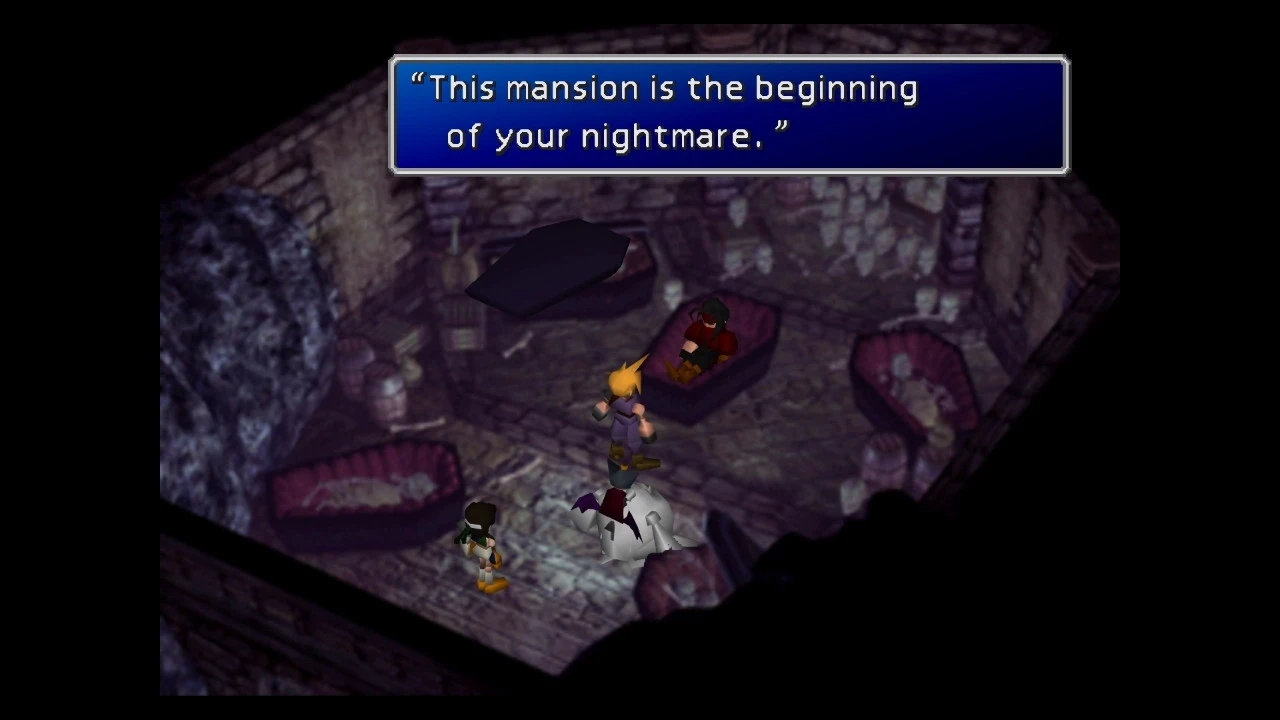
Final Fantasy 7 leached out of the space between my eyes, leaving behind the suggestion of a game that I struggled to play, and yet held myself to finishing for years. The way it failed to stay present in my mind, failed to compel me to engage, began to feel like my own personal failing. It’s my fault for spacing out my playthrough so widely. I should be focused enough to know where I’m going, it shouldn’t matter that the translation is famously confusing. If I just cared a little more, I’d finish this thing. It didn’t strike me that I’m under no obligation to care about everything until my partner encouraged me to drop this game without remorse. I think I had still yet to understand what Boku might have been trying to tell me.
You Forgot It In People
Here we reach the core of it: feelings of obligation. The reason I felt so drained by Final Fantasy 7 was not just spacing out my playthrough, though that didn’t help me retain information. It was holding myself to it so ardently that really killed it for me. In the same sense, Umurangi Generation instilled a different sense of obligation. Artistic expression through photography felt stymied by a formula that produces nothing but an album of all the same photos each playthrough.
In contrast, Boku no Natsuyasumi and Seabed each remind me, through beautiful expressions of not-a-whole-lot happening, the value of deliberation and slowness in everyday life. Neither title fixed me on their own, it was and still is an ongoing process of self-discovery. But the ways they make me feel are relevant, in my opinion, to this process, and their lasting places in my heart stand as testament to their efficacy. If it wasn’t already obvious, I recommend both games wholeheartedly. You, too, should remember to slow down once in a while, and take in the art you love, rather than consume it. On another note, I haven’t remembered to update my spreadsheet in a while.
Isabelle is highly preoccupied with hype moments and aura, and the weight of human emotion. You can find more of her words on Bluesky.