I’m not a cozy gamer, generally. I don’t conceal the fact I like my games brimming with pathos, action, and violence; if I’m not stressed out in some way, I’m not having a good time. My past writings wouldn’t indicate that I’d find something interesting to talk about with Kemono Teatime, at least on the surface. I tried the demo amidst a drought of games to play. Well, that’s not strictly true: it would be more accurate to say that I had just played a lot of Beyond Citadel in the same month, and wanted to play something slightly more soothing. With minimal expectation—other than perhaps a small amount of anti-cozy game bias—I tried its demo. By the end, my expectations were subverted completely.
It seems I’m not the only one who had this experience. I imagine in the months since that demo released some amending needed doing, as there is now a giant “this game is more than just cozy” warning on the Steam page.
To discuss the game properly, talking about the things I found most captivating about it, I am going to delve into extensive spoilers. If that bothers you, I will say in no uncertain terms that this is an excellent story. Even at full price ($12.99 USD in my region), I would highly recommend it.
For everyone else, let’s dig a little deeper into why this game surprised, delighted, hurt, and enthralled me.
Kemono Teatime is a 2025 visual novel by Studio Lalala and, at first glance, absolutely a game I would write off: a vaguely VA-11 Hall-A-type game with the grittier edges of cyberpunk worn off. The game markets itself similarly to many of the dullest cozy games, breaking itself down into three points: Catgirls, Cafes, and ASMR.
“Come now and live your bestest and cutest life,” says the store page, posted sweetly under the game’s two protagonists embracing. Technically speaking, it isn’t a lie.

A Beautiful Lie Served with Tea Biscuits
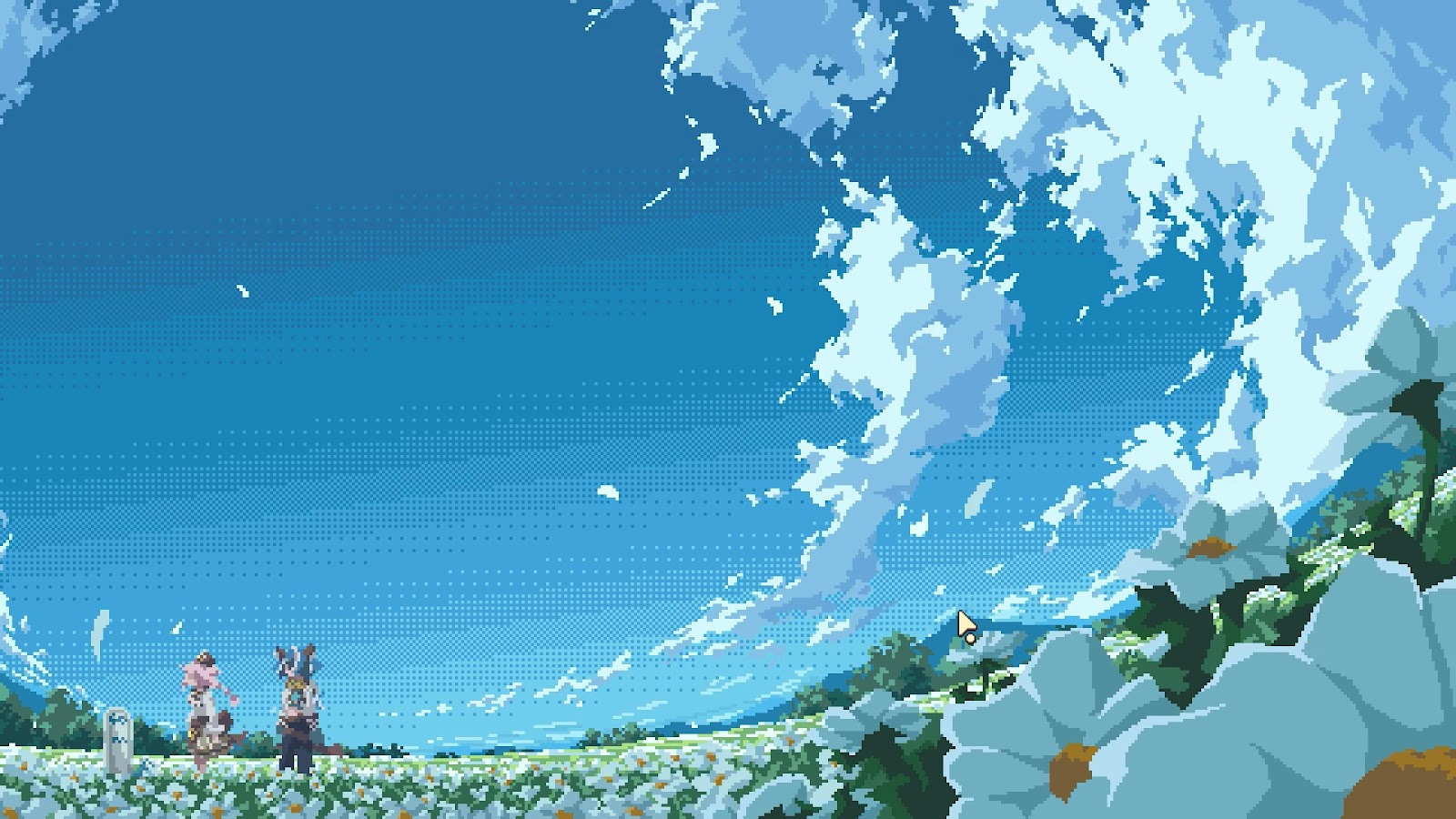
What first attracted me to Kemono Teatime admittedly was the presentation. Its lush, beautiful, and, yes, cozy spritework captivated me where I would have passed on other, similar, but less attractive games. The beautifully realized characters bounce about the screen in both character art and sprite work, bringing life to the game’s singular location.
While graphics are something like the curb appeal of a game, to me, they are largely secondary to how the game actually feels to experience. I can play games that look like Cruelty Squad; I can play games that look like Caves of Qud. Heck, I indulge in TTRPGs, a type of game with no graphics to speak of—how barbaric!
Yet I can’t pretend that the graphics aren’t a part of what drew me in, especially with their promise of a happy, minimal friction time.
“Everything is fine; everything is safe. Come and have a cup of tea with us.”
I believed that surface level lie, and rather cynically, I believed there would be nothing here worth reporting on. But I think that subversion was the beauty of it. I wouldn’t say Kemono Teatime is entirely subversive—it doesn’t become an RTS halfway through or anything—but it’s been a bit of a trend lately: the mundane work game. You go to a job which like any job has difficulties, trials, and tribulations, but this one has had all its roughness polished away. Stock the grocery store; run the card shop; man the bar; drive the sixteen-wheeler. Working a job that doesn’t have the obligation to feed you is inherently more relaxing than reality.
Similarly to other cozy games, Teatime’s cozyness comes from its removal of these abrasive traits and the habituation to routine. Every morning, main characters Tarte and Macaron commit to the same idealistic maxim: “let’s face every day with a smile!” You pick what dessert you will serve your clientele, who have equally cute, sweets-based names, and offer them tea best suited to their specific needs and problems. Nothing particularly unusual thus far.

The sound design, music, and ASMR further foster this relaxed tone. Each time you make a cup of tea, Tarte whispers spine-tingling ASMR-isms at you before placing yet another beautiful spread of pixel art drinks and sweets in front of you. Snail’s House’s bubbly, bouncing soundtrack carries a similarly optimistic bent.
Each day avails you with interactions with a repeat cast of unique characters, each with their unique roles in the picturesque, idyllic commune of La Bête. The sisters who run the farm, the serious yet romantic journalist, the princess-like woman yearning for her lost love; each one needs the help of the protagonists’ compassionate ear and ailment-curing tea. The cast is diverse and interesting, yet their problem is singular.
Soon, too soon, every single one of them will be dead.
Two Sugars Worth of Self Deception
The reveal of impending death is not actually that much of a spoiler. You know this secret almost immediately. Nearly everyone in Kemono Teatime is a kemomimi—that is to say, basically everyone in the game has cat ears or something equivalent. Rather than taking this concept as simple stylization, it’s the central problem around which the game orbits. A virus has spread the world, and everyone infected grows animal features; while potentially a cute conceit for an anime-adjacent story to have girls with cat ears, in this one it’s deadly serious. The strain of a body gradually evolving into another creature kills the host. There is no hope for a cure.
It sounds absurd, even for me writing it, but it unifies what I see as the dark and light halves of this story. On one side, you have this story about tending a darling tea shop, dealing with problems and enduring social faux pas; on the other, you have a cast coping, in denial, or outright self-destructing in the face of their own inevitable, premature deaths. The majority of the in-game population is already dead, and the main characters have—as a coping measure—had to adopt optimistic apathy. Stress makes the disease accelerate; why make it worse for yourself?
What starts as unsettling subtext—people talking too weightily in proper nouns no one wants to explain—becomes all too textual. A death within the very workplace that has been the game’s sanctuary for the first few hours. Once the nature of the disease is known, it’s hard not to appreciate the gambit the game is making. The story is about the contradiction between choosing to be happy and engaging with the material reality around you.
Every night, the main character, Tarte, stays up late to read the news and listen to the radio. These are mechanically useless but provide background context: who is responsible for the disease? How does the rest of the world feel? What is happening beyond the bounds of La Bête’s idyllic stasis? In its own way, it’s also a characterization of the protagonist. She chooses to make this choice every evening: she stays up to steal time, even if it’s impossible. Her sister will still be dead by the end of the month; then that will be that.

The game’s intentional toxic positivity expresses itself with regularity, yet just as often asks: “what’s the better option?” If you want to maximize your time with a dying loved one, why make things more painful? Why borrow grief from your future if you can make a more beautiful now?
The story is very much about how this ideology succeeds and fails. We see people enter the café knowing full well they’re going to be dead soon; much of how they differentiate themselves is through how they deal with their coming demise. Some seek chemical oblivion, either through alcohol or the cognition-distorting Ramune pills—used when you’re close to death and in mortal agony. Others simply deny the very nature of the world around them.
Through mundanity we see the texture of the story, of people trying to endure the unendurable. Each person is torn apart in different ways. Lovers, sisters, mentor and student; death doesn’t care what relationship it tears apart. When death comes is arbitrary, it just happens when it happens; it’s never convenient. Often the story will promise a character will be there, only to have them gone the next day.

What’s more, the character whose perspective we never leave is even more intimately broken down as the building losses rip them apart. We learn the nature of why she always smiles. Two sisters who promised one another, and themselves, that they would remain happy until the end.
The promise only ever gets more painful. As the days go by, we learn the oppressive grinding motion by which time destroys relationships and promises.
A Laugh Indistinguishable from a Sob
Even I have my limits. By the midpoint of the story, I said, “I get it.” I was tired of feeling oppressed by the sorrow. This endlessly smiling girl was going to be dead soon; I just wanted the axe to fall already. As I continued to play I realized the intentionality behind that feeling.
Like the characters in the story, knowing death was coming but not its hour is exhausting. There is a perverse, macabre addiction to asking, “will today be the day?” The mundane days are more painful than the eventful ones because they are gone all too soon and your muscles still ache from the tension of bracing. Today was fine, but how many more of those do we have? The middle act ground against me as it slowed down. Everything, and nothing, was fine.
This is, in its own fashion, the most post-COVID game I’ve yet played. It felt a lot like being in the pandemic (sorry, we’re back in 2020 again). I was bombarded with information about how not-okay everything was and yet I was afforded a position of privilege: at least for a little while I had the ability to do a job from home and didn’t expose myself to the worst of it. Not everyone had the same luck. Every day I woke up, did an insipid, valueless, nothing job to help people who didn’t care in the slightest. It wasn’t like shirking those duties was any more fun; every timeline on earth was filled with new and novel ways to make you depressed. So, lots of people receded. You played every game in your Steam library; you learned how to make sourdough in between remote-work phone calls; you binged every video by a YouTuber you like while living and sleeping on your couch.
The decision many people made to do something even when it was futile felt understandable. It feels understandable here.
But denial only lasts so long, for us, and our protagonist. Eventually, death finds a window even when you close the door. There is no denying it. Our protagonist’s promise to always smile crumbles. One night, she sits on the café’s front step refusing to sleep; sitting out in the winter cold was less painful than sharing space with her dying sister.

Every single step to the end of this story hurt. I’ve never lost anyone I’ve cared about losing but I know what that pain looks like, and, unfortunately, I’m very good at imagining it. In my own personal life, I’ve had to feel many things I would rather go on not feeling. I went many years without feeling anything at all and thinking it was strength. Dealing with new emotions, even positive ones, can hurt when they’re new. I asked my partner how people can stand feeling the fluctuation of emotions.
She said, “I would rather feel everything in the world than nothing at all.”
It was a simple statement, but it was profound to me. Love, for me, and these characters, is something worth feeling even when that love eventually must become pain.
To the Last Drop
The story ends as it was promised. There is no magical third act cure for Tarte’s sister, only the option to spare her pain or keep her mind clear. There isn’t a good choice in the face of something as final as death. You make your choice, then you live with it.
Kemono Teatime nails the mundanity of death and the process of dying. Friends, family, loved ones, they will all die someday; days where death comes are interspersed with many many mundane ones. Somehow, amid them, you must find time to keep living and endure the sharp pain of it. Community can help, it may make it worse, but ultimately the ability to go on living is in your hands alone. Where many cozy games fail is making a story so fundamentally anodyne that the feeling of earning peace means nothing. Certainly, it’s a respite from the average day but, at least for myself, finding peace in a world that wants nothing more than to rob you of it only makes the choice to build peace more valuable.
It’s a thoughtful and emotional story about coping with death that comes too soon. It hit me emotionally not with intentionally manipulative writing but with a human approach. It asks many questions. What do you do when death is coming and you can’t get off the train tracks? Is happiness a feeling or a choice? Is the mundanity of things truly as safe and comforting as we believe them to be?
Ultimately, I come away with a deeper conviction for something I already believed. The pain of loss is the price for loving at all. There are no shortcuts or easy ways out beyond simply choosing to care for nothing, and that’s a choice I simply refuse to make. I love the ones I love so much; I will bear that burden even when the time comes that I must be strangled with it. It is inevitable but that’s okay. I will not borrow that grief from the future, and I will choose to love, and to care. Everyday until the end.

Superb
"Love So Strong It Hurts"
Kemono Teatime is an emotionally affecting story with beautiful visual appeal which perfectly contrasts with the darkness of the story it wishes to tell.